IB University Preparation: Subject Choices, Predicted Grades and Timelines That Decide Your Offers
A working guide to IB university preparation: how DP subject choices, predicted grades, the Extended Essay and TOK shape offers in India, the UK and the US, and when each decision actually needs to be made.

In this guide · 20 sections
IB university preparation starts in the week you choose your six Diploma Programme (DP) subjects, not in the month you fill in an application form. The subjects you take at Higher Level (HL), the grades your school predicts, the points you earn from the Extended Essay (EE) and Theory of Knowledge (TOK), and the order in which you meet each deadline decide most of what a university can offer you. Almost none of it can be repaired in DP2 if it was ignored in DP1.
This guide is for International Baccalaureate (IB) students in Gurgaon, Delhi NCR and abroad, and for the parents who are trying to work out what actually matters. It covers how subject choice maps to degrees, how predicted grades work and why they are the most misunderstood number in the whole process, what the 45-point total really means, how Indian universities treat the IB, and what the UK and US timelines look like month by month. It also says plainly when a tutor helps with all this and when a family does not need one.
One caution before we start. Admission rules change every year and differ by university and by course. Everything below describes how the process works and how to prepare for it. For any specific requirement, the university's own admissions page and your school's university counsellor are the final word.
What Does IB University Preparation Actually Involve?
IB university preparation is the set of decisions and habits across DP1 and DP2 that determine which degrees a student can apply for and how strong the application is. It has five working parts: subject choices, predicted grades, the core (EE, TOK and Creativity, Activity, Service, CAS), the application itself, and the final results.
The mistake most families make is treating these as one event that happens in the final year. They are five separate pieces with five separate clocks.
Subjects are chosen first and cannot easily be changed after the first term. Predicted grades are produced by your school from your actual performance, so they depend on everything you did in the previous eighteen months. The core quietly decides up to 3 points. Applications are paperwork, but paperwork with hard dates. Results come last and, for many offers, decide whether the conditional place becomes a confirmed one.
A student who understands this sequence can work backwards from a target course. A student who does not usually discovers, in October of DP2, that a chemistry requirement was sitting there since DP1.
How Do Your DP Subject Choices Shape University Options?
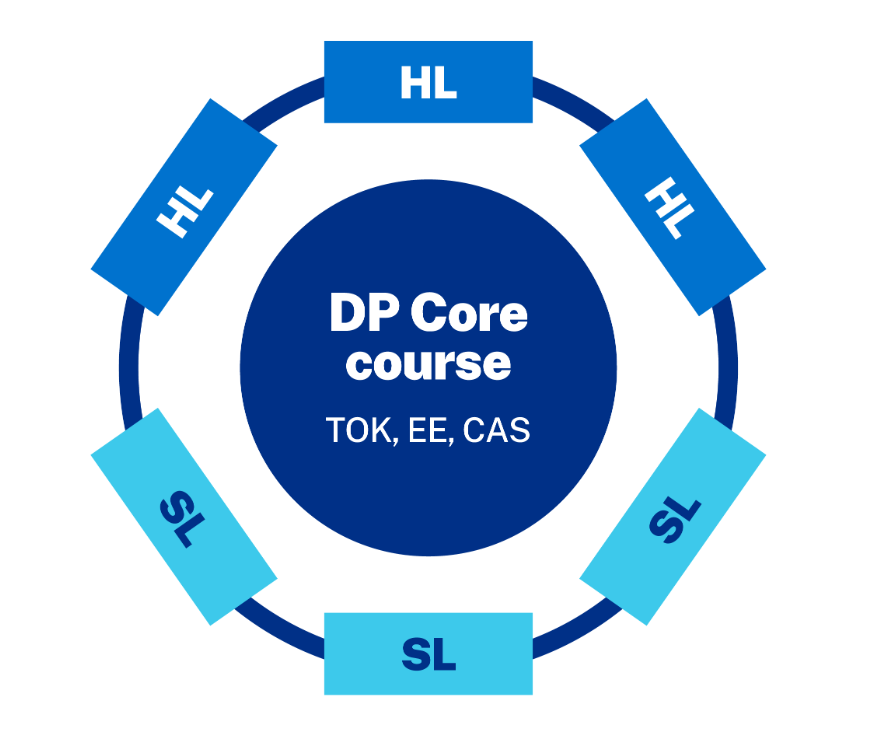
DP subject choices shape university options because many degrees list specific subjects at specific levels as entry requirements, and no later effort can substitute for a subject you never studied. The DP asks for six subjects, three or four at HL and the rest at Standard Level (SL), so every student is making a trade: depth in the subjects they pick for HL, breadth everywhere else.
The practical rule is to start from the degree family, not from favourite subjects. Here is how typical combinations map. Treat the table as a first draft to check against the actual course pages, because requirements differ by university.
| Intended degree family | HL subjects that are commonly asked for | What to verify before committing |
|---|---|---|
| Engineering | Mathematics (usually Analysis and Approaches) and Physics | Whether Chemistry is also asked, and whether Mathematics AI is accepted |
| Medicine and life sciences | Chemistry and Biology, sometimes Mathematics | Admissions tests, and whether SL Mathematics is enough |
| Economics and finance | Mathematics, often Economics | Whether the course names a specific Mathematics course |
| Computer science | Mathematics, sometimes Physics or Computer Science | Mathematics AA versus AI preference |
| Law, humanities, social sciences | Usually open, with essay-heavy subjects valued | Whether a language or History is named |
| Architecture and design | Mathematics or Physics plus Visual Arts | Portfolio requirements, which sit outside the diploma |
Notice how often Mathematics appears. DP Mathematics comes as Analysis and Approaches (AA), algebraic and proof-heavy, and Applications and Interpretation (AI), modelling and statistics-heavy with technology throughout, each at HL or SL. Students heading for engineering or economics are often advised towards AA, but the right choice depends on the degree and the student, and the school's DP coordinator makes the final placement. If the maths decision is the one you are stuck on, IB Maths AA versus AI: which one should you choose works through it properly, and how to choose STEM subjects in the IB DP covers the science side.
Why HL is not only about prestige
HL carries 240 recommended teaching hours against 150 for SL. That difference is real, and a university reading your transcript knows it. An HL grade in the subject you want to study says more than a high SL grade, because the content went deeper and the exams were harder. But HL also costs time, and time is the resource that DP2 runs short of. A student who takes three HL subjects they are not suited to, purely because they look impressive, often ends the programme with weaker grades across the board than a student who chose HL carefully.
The balanced choice that keeps doors open
Consider a student who is undecided between engineering and economics at the end of Grade 10. A combination with Mathematics AA HL, Physics HL and Economics SL, alongside English, a second language and a humanities or arts subject, keeps both routes open far better than a combination that commits fully to one. It is not magic: Economics at SL is a lighter signal than HL if economics turns out to be the target. But it avoids closing the engineering door early, which is the harder door to reopen.
What Are Predicted Grades and Why Do They Matter So Much?
Predicted grades are the grades your school forecasts you will achieve in each subject in the final exams, submitted to universities that ask for them, mainly in the UK and for many applications elsewhere. They matter because, for most applicants, the offer is made on the prediction, long before real results exist.
Here is the part families get wrong. A predicted grade is not a target the school sets for you, a motivational number, or a negotiable figure. It is a professional judgement made from evidence: your internal assessments, class tests, DP1 end-of-year exams, and above all your DP2 mock examinations. Schools take it seriously because over-predicting repeatedly damages their reputation with universities.
Each school has its own policy. Some predict conservatively and tell students so. Some predict the grade a student is working towards if the trend is right. Some have a formal moderation process. Ask your school's counsellor early how predictions are produced, who signs them off and which assessments carry the most weight. A family that asks this in the first term of DP1 can plan; a family that asks in October of DP2 can only hope.
What actually moves a prediction
In practice, three things move predictions up or down:
- Consistency over a single peak. One excellent test does less than a steady pattern of strong ones.
- Mock exam performance. The DP2 mock, which each school schedules several months before the May session, is usually the heaviest piece of evidence.
- Internal assessments completed on time. A late or weak IA signals risk, and a missing one can cap a prediction.
Where a tutor adds value is not in "getting the predicted grade raised" but in lifting the real performance the prediction is built from. A student who finishes DP1 with a 4 in HL Physics and spends a term fixing the specific gaps behind that 4 will give the school different evidence in the DP2 mock. The prediction follows the evidence.
Weights vary by school; ask your counsellor how yours are combined.
This chart is a judgement about typical practice, not an official IB figure. The point is the order: mocks matter most, and mocks are in DP2, which is why the middle of DP1 is the right moment to find and fix weak topics, not the month before the mock.
How Do the 45 Points Work, and What Is a Realistic Target?
The IB diploma is scored out of 45. Each of the six subjects is graded 1 to 7, giving up to 42 points, and the EE and TOK together add up to 3 more. The diploma needs at least 24 points subject to the IB's failing conditions, and CAS must also be completed. Those facts are fixed; the realistic target for you is not.
The right target comes from the course, not the other way round. Compare how three different goals tend to set the working number:
| Goal | How to find your target | Where the pressure sits |
|---|---|---|
| A course with published HL grade requirements | Read the exact subject-level grades the course names, then the total | Hitting specific HL grades matters more than the total |
| A course that publishes only a total | Use the total, but confirm whether the core points count | Balanced six-subject performance |
| An Indian degree via equivalence | Confirm equivalence and any course-specific rules | Passing comfortably with strong marks in relevant subjects |
Many offers combine a total with named HL grades, for example a total plus specific grades in two HL subjects. If your offer looks like that, the HL subjects named in the offer are where your revision time should go first. Spreading effort evenly across all six, when two of them carry the real condition, is a common and costly mistake.
The 3 core points deserve more respect than they get
The EE and TOK grades (A to E) combine for up to 3 diploma points, and an E in either is a failing condition. That matrix means a student can lose a diploma over a core component while scoring well in subjects. It also means the core is the cheapest place to gain points: a strong EE and a solid TOK essay can add 2 or 3 points, which is the equivalent of lifting a subject by a full grade. The complete guide to IB Internal Assessment with examples and how to write an IB Extended Essay go through both in detail.
When Should You Plan Each Stage of IB University Preparation?
IB university preparation works best on a two-year calendar that front-loads decisions and leaves DP2 for performance. Below is a plan that works for May-session candidates in India. Your school's calendar will shift specific dates, so treat it as a skeleton.
- Grade 10 endChoose subjects from the degree family backwards
- DP1 term 1Settle subjects, start CAS, learn how predictions work
- DP1 term 2 and summerChoose EE subject, draft it, research courses and tests
- DP2 autumnApplications, references, TOK work, IA deadlines
- DP2 springMocks, offers arrive, focus shifts to the exams
- MayExaminations, then results in early July
A numbered version of the same sequence is useful on its own:
- 1Decide the degree family before the subject form is submitted, and write down which HL subjects it implies.
- 2Check at least three target courses for named subject and level requirements, and note any differences.
- 3Ask the school counsellor how predicted grades are produced and which assessments matter most.
- 4Choose the EE subject by the end of DP1 term 2, in a subject where you expect a strong grade, not one picked for sounding clever.
- 5Use the DP1 summer to draft the EE, read past exam material for weak subjects and visit or research universities.
- 6In DP2 autumn, complete applications and the personal statement while keeping internal assessment deadlines.
- 7After the mocks, rebuild the revision plan around the two or three subjects with named offer conditions.
The most overlooked step is the second one. It costs an evening and removes the single largest source of regret in IB applications: discovering at application time that a course wanted a subject you did not take.
For deeper timeline detail on the three core components, the IB DP core planning timeline lays out how EE, TOK and CAS stack up across both years, and when to start IB tutoring explains how timing decisions for support fit around it.
How Do UK Applications Work for IB Students?
UK applications run through a central service called UCAS, with offers made largely on predicted grades and then confirmed or rejected when results arrive. For IB students this has a distinctive shape: the offer is conditional, it usually names a total and specific HL grades, and the final decision depends on the July results.
The calendar pressure comes early. Applications for most courses are submitted in the autumn and winter of DP2, with earlier cut-offs for medicine and for Oxford and Cambridge. Check the current cycle on UCAS and each university's page, because dates shift. Some courses also need an admissions test or interview, which takes preparation time on top of the diploma.
What this means for the DP1 student is that predicted grades from the end of DP1 and the early DP2 months are what the first set of offers rests on. A DP1 year of 5s that is still improving gives a counsellor something to work with; a DP1 year of unexplained gaps does not.
Three practical points for UK-bound IB families:
- The reference carries weight. The counsellor's reference and the teacher's predictions are read together, so a student who has been consistent and engaged tends to get a more convincing reference.
- Offers are conditional. A typical offer states a total and requirements in specific subjects, sometimes with a core-points condition. Read it for what it requires of the EE and TOK too.
- Insurance and firm choices matter. Holding a realistic fallback offer protects you if results land one point short.
How Do US Applications Differ for IB Students?
US applications differ because they read the whole person: transcript, essays, recommendations, activities and, depending on the college, test scores, rather than leading with a prediction-based offer. IB students are well placed because the diploma's rigour is understood, but the process is more holistic and the deadlines are earlier.
Applications commonly go through a shared application platform, with early rounds in the autumn and regular rounds around the turn of the year. Check each college's current deadlines and policies, including whether it asks for standardised test scores. Many colleges also consider your DP1 results and course load, and may award credit or placement for strong HL results, which is a reason HL choices still matter even in a system that does not make grade-based offers.
The difference for preparation is where effort goes. For a UK application, the grades and the personal statement carry the weight. For a US application, add essays that sound like a person, extracurricular depth, and a school report that contextualises your course load. CAS can become genuine material here, if the student treats it as real activity rather than a box to tick. The Extended Essay is also useful: a student who has done independent research has something concrete to write about.
- Maximum diploma points
- 45
- Points from EE and TOK combined
- 3
- Minimum points for the diploma
- 24
- Subjects, each graded 1 to 7
- 6
How Do Indian Universities Treat the IB Diploma?
Indian universities treat the IB through equivalence rules and, increasingly, their own admission processes. Equivalence for international qualifications is issued by the Association of Indian Universities (AIU), and requirements differ by university and by course, so a family should confirm with the institution rather than rely on general advice, including this guide.
Here is what that means in practice:
- Confirm equivalence early. Ask the target university or course what documents it needs and whether its own entrance test applies to IB students in addition to the diploma.
- Entrance tests do not disappear. Many Indian degrees rely on their own tests or on national tests. An IB student aiming at one has to prepare for the test as well as the diploma, which is a significant extra load in DP2 that nobody warns them about.
- Subject match still counts. A course in engineering will look at Mathematics and Physics preparation; a medicine pathway will look at the sciences. The logic is the same as abroad, only the mechanism differs.
- Results arrive in early July for May candidates. Indian admission calendars may have moved by then, so ask how the university handles late-arriving results.
Students who are weighing a JEE-style route alongside the diploma will find how to prepare for JEE Advanced mathematics useful for judging how much overlap there really is. The honest answer is that the overlap in mathematics is real but partial, and the workload of doing both seriously is large.
How Do the Extended Essay and TOK Fit Into University Preparation?
The EE and TOK fit into university preparation in two ways: they are worth up to 3 diploma points, and they are the nearest thing a school student has to university-style work. A strong EE is evidence of independent research; a good TOK essay is evidence of reasoning about how knowledge works.
The Extended Essay is an independent research essay of up to 4,000 words and roughly 40 hours of work, supervised by a teacher at the student's own school, with reflection sessions recorded along the way. It is written in one DP subject or as an interdisciplinary essay. The EE guide was updated for first assessment in 2027, so follow the version your DP coordinator issues instead of relying on older criteria summaries.
TOK has two assessments. The exhibition uses three objects linked to one of 35 IA prompts, up to 950 words, internally assessed and one third of the TOK grade. The essay answers one of six prescribed titles released for each exam session, up to 1,600 words, externally assessed and two thirds of the grade.
Choosing the EE subject with a university in mind
Pick the EE subject for the grade you can earn and the story it lets you tell. A student applying for engineering who writes a physics or mathematics EE gives a tutor, a supervisor and an admissions reader something coherent. But a weak, overambitious essay in the "right" subject is worse than a strong essay in a neighbouring one. The research question is the part that decides whether the 4,000 words feel purposeful or padded. Narrow questions with accessible sources tend to score better than grand ones.
Where support is allowed and where it is not
Every IB internal assessment is the student's own work. The IB's academic integrity policy allows a teacher to give feedback on one draft; it does not allow anyone, tutor or parent, to write, rewrite or edit the student's submission. A tutor may teach the underlying skill, question the reasoning, point at a criterion and ask the student to reread their own paragraph against it. This boundary protects the student. A diploma lost to a malpractice finding takes every university offer with it.
What Do Admissions Readers Actually Look For Beyond Grades?
Admissions readers look for evidence that a student can do the work the degree demands: reason independently, write clearly, handle sustained effort and stay curious about the subject. Grades are the filter. These qualities are what separate candidates after the filter.
Those qualities are not decorative. They show up in specific places in an IB student's record:
| Quality | Where it shows in an IB profile | How to build it deliberately |
|---|---|---|
| Independent research | Extended Essay, Internal Assessments | Choose narrow questions and keep a source log from the start |
| Clear writing | TOK essay, English papers, personal statement | Write regularly and get feedback on one piece at a time |
| Reasoning under pressure | HL papers, especially extended-response questions | Practise unfamiliar problems, not just familiar ones |
| Sustained commitment | CAS, long-running activities | Stay with two or three activities for a long time |
| Subject curiosity | Reading, projects, competitions, relevant IA topics | Follow questions beyond the syllabus in your target subject |
The old marketing line that "universities want leaders and critical thinkers" is vague. The practical version is narrower: do not let your record look like six subjects of box-ticking. A student whose EE, IAs and reading all point in one direction tells a clear story. A student whose record points everywhere does not.
What Does a Strong IB Student's Two Years Look Like in Practice?
A strong IB student's two years look unremarkable from the outside: steady work, early decisions, and very few emergencies. The crises that fill DP2 for others are usually decisions that were postponed.
Consider a typical profile. A student in Gurgaon finishes Grade 10 strongly in Mathematics and Science and aims at engineering. She chooses Mathematics AA HL, Physics HL and Chemistry SL. In DP1 term 1 she finds Physics harder than expected. Her marks wobble. She and her parents have a decision to make: wait and hope, or diagnose. A diagnostic reveals that the gap is not in physics but in algebraic manipulation she skipped in Grade 10. She spends six weeks closing it. By DP1 summer she has stable marks, a drafted EE, and a prediction trend her school can defend.
Compare that with a second student who also finds Physics hard but waits for the DP2 mock. The mock confirms the problem too late for the prediction to change meaningfully. Same intelligence, same school, different calendar.
This is why the best preparation is mostly early diagnosis. For maths specifically, how to score a 7 in IB Math AA HL shows what a systematic two-year approach looks like at the top end of the subject.
Which Mistakes Cost IB Applicants the Most?
The costliest mistakes are decisions deferred, assumptions unchecked and effort spread evenly when the offer conditions are not even. Here are the ones that appear most often.
| Mistake | Why it hurts | What to do instead |
|---|---|---|
| Choosing subjects without checking course requirements | A needed subject or level is missing at application time | Read three target course pages before the subject form is final |
| Assuming predicted grades are negotiable | Pressure on staff damages trust and changes nothing | Improve the evidence the prediction is built from |
| Ignoring the core until DP2 | EE and TOK weaknesses can cost diploma points | Fix the EE subject and supervisor by the end of DP1 term 2 |
| Treating the total as the only target | Named HL grades in an offer are the real condition | Revise to the offer conditions, not to an average |
| Leaving Indian equivalence and entrance tests to chance | An extra test collides with the mocks | Confirm requirements in DP1 and schedule test preparation |
| Overloading HL | Weaker grades across the board | Pick HL for the degree, not for appearances |
One more worth naming: mistaking effort for evidence. Hours spent studying are not what a prediction counts. Marks on school assessments are. A student who revises for six hours a day but never takes timed papers has produced very little evidence.
How Should Families Plan the Final Year Around Offers?
Families should plan the final year in two phases: before offers, when the aim is strong evidence and a good application; and after offers, when the aim is a precise revision plan for the conditions attached. The shift in focus after offers arrive is the single most useful change a DP2 student can make.
Before offers, the main tasks are:
- Finish internal assessments before the application peak, so they do not collide with exam preparation.
- Prepare any admissions test or interview early, because these have their own timelines.
- Keep school marks strong, because early DP2 results are the freshest evidence in the file.
After offers, the plan changes. List each offer's conditions in one place: the total, the named HL grades, the core requirement. Then rank the subjects by how far your current mock grades are from the condition. A subject sitting on the condition needs maintenance. A subject two grades below it needs a rebuilt plan. A subject comfortably above it needs the least time. How toppers study in the last 30 days before IB exams covers the final stretch in detail.
Exam sessions run in May and November; schools in India overwhelmingly enter candidates for the May session, and May results are released in early July. Each school sets its own DP2 mock dates, usually several months before May, so ask your coordinator for the dates in DP1 and build backwards from them.
What Happens If the Results Come In Lower Than Expected?
If results come in below an offer, the first move is to contact the university and the school counsellor immediately, because several routes may still exist: the university may confirm the place at a slightly lower total, a different course may be available, a retake may be possible, or an enquiry upon results (a re-mark) may be worth requesting.
A DP candidate who missed the diploma, or who wants a higher subject grade, can register for a later session through a school, normally the one they sat the exams with, most often the following November. Internal assessment marks are usually carried forward, so a retake mainly targets the externally assessed papers. The IB limits how many sessions a candidate may sit, and the DP coordinator confirms eligibility, deadlines and costs. Before retaking, families can ask the coordinator about an enquiry upon results, which has a short deadline after results come out.
Two honest points. First, a retake is a plan, not a panic response: it needs a specific diagnosis of which papers lost the marks. Second, a gap period needs a purpose. A student who retakes two papers, shows a clear grade improvement and uses the rest of the year for something real presents a stronger story than one who drifts.
How Can a Tutor Help With IB University Preparation, and When Is One Not Needed?
A tutor helps with IB university preparation by raising the real performance that predictions and final grades are built from: diagnosing weak topics in HL subjects, building exam technique, and keeping a student on schedule through the core. A tutor does not write the EE, edit an IA, change a prediction or promise a grade.
Many families do not need one. If a student has stable marks near the target, a school that gives clear feedback and good habits, extra tuition adds cost and load without adding much. The cases where support pays are specific: a student with a named gap in a subject an offer depends on, a student switching boards who is adjusting to criterion-based marking, or a student whose school offers limited individual feedback.
IB Gram is an independent tutor-matching platform. A family sends a query or books a free consultation; IB Gram asks about board, programme, level, subject, school calendar, location and schedule; it shortlists tutors whose profiles are verified and fit; a demo or trial session can be arranged before committing; and lessons run at home, online or hybrid. The family can ask for a different match if the first one is not right. Availability is subject to tutor availability. For students in Gurgaon, the IB Diploma Programme tutors in Gurugram page lists the subject support available, and for maths specifically, IB Math AA HL tutors in Gurugram is the starting point. Students planning the Extended Essay can look at IB Extended Essay tutor support in Gurgaon.
IB Gram is an independent platform and is not affiliated with the International Baccalaureate, Cambridge International Education, Pearson Edexcel or any school named here.
Judging whether a tutor is helping
After four to six weeks, a good arrangement leaves evidence: a clearer error log, timed-paper marks that have moved, and a student who can explain a method they could not explain before. If none of that appears, the problem is either the fit or the diagnosis. Raise it with the tutor first, then ask for a different match. How to compare options is covered in how to choose an IB tutor in Gurgaon, and the question of cost drivers sits in what affects IB tutor fees in Gurgaon.
Which Subjects Need Early Support for University Goals?
The subjects that most often need early support are those where the university requirement is strict and the course content builds on itself: Mathematics, Physics, Chemistry and, for some routes, Economics. Mathematics is the clearest case because every later unit assumes the previous one.
For students aiming at engineering, the load sits on Mathematics AA HL and Physics HL, and IB Physics HL most important topics and study plan helps prioritise. For medicine-track students, Chemistry is often the pressure subject, and why students struggle in IB Chemistry and how to fix it deals with the common failure points. For students who will meet criterion-referenced marking for the first time, IB command terms explained with real examples fixes a surprising number of lost marks quickly.
The DP sciences, first assessed in 2025, give the internal assessment 20% of the grade, marked on four criteria of 6 marks each: Research design, Data analysis, Conclusion and Evaluation, with a maximum of 3,000 words. A student aiming at a science degree should treat that investigation as a rehearsal for university lab reports.
A Subject-by-Subject Checklist Before You Submit Anything
Before a subject form, an application or an offer response goes in, run through this list. It takes an hour and catches the problems that otherwise surface when it is too late to fix them.
| Check | Done when |
|---|---|
| Degree family named | You can write the target degree in one line |
| Three course pages read | Subject and level requirements recorded for each |
| HL subjects match | Every named HL requirement is covered by your choices |
| Predictions understood | You know who produces them and from which assessments |
| Core plan set | EE subject, supervisor and TOK dates are on a calendar |
| Entry tests listed | Each target course's tests and dates are written down |
| Equivalence confirmed | For Indian courses, AIU and course requirements verified |
| Backup route chosen | A realistic fallback exists if results land short |
Related Guides on IB Gram
- IB Internal Assessment guide: how the IA works across subjects and where students lose marks.
- IB exam preparation guide: a broader plan for the exam months.
- Personalised home tuition for IB students: what a diagnostic and a learning plan look like in practice.
- Online IB tutoring in India: how online lessons work when a student lives outside a major city.
Frequently Asked Questions
When should a student start IB university preparation?
A student should start before choosing DP subjects, which means in Grade 10. The first step is naming a degree family and checking which HL subjects it needs. After that, the real work is steady: stable DP1 marks, an EE subject chosen by the end of DP1 term 2, and early checking of applications and tests. Starting in DP2 is possible, but it removes the cheapest options.
Can a student change HL subjects after DP1 begins?
Sometimes, but only early and only with the school's approval. Schools usually allow changes within the first weeks, subject to timetable and staffing, and the DP coordinator decides. After the first term it becomes difficult, because the student has missed content and the course design assumes continuous study. If you doubt a choice, raise it in the first month instead of waiting for the first big test.
How are predicted grades decided?
Predicted grades are decided by the school from evidence of performance. That evidence typically includes internal assessments, class tests, DP1 exams and the DP2 mocks, with the mocks usually carrying the most weight. Each school has its own policy and moderation. A prediction is a professional judgement, not a number a family can negotiate, so the way to improve it is to improve the work it is built from.
Do universities look at the EE and TOK?
Yes, mostly through the points. The EE and TOK grades combine for up to 3 diploma points, and an E in either is a failing condition. Some offers also mention them, and the EE is useful material for personal statements and essays because it is a piece of real independent research. The grade matters more than the topic for most readers.
Is Mathematics AA or AI better for university?
Neither is better in general; the right one depends on the degree. AA is algebraic and proof-heavy and is often advised for engineering and economics routes. AI is modelling and statistics-heavy with technology throughout and suits many social science and business paths. Check each target course's wording, because some name AA specifically. The school's coordinator confirms final placement.
How do Indian universities treat the IB diploma?
They treat it through equivalence and their own rules. The Association of Indian Universities issues equivalence for international qualifications, and requirements differ by university and by course. Some degrees also require separate entrance tests that IB students must prepare for alongside the diploma. Confirm the requirements with the institution early, and do not rely on general advice, including this guide.
What if a student is borderline for the diploma?
Talk to the DP coordinator early about exactly where the risk lies. The diploma needs at least 24 points subject to the IB's failing conditions, and a failing condition in a subject, the EE, TOK or CAS can sink a total that looks sufficient. A targeted plan for the weakest component usually beats general extra study. If results still fall short, retake options exist through the school.
Does a tutor improve predicted grades?
A tutor can improve the work that predictions are based on, but cannot change a prediction directly. If a student fixes real gaps and shows it in assessments and mocks, the school's judgement follows. No tutor can guarantee a grade, and any promise to raise a prediction is a warning sign. Ask for specifics: which topics, which papers and what evidence of progress at four to six weeks.
Is it too late to start in the final term of DP2?
It is late but not useless. By then the evidence for predictions is mostly in, so the realistic goal is the final exams: a plan built on the offer conditions, timed papers and an error log for the named subjects. Preparing for the exams is still possible. Rewriting the application story is not. Focus on the conditions your offers actually carry.
Do we need to hire help for the Extended Essay?
Not necessarily, and no one may write it for the student. The school assigns a supervisor, and the student does the work. A tutor can help with research methods, structuring an argument or reading a criterion, but cannot write or edit the submission. Many students do the EE well with only school supervision, so ask what is actually missing before paying for support.
Can online tutoring work for a student applying abroad?
Yes, and for many students it is the more practical option, especially when schedules are crowded or the best fit is in another city. Online lessons work well for mathematics and sciences with a pen tablet and shared whiteboard. A hybrid arrangement is also possible. Availability is subject to tutor availability, and a demo session lets you test the fit before committing.
Next Steps
- 1Write down the degree family and the HL subjects it implies, then read three target course pages and note every named requirement.
- 2Ask your school counsellor how predicted grades are produced and when the DP2 mocks are scheduled, and put both dates on a calendar.
- 3Name the two or three subjects where an offer condition is most at risk and ask for a diagnostic in each, instead of a general revision push.
If you want help with the third step, contact IB Gram for a free consultation. We will ask about the programme, subjects, school calendar and schedule, then shortlist verified tutors, and you can start with a demo session. For students in Gurgaon, the IB tutors in Gurugram page is the place to see what is available.
Need a tutor for this subject?
Share your city, programme stage and subject — the IB Gram advisor team replies with a small, honest shortlist.