IGCSE to IB DP Maths Transition: The Gap Analysis, a Summer Bridge Plan and the AA or AI Choice
A Class 10 student with a strong IGCSE Mathematics result still meets surprises in DP1. This guide maps the gap from 0580 and 0606 to DP Analysis and Approaches and Applications and Interpretation, with a summer bridge plan.
In this guide · 16 sections
The IGCSE to IB DP maths transition catches strong students off guard because the first DP1 unit test rarely looks like a harder version of the IGCSE paper. It looks like a different kind of paper. A student who finished Cambridge IGCSE Mathematics 0580 Extended with an A* can still score in the low 4s in the first DP Mathematics assessment, not from a lack of ability but because five or six specific habits that IGCSE rewarded are no longer enough.
This guide is for Class 10 students finishing IGCSE and their parents, and for DP1 students in their first term who feel the floor has moved. It covers what 0580 and Additional Mathematics 0606 build and what they leave out, the gap list that matters, a summer bridge plan you can run in six to eight weeks, how to choose between Mathematics Analysis and Approaches (AA) and Applications and Interpretation (AI), and the way the first term of the Diploma Programme (DP) is best used. It is written from the mentoring side: the patterns come from sitting with students at exactly this point, not from the subject guide alone.
Nothing here is a promise of a grade. The International Baccalaureate (IB) sets assessments and boundaries, and your school's DP coordinator makes the final subject placement. IB Gram is an independent platform and is not affiliated with the International Baccalaureate, Cambridge International Education, Pearson Edexcel or any school named here.
- DP maths subjects: AA and AI
- 2
- Levels each: Higher Level and Standard Level
- 2
- Internal exploration weight in the final grade
- 20%
- Weeks for a realistic summer bridge
- 6-8
What Is the IGCSE to IB DP Maths Transition, Really?
The IGCSE to IB DP maths transition is the move from a content-complete, tier-based, mostly procedural two-year course (Cambridge IGCSE or Pearson Edexcel International GCSE) to a two-year Diploma course that is broader, more connected across topics, and assessed with longer, multi-part questions plus a 20% internal exploration. The mathematics itself is not unfamiliar. The expectations around reasoning, notation, written explanation and independent decision-making are.
Three structural shifts explain most of the difficulty. First, the DP expects the student to choose the method, where IGCSE questions often name or hint at it. Second, a DP question is frequently one scenario split into parts (a) to (f), each depending on the last, where a mistake in part (b) quietly poisons the rest. Third, the DP uses the student's mathematical writing as evidence: working, notation and interpretation earn marks in themselves.
None of this is a reason to worry in Class 9. It is a reason to be deliberate in the three months between the IGCSE exams and the first DP1 week, because the IGCSE to IB DP maths transition rewards a plan far more than it rewards raw talent.
What IGCSE Mathematics Builds, and What It Leaves Out
Cambridge 0580 and Edexcel 4MA1 at a glance
Cambridge IGCSE Mathematics 0580 (from the 2025 exams) has Core candidates sitting Paper 1 (non-calculator) and Paper 3 (calculator), and Extended candidates sitting Paper 2 (non-calculator) and Paper 4 (calculator). Core tops out at grade C and Extended reaches A*. Pearson Edexcel International GCSE Mathematics A (4MA1) is tiered Foundation or Higher, with two calculator papers per tier. Syllabus codes and details change, so confirm with the current Cambridge or Pearson documents.
For a student heading to DP Mathematics, the single most important fact is the tier. A student who took Core has not met enough algebra, functions and trigonometry to start AA Higher Level (HL) comfortably, and would be better advised, with the school's agreement, to look at AI or AA Standard Level (SL) and to do remedial work before term one. An Extended or Higher-tier student is in the group the DP assumes.
Additional Mathematics 0606
Cambridge IGCSE Additional Mathematics 0606 has no tiers, two written papers with a calculator allowed, and is graded A* to E. Its content includes functions, quadratic functions, factors of polynomials, equations, inequalities and graphs, simultaneous equations, logarithmic and exponential functions, straight-line graphs, coordinate geometry of the circle, circular measure, trigonometry, permutations and combinations, series, vectors in two dimensions, differentiation and integration. It is usually taken alongside 0580 Extended by students heading for IB Mathematics AA HL or A Level Mathematics. Pearson Edexcel's nearest equivalent is International GCSE Further Pure Mathematics (4PM1).
A student with 0606 has already met the first term or two of AA HL's calculus and algebra, which is a genuine advantage. It is not a shortcut. The DP revisits those topics with proof, with unfamiliar contexts and in longer questions, and a student who assumes "I did this already" is the one who loses marks in October.
What both leave out
Whatever the board, these are the most common content and skill gaps a DP1 teacher sees, in no particular order of difficulty:
- Rigorous notation and "show that" reasoning. IGCSE rewards the answer; DP rewards the line of reasoning toward a given result.
- Functions as objects. Domain, range, composite and inverse functions, transformations as a system, not as isolated skills.
- Exponentials and logarithms in depth, including solving equations where the unknown is an exponent, and modelling.
- Sequences and series with sigma notation, and, at HL, the binomial theorem and proof by induction.
- Calculus with context, such as optimisation, kinematics and related rates, and more integration technique than IGCSE ever needs.
- Probability and statistics beyond the basics: conditional probability, distributions, hypothesis-style thinking, and, in AI, a lot more statistics done with technology.
- Technology use. Neither IGCSE nor most schools teach graphic display calculator (GDC) fluency before DP1, and the DP assumes it.
The Gap Analysis: A Topic-by-Topic Table
The table below is a practical map, not a syllabus statement. It shows where an IGCSE Extended (with or without 0606) student usually stands against the early DP units. "Check the current subject guide" applies to every row, as the IB revises content.
| DP topic area | IGCSE Extended (0580 or 4MA1 Higher) | Plus 0606 or 4PM1 | Typical DP1 surprise |
|---|---|---|---|
| Number and algebra | Strong on manipulation | Stronger on polynomials and logs | Proof, sequences and series with sigma notation |
| Functions | Graphs, basic transformations | Quadratics, exponential and log functions | Composite and inverse functions, rational functions, formal domain and range |
| Geometry and trigonometry | Right-angled and sine and cosine rules | Circular measure, identities started | Radians as the default, unit circle, identities and equations in exact form |
| Statistics and probability | Averages, probability trees, histograms | Permutations and combinations | Distributions, conditional probability, interpretation with a GDC |
| Calculus | Gradient basics | Differentiation and integration introduced | Techniques, applications, rates, longer multi-part problems |
| Reasoning and writing | Short answers | Short answers | Show-that, justify, interpret, state assumptions |
If you want the DP side of this in depth, how to prepare for IB Math AA HL lays out the two-year calendar from week one of DP1, and the main strategy guide how to score a 7 in IB Math AA HL covers what the top grade rewards. This post stays on the bridge between the two courses.
Why Strong IGCSE Students Stumble in DP1
Here is the pattern, described as it is usually seen rather than as an abstract list.
A student arrives in DP1 with a high grade in IGCSE Mathematics. The first unit is algebra and functions, which feels familiar, so the student works at IGCSE speed and style: terse working, a quick answer, a check against the back of the book. The first test returns at 60%. The student's reading is "careless mistakes". The teacher's reading, in the comments, is "method marks missing, no justification, notation errors". Neither is wrong, and neither identifies the cause: the student's IGCSE habits were calibrated to a marking style that rewarded the answer.
Three habits are the usual culprits.
Answer-first working. The student reaches an answer mentally and then writes a compressed version of the working. In IGCSE that costs little. In the DP, the marks are attached to the lines, and a missing line is a missing mark.
Question recognition rather than question reading. At IGCSE, many questions are close relatives of past-paper questions. The student has built a library of types. DP questions are written to be unfamiliar. The student's library does not match, and instead of reading the question as a problem, the student searches for a type.
Calculator dependence in the wrong place. In Paper 1 style work no calculator is allowed, and the student who relied on one for IGCSE arithmetic loses time on fractions, surds and exact trigonometric values. In the calculator papers, the opposite problem appears: the student does not know the GDC's solver, graph analysis or statistics functions, and works by hand what the machine would do in seconds. The calculator side is covered in the GDC advantage in IB Math AA HL.
The first DP1 test is not measuring how much maths you know. It is measuring how much of it survives unfamiliar wording.
The MYP Route Is Different: A Note for Students Who Did Not Take IGCSE
Some DP1 students arrive from the Middle Years Programme (MYP), not IGCSE. MYP Mathematics is assessed against four criteria (A Knowing and understanding, B Investigating patterns, C Communicating, D Applying mathematics in real-life contexts), each scored 0 to 8. Schools often split MYP 4 and 5 into standard and extended mathematics, and extended covers additional topics that prepare a student for DP AA. MYP students tend to be stronger at communication and investigation and weaker at timed, unseen, procedural work, which is the reverse of the typical IGCSE profile.
If your child is moving from MYP, the bridge plan below still applies but the weighting changes: more timed fluency, less explanation practice. The MYP side of this story is in MYP 4 and MYP 5 mathematics tutoring. For the board difference at a higher level, see IB MYP maths vs CBSE maths.
Choosing AA or AI After IGCSE
The choice between the two DP Mathematics subjects is the biggest single decision in the transition, and it is often made in a rush in the weeks after IGCSE results. The detailed decision framework is in IB Maths AA vs AI: which one should you choose. The short version, framed for an IGCSE student, follows.
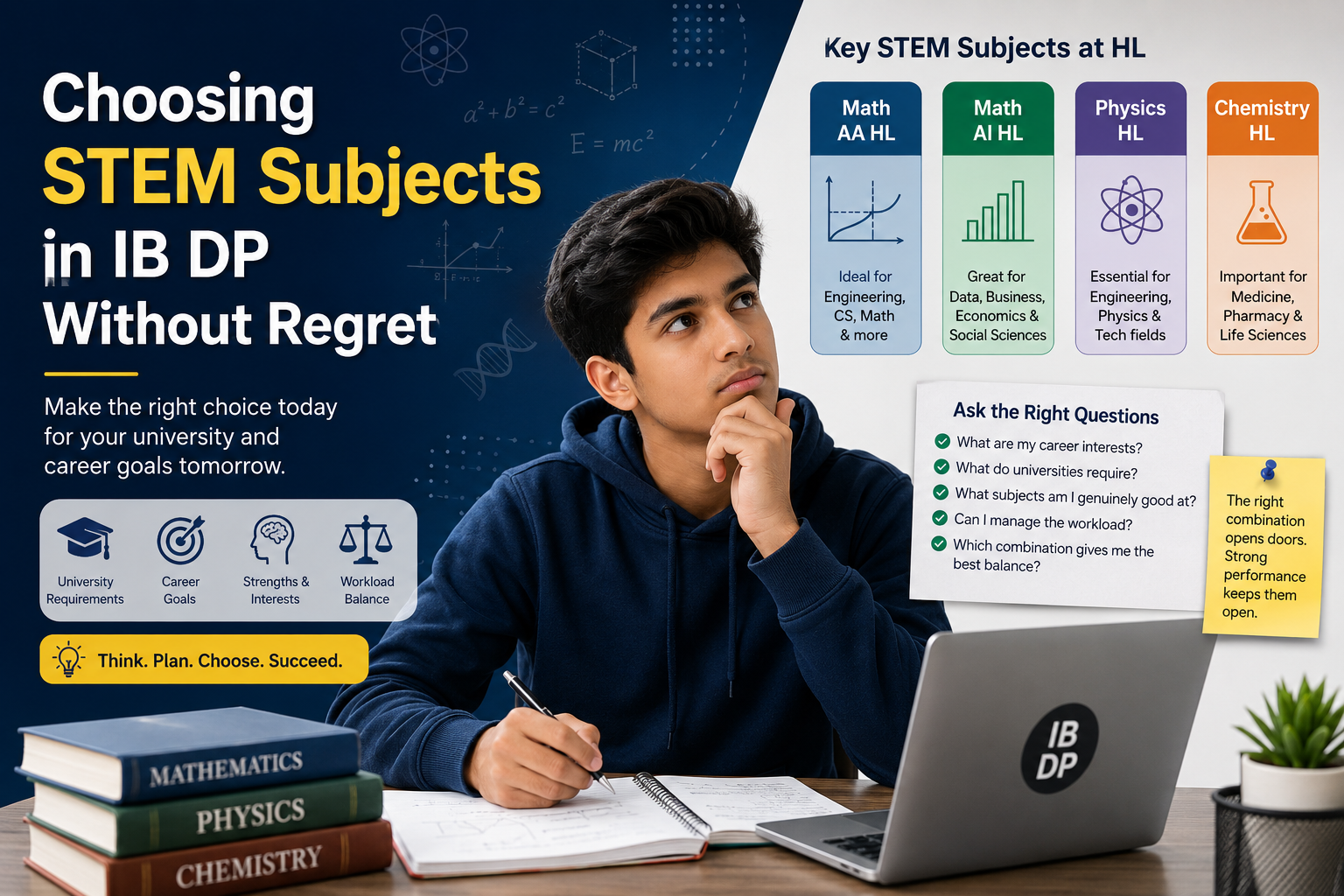
DP Mathematics comes in two subjects, each available at HL and SL. Mathematics Analysis and Approaches (AA) is algebraic and proof-heavy. Mathematics Applications and Interpretation (AI) is modelling and statistics-heavy with technology used throughout. Students heading for engineering or economics degrees are often advised towards AA, but the right choice depends on the degree and the student, and the school's DP coordinator makes the final placement.
| Question | Points towards AA | Points towards AI |
|---|---|---|
| IGCSE profile | Extended or Higher, comfortable with algebra, perhaps 0606 | Extended with solid statistics and context work, less love of algebra |
| What the student enjoys | Structure, proof, abstract patterns | Data, modelling, real situations, technology |
| Intended degree | Engineering, physical sciences, mathematics, economics with a quantitative bent | Business, social sciences, psychology, some life sciences, design |
| Relationship with the GDC | Tolerates it | Happy to use it constantly |
| Check before deciding | University course requirements for HL or SL maths | The same, plus whether the course accepts AI |
Two cautions apply. First, do not choose AI because it "sounds easier". It is different, not easier, and AI HL is a demanding course. Second, do not choose AA HL because a friend did. A student who got a 6 in IGCSE Extended with little algebraic fluency is under real strain in AA HL, and an honest conversation with the school's coordinator in May or June is worth more than three months of regret. Course requirements for universities vary, so confirm the exact requirement for the target course rather than relying on general advice. For how this ties to later university applications, see IB university preparation.
A quick self-test for the choice
Try these three prompts in a quiet half hour. Prove that the sum of two odd numbers is even, in your own words. Then take a small dataset (say, daily screen time for a week) and write three sentences about what it says and what it cannot say. Finally, solve a quadratic and then graph it on a graphing tool and read off the same roots.
If the first felt like a puzzle you wanted to finish, that points towards AA. If the second was the more interesting one, that points towards AI. If the third felt natural, the technology demands of either course will not bother you. It is not a test result. It is a conversation starter for the student and the coordinator.
A Six to Eight Week Summer Bridge Plan
The summer between IGCSE and DP1 is short in India, and the IGCSE to IB DP maths transition has to fit inside it. In a typical Indian academic calendar, Cambridge exams end in May or June, results come in the summer or in the case of the February/March series earlier, and DP1 begins in April or in the new academic year depending on the school. Treat the timeline below as a template and compress or stretch it to your school's start date.
The principle is to spend about 45 minutes a day, five days a week, never more. A bridge that eats the holiday gets abandoned in week two.
- Weeks 1-2Algebra and notation repair, daily 45 minutes
- Weeks 3-4Functions, exponentials and logs, first GDC skills
- Weeks 5-6Trigonometry in radians, sequences, series
- Weeks 7-8Mixed unfamiliar problems, written-reasoning practice
Weeks 1 and 2: algebra and notation repair
Start with the tool that all later topics use. Spend the first two weeks on:
- 1Expanding and factorising at speed, including quadratics with a leading coefficient, difference of squares and factorising by grouping.
- 2Rearranging formulae where the subject appears twice.
- 3Fractions with algebraic terms, with no calculator, because Paper 1 style work demands it.
- 4Indices and surds, including rationalising denominators.
- 5Writing equals signs correctly. Each line should follow from the line above. A common IGCSE habit is chains like "3x + 2 = 8 = 3x = 6", which loses marks in DP work.
Run one short test at the end of week 2, ten questions, no calculator, timed at twenty minutes. Log every mistake by cause, as described in the error log section below.
Weeks 3 and 4: functions, exponentials, logarithms and first GDC skills
This is where AA and AI begin to diverge in emphasis, but both need the vocabulary. Cover:
- Function notation, domain and range, and reading these from a graph.
- Composite functions and inverses, by hand for simple cases.
- Transformations of graphs, treated as a system (a translation, a stretch, a reflection, and the order that matters).
- Laws of exponents, then logarithms as the inverse of exponentials, and solving equations such as 3^x = 20.
- Basic GDC use: graphing, finding intersections, finding zeros, and a table of values. Do this with the actual calculator model the school will use, if known.
A beginner GDC habit worth installing early: after solving by hand, check by graph. It teaches both skills and builds the habit of verifying.
Weeks 5 and 6: trigonometry in radians, sequences and series
Trigonometry in the DP is more algebraic than at IGCSE and moves to radians. Spend time on:
- Radians and degrees, arc length and sector area.
- The unit circle, exact values for 0, 30, 45, 60 and 90 degrees (and the radian equivalents), and the symmetry that gives the others.
- Solving simple trigonometric equations over an interval.
- Arithmetic and geometric sequences and series, the formulae and when to use each, and sigma notation, even if only at an introductory level.
If the student has done 0606, they have met some of this. Treat it as revision at higher speed, and add proof-style questions: "show that" and "hence find".
Weeks 7 and 8: unfamiliar problems and written reasoning
The last two weeks are the most valuable and the most often skipped, because they are the least comfortable. Use three kinds of work.
- Unfamiliar problems. Pick problems that do not name the method. Spend at least ten minutes on each before looking at anything. Write down what you tried even when it failed.
- Show-that questions. Take a given result and write the reasoning that reaches it, in full sentences and equations.
- Explain-your-working. Choose one solved problem a day and rewrite it so a classmate could follow it without asking you anything.
The bridge ends with a check, not an exam. Retake the first test from week 2 and compare causes of errors, not scores.
What a Typical Bridge Week Looks Like
A student who treats the bridge as a weekly pattern, not a daily crisis, usually does better. A sample week for weeks 3 and 4:
- 1Monday. Function notation and domain, 45 minutes, ten questions.
- 2Tuesday. Composite and inverse functions, 45 minutes, including two "explain why this works" problems.
- 3Wednesday. Exponentials and log laws, 45 minutes, no calculator for the first half.
- 4Thursday. GDC skills, 30 minutes, followed by 15 minutes checking Monday's answers by graph.
- 5Friday. Six mixed questions, timed at 30 minutes, then the error log.
Saturday and Sunday are off. Rest is part of how the student absorbs the work.
Using the Error Log During the Bridge
The tool that most changes outcomes is the same one that works in DP1 and DP2: a written error log. After each session or test, the student records each mistake in three columns: what happened, why, and what to do differently. Over two weeks the pattern is visible.
| Typical cause | What it looks like in the bridge | The fix |
|---|---|---|
| Knowledge gap | Cannot recall log laws or a trigonometric value | Short daily retrieval, not rereading |
| Method choice | Unsure whether to factorise, complete the square or use the formula | Mixed sets that force a decision |
| Notation | "=" misused, missing brackets, missing dx | Rewrite the solution, compare to a model |
| Arithmetic | Signs and fractions in no-calculator questions | Slow, accurate practice; check pass |
| Reading | Missed "exact", "hence", or a given interval | Underline command words before solving |
A DP1 teacher can often predict who will struggle by whether the student has this log or something like it. Families that wish to build this habit with a tutor can find the wider method in why students struggle in IB Mathematics, where struggle types are diagnosed one by one.
Do You Need a Tutor for the Bridge?
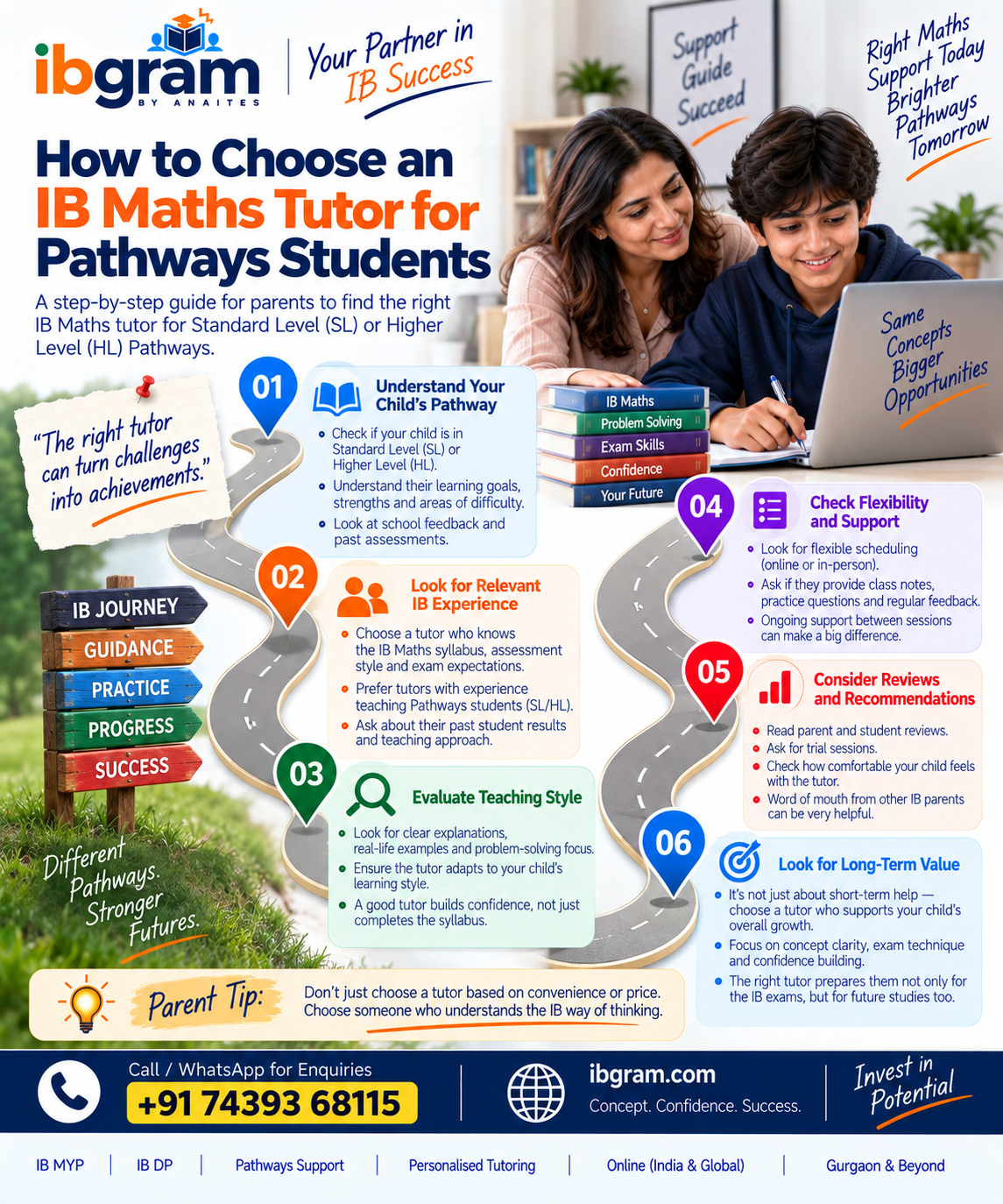
Often not. A motivated student with a good textbook, a past-paper habit and a parent who can check progress at weekly intervals can run the plan alone. A tutor is worth considering in three situations.
- The IGCSE tier or grade was borderline. A student coming off a B or C in Extended, or Core to AA, benefits from guided repair so that gaps do not become DP1 habits.
- The student wants AA HL and has not done 0606. The distance is real, and the plan has to be accelerated without being rushed.
- The student is anxious. A weekly session gives structure and perspective, which can matter more than the content.
If you do use a tutor, ask for a diagnostic in the first session, a written plan for the summer and a review at week four. In an ideal pattern, the tutor teaches less and asks more, and the student leaves each session with a short, specific task. A tutor who simply starts at "Chapter 1 of the DP textbook" has missed the point of the bridge. The principle behind this approach, across the board, is described in personalised home tuition for IB students.
IB Gram connects families with verified tutors for this stage. A family sends a query or books a free consultation, and IB Gram asks about board, programme, level, subject, school calendar, location and schedule before shortlisting tutors. A demo or trial session can be arranged before committing, and lessons run at home, online or hybrid, subject to tutor availability. For Gurgaon families, relevant service pages include IGCSE additional maths tutors in Gurgaon and IB maths AA HL tutors near Golf Course Road.
Ajay Vatsyayan's Approach to the Transition
Ajay Vatsyayan is IB Gram's IB Mathematics mentor. His approach, as set out in the flagship strategy guide, begins with a genuine diagnosis of the student's own script: which topics, which error types and which papers. That logic carries directly to the IGCSE to DP bridge.
Personalised learning. No two students arrive from IGCSE with the same gaps. One is fluent in algebra and weak at written explanation; another is the reverse. The first session is spent finding out which.
An error-correction system. Mistakes are treated as trainable habits, not as carelessness. The question is always why the error happened and what habit would prevent it recurring.
Exam strategy training. Timed drills, marks-to-minutes discipline and the presentation habits that keep method marks on the page, started early enough to become automatic by the first DP1 test.
How Should DP1 Term One Be Used?
DP1 term one should be used to convert IGCSE knowledge into DP habits: writing every line of reasoning, reading each question as a new problem, and practising without the calculator on purpose. The student's goal in the first term is not a high score on the first test. It is the habit change that produces high scores from the second term onward.
Concretely, in the first ten weeks of DP1:
- 1Do every set homework in full, even the questions that look easy, with all working shown.
- 2Keep the error log going, and review it before each unit test, not only after.
- 3Redo failed questions a week later without looking at the solution.
- 4Ask the teacher one specific question a week. A question that names the line where the student got stuck is far more useful than "I did not understand".
- 5Start thinking about the internal exploration topic by the end of term one: not choosing, only noticing what interests you.
The IA is the 12 to 20 page mathematics exploration, 20% of the final grade, marked out of 20 on five criteria: A Presentation (4), B Mathematical communication (4), C Personal engagement (3), D Reflection (3), E Use of mathematics (6). HL work is judged against a higher standard on criterion E. The teacher can comment on one draft, and the work must be the student's own. Early reading and noticing helps; tutor support is limited to teaching the underlying skills and questioning, not writing. The maths-specific support route is at IB maths IA tutors in Gurgaon.
Common Mistakes in the Bridge
- Starting too late. The weeks of rest after exams are valuable; starting the bridge in the final fortnight turns it into cramming.
- Doing only what feels familiar. Algebra drills are comfortable, and writing "show that" solutions is not, so the second is what to do.
- Skipping the GDC. Students who delay learning the calculator until the first DP1 test pay for it in time.
- Choosing the subject by marks alone. Interest and degree plans matter as much as the last grade.
- Copying solutions. Copying a worked example teaches handwriting. Redoing it from memory teaches mathematics.
- Overloading. An hour of mathematics every day through the whole break often ends in a collapse by week three.
Where IGCSE Past-Paper Skills Still Help
The IGCSE to IB DP maths transition is not a reset. Several IGCSE strengths carry straight across and are worth keeping. Past-paper discipline, covered in why past papers are key to IGCSE maths success, becomes DP past-paper discipline with different papers. Marks-to-minutes thinking works in both. The habit of checking each answer for reasonableness is a gift to anyone entering the DP. The IGCSE reasoning about estimation and error bounds helps in the DP's modelling contexts.
For students still in the final stretch of IGCSE, the 3-month study plan for IGCSE Maths 0580 and the IGCSE Maths 0580 and 0606 parent guide cover the exam side. The Gurgaon service page for the board is IGCSE maths home tutors in Gurgaon.
Frequently Asked Questions
Is IB DP maths harder than IGCSE maths?
DP maths is broader and expects more independent reasoning, so most students find it harder, but not because the individual topics are far beyond IGCSE. The difficulty is that questions are longer, methods are not named, and written reasoning earns marks. A student with solid IGCSE Extended foundations and deliberate bridge work usually adapts within the first term.
Can I take IB AA HL without Additional Mathematics 0606?
Yes, many students do, subject to the school's own entry requirements. Additional Mathematics gives a head start on calculus, logs and functions, but it is not a formal prerequisite in most schools. A student without it should plan the bridge more carefully, particularly on functions, exponentials and trigonometry. Check with the school's DP coordinator, who makes the final placement decision.
I scored well in IGCSE Core. Can I do AA?
Core tops out at grade C and does not cover enough algebra, functions and trigonometry for AA HL comfortably. A Core student would usually be advised towards AI or AA SL, and to do remedial work before term one. The school's coordinator decides. If the student is strongly motivated, discuss a diagnostic and a staged plan, not an automatic yes or no.
When should I start the summer bridge?
Start within the first two weeks after the last IGCSE exam, after a short break. A six to eight week plan at about 45 minutes a day, five days a week, fits most summers. Start later if the school begins DP1 early, and compress the plan to the weeks available while keeping the order: algebra first, then functions, trigonometry and unfamiliar problems.
Should I choose AA or AI after IGCSE?
Choose based on the intended degree, the student's interests and the school's advice, not on perceived difficulty. AA suits students who enjoy algebra and proof and are heading for engineering, physical sciences or mathematics. AI suits those who prefer modelling, data and technology. Confirm the course's maths requirement with the universities in question, and read the AA vs AI decision guide.
Is a tutor necessary for the IGCSE to IB maths transition?
Not necessarily. A motivated student with a plan, a past-paper habit and weekly check-ins can manage alone. A tutor adds value when the IGCSE result was borderline, when the student wants AA HL without 0606, or when anxiety is a factor. Look for a tutor who diagnoses first, writes a plan, reviews at week four and is willing to say when sessions are no longer needed.
How much calculator practice should I do before DP1?
Spend about 15 minutes a day on the graphic display calculator in the second half of the bridge. Learn to graph, find intersections and zeros, build tables, and use the statistics menu if heading for AI. Practise on the model the school will use. Always solve by hand first and use the calculator to check, so both skills develop.
What if my child's first DP1 maths test goes badly?
A poor first test is common and recoverable if handled with evidence. Look at the marked script for lost method marks, notation errors and unfamiliar wording, and build an error log. Speak to the teacher about specific lines, not general worry. Give the new habits six to eight weeks to show. Only if marks stay flat after that is more support, such as a tutor, worth considering.
Can I do the bridge if my child comes from CBSE or ICSE?
Yes, with a different emphasis. CBSE and ICSE students often have strong procedural fluency and need more practice with unfamiliar, multi-part and written-reasoning questions, plus GDC skills. The gap analysis table still applies, and a short diagnostic in week one shows which rows to spend extra time on. Equivalence for admissions is a separate matter confirmed with the institution.
How early should my child start thinking about the IA?
Begin noticing topics in the first term of DP1, but do not commit. Interest drives the best explorations. Keep a short list of questions that made the student curious, and review it with the maths teacher in term two. The teacher can comment on one draft, and the work must be entirely the student's own, so tutors can teach skills but cannot write or edit it.
Next Steps
- 1Confirm the level. Ask the school's DP coordinator which maths subject and level your child's IGCSE result supports, and what the school's own entry conditions are.
- 2Run the diagnostic. In week one of the break, give the student a no-calculator algebra test and one unfamiliar problem, and read the errors by cause.
- 3Start the bridge. Fix the daily 45 minutes, choose a start date and put the week-two test in the calendar.
To talk through your child's situation, contact IB Gram with the IGCSE tier, the target DP subject and the school start date, or look at IB DP tutors in Gurgaon for the service that matches your child's stage.
Need a tutor for this subject?
Share your city, programme stage and subject — the IB Gram advisor team replies with a small, honest shortlist.