Choosing STEM subjects in IB DP without regret
Real questions DP families should ask before committing to HL Maths AA or AI, and HL Physics or Chemistry.
Choosing STEM Subjects in IB DP Without Regret
Choosing STEM subjects in the IB Diploma Programme can feel like one of the most important academic decisions a student will make before university. For many families, the pressure is not just about picking interesting subjects. It is about choosing the “right” Higher Level combination for engineering, medicine, computer science, architecture, economics, data science or other competitive university pathways.
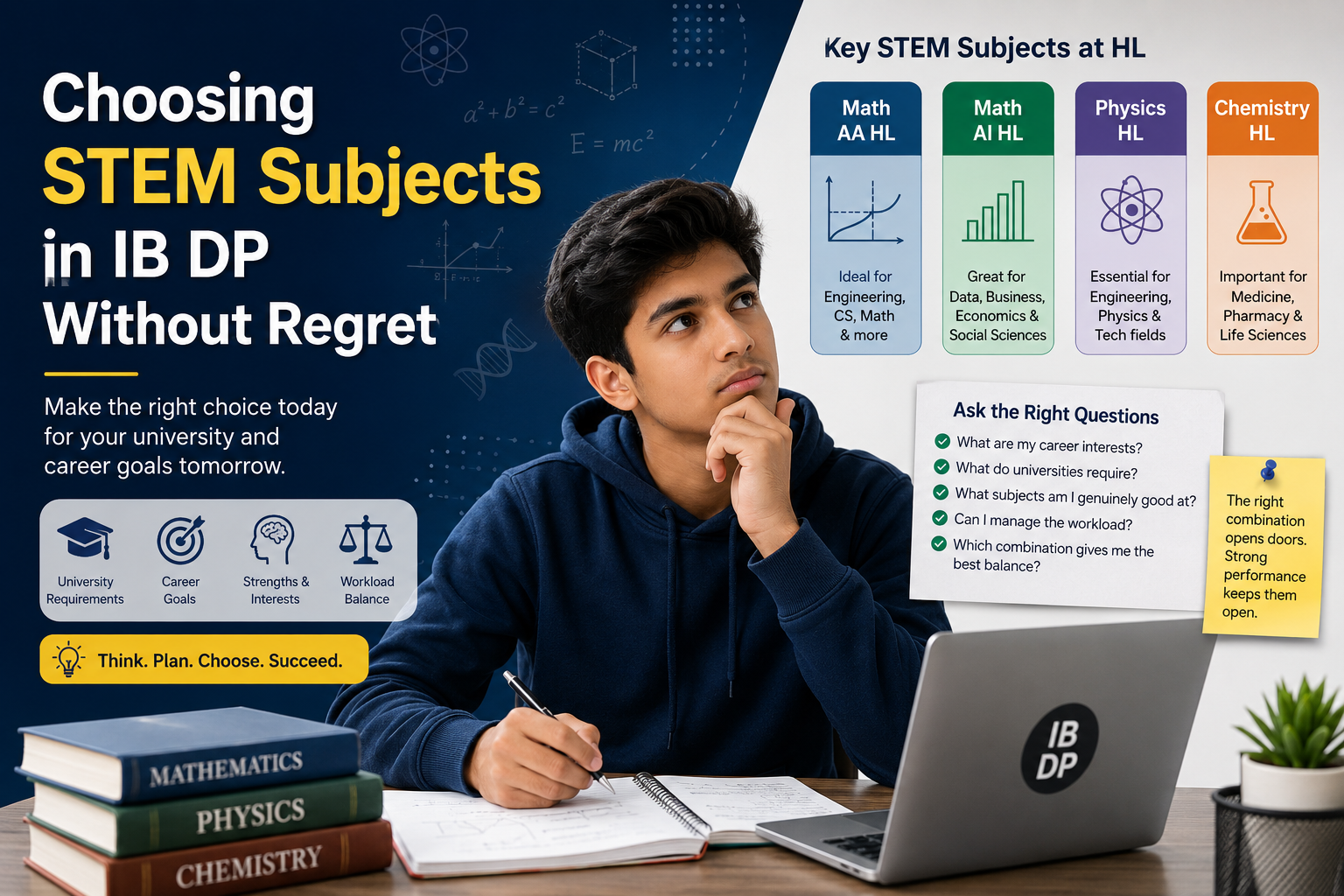
The most common confusion usually begins with four subjects: Mathematics: Analysis and Approaches HL, Mathematics: Applications and Interpretation HL, Physics HL and Chemistry HL. Students hear different advice from teachers, seniors, counsellors, relatives and online forums. One person says Math AA HL is essential. Another says Math AI HL is accepted by many universities. Someone says Physics HL keeps more doors open. Someone else warns that Chemistry HL is extremely demanding. The result is often anxiety, not clarity.
The truth is more balanced. There is no perfect IB STEM combination for every student. A strong choice depends on three things: the student’s ability, the university course they may apply for, and the amount of workload they can manage consistently for two years. The goal is not to select the hardest subjects just to look impressive. The goal is to build a subject combination that is ambitious, realistic and aligned with future options.
This guide explains the practical questions families should ask before committing to HL Math AA or AI, and HL Physics or Chemistry.
Why STEM Subject Choice Matters in IB DP
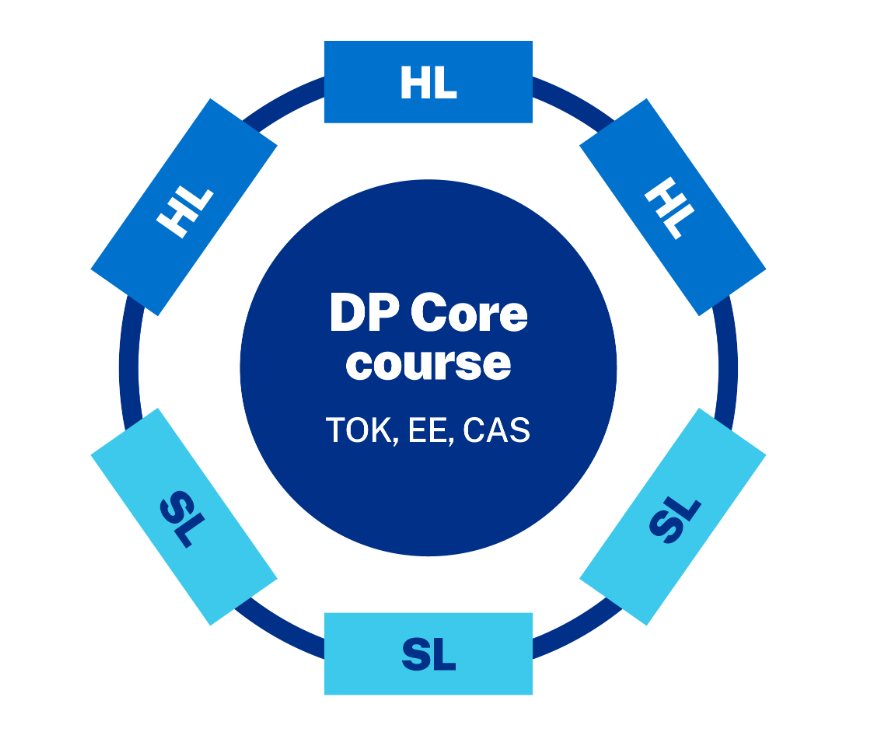
IB DP is different from many national curricula because it asks students to balance depth and breadth. A student may be strong in science and mathematics, but they still need to manage languages, humanities, Theory of Knowledge, the Extended Essay and CAS. That means subject choice cannot be based only on prestige.
STEM subjects at Higher Level are academically demanding because they require conceptual understanding, problem-solving, regular practice and exam technique. Math AA HL, Physics HL and Chemistry HL are not subjects students can leave for the final months. They need steady work from the beginning of DP1.
This is why families should avoid choosing HL STEM subjects only because “top universities like them.” Universities do care about subject relevance, but they also care about grades. A student who takes three very difficult HL subjects and struggles to maintain scores may be in a weaker position than a student who chooses a slightly better-balanced combination and performs strongly.
The best IB subject choice is not always the most difficult one. It is the one that gives the student a credible pathway to university while allowing them to perform at their best.
Start With the University Course, Not the Subject
Before choosing IB DP STEM subjects, ask: what university courses might the student realistically apply for?
If the answer is engineering, physics, mathematics or computer science, Math AA HL is often the safer and more widely expected option. Many competitive STEM programmes prefer or require a mathematics course with strong calculus and algebra. Physics HL is also commonly expected for engineering and physics-related degrees.
If the answer is medicine, dentistry, pharmacy, biochemistry or biomedical science, Chemistry HL is often very important. Depending on the country and university, Biology HL may also be required or strongly recommended. Physics may be useful, but Chemistry usually carries more weight for medical and life-science pathways.
If the answer is economics, business analytics, data science, psychology with statistics, finance or social science research, the decision between Math AA HL and Math AI HL becomes more nuanced. Math AI HL can be a strong choice for students who enjoy statistics, modelling and applied mathematics. However, some highly selective universities may still prefer Math AA HL for economics, computer science or quantitative finance.
If the student is undecided, the family should identify the broadest realistic pathway. A student choosing between engineering and medicine, for example, may need a careful combination such as Math AA HL with Chemistry HL and possibly Physics HL, depending on school rules and personal capacity. But this is a heavy route and should not be chosen casually.
Math AA HL vs Math AI HL: What Is the Real Difference?
One of the biggest IB subject choice questions is whether to take Math AA HL or Math AI HL.
Math AA HL is usually more suitable for students who enjoy abstract mathematics, algebra, calculus, proofs, functions and theoretical problem-solving. It is often the preferred choice for students considering engineering, mathematics, physics, computer science and highly quantitative university courses.
Math AI HL focuses more on applications, modelling, statistics, technology and real-world mathematical interpretation. It can be excellent for students interested in data, business, economics, social sciences, psychology, design, environmental systems or applied research. It is not an “easy” course. At Higher Level, Math AI still requires strong mathematical thinking, but the style of thinking is different.
The mistake many families make is assuming Math AA HL is always better. It is not always better; it is better for certain pathways. Another mistake is assuming Math AI HL is weak. It is not weak when chosen for the right reasons and accepted by the target universities.
The real question is: which mathematics course matches the student’s future course and learning style?
A student who dislikes algebraic manipulation and struggles with non-routine proofs may suffer in Math AA HL even if they are generally good at school. A student who enjoys patterns, data, technology and applied problems may flourish in Math AI HL. On the other hand, a student applying to engineering or physics should be very cautious about avoiding Math AA HL, because some universities may see Math AI HL as less suitable for those courses.
Before finalising, families should check the entry requirements of universities in the countries they are considering: UK, US, Canada, Singapore, Australia, Netherlands, India or elsewhere. Requirements can vary significantly.
When Should a Student Choose Math AA HL?
Math AA HL is usually the strongest choice when the student is considering:
Engineering Computer science Mathematics Physics Architecture at some universities Economics at highly competitive universities Quantitative finance Data science at mathematically rigorous universities
A student should consider Math AA HL if they are comfortable with challenging mathematics and willing to practise consistently. Success in Math AA HL rarely comes from talent alone. It comes from weekly problem-solving, reviewing mistakes and building exam speed.
Families should also ask how the student performed before IB. Did they enjoy advanced algebra and trigonometry? Were they comfortable with multi-step problems? Do they panic when questions look unfamiliar? Do they have the discipline to practise even when there is no immediate test?
Math AA HL can be rewarding, but it can also become a source of stress if chosen only for status. If a student chooses it, they should do so with open eyes and a clear support plan.
When Should a Student Choose Math AI HL?
Math AI HL may be a strong option when the student is interested in:
Business analytics Economics at universities that accept AI HL Psychology Social sciences Environmental studies Design and technology Data interpretation Statistics-heavy fields Some computer science or data science courses, depending on university requirements
Math AI HL suits students who like applying mathematics to real-life situations. The course often feels more connected to modelling, statistics and interpretation. However, students should not treat it as an easy alternative. At HL, it still requires strong reasoning and consistent work.
The most important step is to verify university requirements early. Some universities clearly accept Math AI HL for certain courses. Others prefer Math AA HL, especially for engineering, computer science, economics or mathematics. A student should never assume acceptance based on general advice. Always check course-specific entry requirements.
If Math AI HL is accepted for the desired pathway and matches the student’s strengths, it can be a smart and strategic choice.
Physics HL: Powerful but Demanding
Physics HL is one of the most respected IB STEM subjects because it develops analytical thinking, mathematical modelling and problem-solving. It is highly relevant for engineering, physics, astrophysics, mechanical engineering, electrical engineering, aerospace engineering and some computer science pathways.
However, Physics HL is not simply “more formulas.” Students need to understand concepts deeply and apply them in unfamiliar contexts. Many students find Physics HL difficult because the exam questions often test reasoning rather than memorisation.
A student should consider Physics HL if they enjoy asking why things happen, are comfortable with mathematics and can visualise abstract ideas. Physics rewards curiosity and persistence. It can be frustrating at first, but students who practise regularly often improve significantly over time.
Families should be careful if the student is choosing Physics HL only because it “keeps options open.” It does keep many STEM options open, especially engineering, but it also adds a serious workload. If the student has no interest in physics-based courses and is leaning toward medicine or life sciences, Chemistry HL and Biology HL may be more relevant.
Chemistry HL: Essential for Medicine and Life Sciences
Chemistry HL is often the key science for students considering medicine, dentistry, pharmacy, biochemistry, biomedical science, chemical engineering, veterinary science and related fields. For many medical and life-science courses, Chemistry HL is either required or strongly recommended.
Chemistry HL combines understanding, memory and application. Students need to learn concepts, practise calculations, understand reactions and apply knowledge to unfamiliar questions. It is not purely memorisation, and it is not purely mathematics. This makes it challenging in a different way from Physics HL.
A student should consider Chemistry HL if they are comfortable with detailed content and can revise consistently. Chemistry often punishes last-minute study because topics build on one another. Organic chemistry, equilibrium, energetics and acids and bases require repeated practice.
For medicine-focused students, Chemistry HL is usually difficult to avoid. For engineering-focused students, Chemistry may be useful for chemical engineering, materials science or environmental engineering, but Physics is often more central for many engineering branches.
Should a Student Take Both Physics HL and Chemistry HL?
Taking both Physics HL and Chemistry HL can be a strong combination, but it is not for everyone. It is usually suitable for students who are academically strong, genuinely interested in science and capable of managing a heavy workload.
This combination may be useful for students who are undecided between engineering and medicine, or for students considering chemical engineering, materials science, biomedical engineering or physical sciences. However, adding Math AA HL to Physics HL and Chemistry HL creates one of the most demanding IB HL combinations.
Families should ask a practical question: can the student maintain high grades in this combination while also managing Standard Level subjects, TOK, EE, CAS and university applications?
If the answer is yes, it can be an excellent route. If the answer is uncertain, the student may need to prioritise based on likely university direction. A slightly narrower but stronger application is often better than a broad but weaker one.
Common IB STEM Combinations and Who They Suit
Math AA HL + Physics HL + Chemistry HL is a high-intensity STEM combination. It suits students who are very strong in mathematics and science and want to keep engineering, physical sciences and some medicine-related options open. It is powerful but demanding.
Math AA HL + Physics HL + Economics HL may suit students interested in engineering, computer science, economics, finance or technology-related careers. This combination balances STEM with social science and can be attractive for quantitative pathways.
Math AA HL + Chemistry HL + Biology HL is common for medicine, dentistry, biomedical science and life sciences. It is content-heavy and requires strong memory, analysis and exam discipline.
Math AI HL + Chemistry HL + Biology HL may suit some medicine or life-science applicants only if target universities accept Math AI HL. Families must verify this carefully.
Math AI HL + Economics HL + Business Management HL may suit business, management, analytics or social science pathways, but it may not be enough for highly mathematical university courses.
Math AA HL + Computer Science HL + Physics HL may suit computer science, engineering and technology-focused students, depending on school availability and university expectations.
There is no universal best combination. The best combination is the one that fits the student’s future pathway and gives them the best chance of strong results.
Do Universities Prefer “Harder” IB Subjects?
Universities usually care about three things: whether the student has the required subjects, whether the predicted and final grades are strong, and whether the overall academic profile fits the course.
Taking harder subjects can help only when the student performs well in them. A difficult combination with weak grades is not automatically impressive. For competitive courses, universities may expect certain HL subjects, but they rarely reward unnecessary difficulty if it damages performance.
For example, an engineering applicant usually needs strong mathematics and physics. Taking Chemistry HL as a third HL may help for some branches, but it may not compensate for a low Math AA HL score. Similarly, a medicine applicant usually needs Chemistry and often Biology. Taking Physics HL may be impressive, but not if it lowers the student’s overall score.
The smartest subject choice is strategic, not emotional.
Questions Families Should Ask Before Finalising IB STEM Subjects
Before submitting final IB subject choices, families should sit together and discuss these questions honestly.
What university courses is the student seriously considering?
Which countries are most likely for university applications?
Do those universities require Math AA HL, Math AI HL, Physics HL or Chemistry HL?
Is the student choosing a subject because they enjoy it, because they need it, or because someone said it looks impressive?
How did the student perform in mathematics and science before IB?
Does the student have the discipline to practise weekly without constant reminders?
Will this combination leave enough time for TOK, EE, CAS and applications?
If the student struggles in the first term, what support plan is available?
These questions reduce regret because they move the decision from fear to evidence.
The Role of Grades: A Strong Score Still Matters
In IB DP, subject choice is important, but grades remain critical. A student applying to a competitive STEM course needs both relevance and performance. Choosing Math AA HL may be necessary for engineering, but the student still needs to perform well in it. Choosing Chemistry HL may be necessary for medicine, but a weak score can damage the application.
This is why students should not overload themselves unnecessarily. IB is a marathon. Burnout in DP1 can affect predicted grades, confidence and university planning. A balanced student who scores consistently well often has better outcomes than a student who chooses an extreme combination and spends two years overwhelmed.
How to Avoid Regret After Choosing Subjects
The best way to avoid regret is to make the decision early, carefully and with evidence. Do not rely only on rumours or senior students’ experiences. Their advice may be useful, but their goals, strengths and universities may be different.
Check university requirements directly. Speak to school counsellors. Review the subject syllabus. Look at sample questions. Ask teachers about the student’s readiness. Most importantly, listen to the student’s actual learning style.
A student who enjoys the subject is more likely to survive the difficult weeks. Interest alone is not enough, but it matters. IB STEM subjects require effort, and effort is easier to sustain when there is some genuine curiosity.
Final Advice: Choose Ambition With Self-Awareness
Choosing STEM subjects in IB DP should not be a panic decision. Math AA HL, Math AI HL, Physics HL and Chemistry HL can all be excellent choices when they match the student’s goals. The danger is not in choosing one over the other. The danger is choosing without understanding the consequences.
Math AA HL is powerful for engineering, mathematics, physics, computer science and quantitative courses. Math AI HL can be valuable for applied, statistical and data-related pathways when accepted by universities. Physics HL is highly relevant for engineering and physical sciences. Chemistry HL is often essential for medicine, dentistry, pharmacy and life sciences.
The right combination should keep the student’s future options open without destroying their confidence or grades. Families should aim for a subject plan that is ambitious enough for university goals and realistic enough for two years of sustained performance.
IB subject choice is not about proving how hard a student can make life. It is about building a pathway where the student can grow, compete and succeed without regret.
Need a tutor for this subject?
Share your city, programme stage and subject — the IB Gram advisor team replies with a small, honest shortlist.