IB Tutor Fees in Gurgaon: What Moves the Price and How to Judge Value
Why two IB tutors in the same sector quote very different rates, which differences are real, and how a Gurgaon family can compare quotes by value instead of by the hourly number alone.

In this guide · 19 sections
IB tutor fees in Gurgaon vary because the work behind a lesson varies: the programme and level being taught, how scarce the subject specialist is, how much preparation and marking sits behind each hour, whether the tutor travels to your home, and how close the student is to an exam. The hourly number on a quote is the visible tip of those factors, and two tutors can charge the same rate while delivering very different amounts of useful work.
This guide is for parents in Gurgaon and Gurugram who have received two or three quotes that do not look comparable, and for students who are being asked to justify the spend. It explains each fee driver in turn, shows you how to turn a rate into a cost per useful outcome, and gives you a short list of questions that expose a weak arrangement before you pay. It does not quote prices. Rates change with demand, the exam calendar and the individual tutor, and any number printed in a blog post would be out of date within a term. What does not go out of date is understanding why the number moves.
If you want the full-programme view (how many hours across two DP years, and where the budget peaks), that lives in the full private IB tutor cost breakdown for Gurgaon. This post stays on the per-session question: what makes one session cost more than another.
Why Do IB Tutor Fees in Gurgaon Differ So Much?
IB tutor fees in Gurgaon differ because tutors are not interchangeable suppliers of the same hour. A Diploma Programme (DP) Higher Level (HL) physics specialist who has taught past-paper technique for several sessions, a teacher who tutors Middle Years Programme (MYP) maths on weekends, and a university student who tutors the subject they scored well in last year are three different products with different supply, different preparation needs and different consequences when something goes wrong.
Think of the rate as the sum of four layers:
- The teaching layer: subject knowledge, level, familiarity with how the International Baccalaureate (IB) assesses it.
- The preparation layer: time the tutor spends before and after you see them, which you never observe.
- The logistics layer: travel, scheduling around your calendar, rescheduling rules.
- The market layer: how many families want the same slot or the same specialist at the same moment.
Most arguments about fees are really arguments about which layer is being priced. A parent who says "that tutor is expensive for one hour" is often looking at the teaching layer alone. The tutor setting the rate is pricing all four. Neither is wrong, but only one of them can tell you whether the rate is reasonable.
The Ten Things That Move a Tutor's Rate
Ranked by how much they usually matter, with the honest caveat that the order shifts by subject and season. The next ten sections go through each driver. The table below is the summary you can screenshot and use while reading quotes.
| Driver | Pushes the rate up when | Pushes it down when |
|---|---|---|
| Programme and level | DP HL, or MYP 5 extended | PYP, MYP 1 to 3 |
| Subject scarcity | HL sciences, Maths AA HL, Economics HL | Subjects with a deep local pool |
| Tutor background | Examiner-style insight, long classroom record | New tutor building a track record |
| Preparation and marking | Marked work and written feedback included | Discussion-only sessions |
| Mode | Home visits across the city | Online, or a tutor who lives near you |
| Session length | Longer blocks that carry more content | Short, targeted checks |
| Format | One-to-one, individual plan | Small group, shared plan |
| Urgency and season | Mock season, weeks before May | Early in DP1, mid-year |
| Package terms | Flexible, pay-as-you-go | Committed, reviewable blocks |
| Cancellation and reschedule rules | Generous flexibility | Strict, short-notice terms |
How Programme and Level Change the Price
The programme sets the depth of the preparation, and depth is what you are buying. A Primary Years Programme (PYP) learner needs a tutor who can keep inquiry-based work playful and organised around the school's units. A MYP student needs someone who understands that the school marks against four criteria, each scored 0 to 8, and that the final 1 to 7 grade comes from the criterion total out of 32. A DP student needs a tutor who has taught from the current subject guide and who knows what the paper structure looks like.
Within the DP, the jump from Standard Level (SL, 150 recommended teaching hours) to HL (240 hours) is real. HL adds content, and it adds the extended reasoning and unfamiliar questions that only a confident specialist can model. A tutor who is comfortable at SL may not be comfortable with the HL extension, and the tutors who are comfortable with both are fewer, which is the first source of a rate difference.
A scenario that repeats every year: a family in Gurgaon asks about IB Mathematics Analysis and Approaches (AA) at HL for a DP1 student who struggled with the early algebra, and receives a quote visibly above what a neighbour paid for MYP maths support. The family feels overcharged. They are not being overcharged. The supply of people who can teach HL calculus and prove results from first principles to a 16-year-old is much smaller than the supply of people who can help a Grade 7 student with ratios and algebra. That scarcity shows up in the rate before any other factor does.
Illustrative judgement of tutor availability by level: thinner supply tends to mean higher rates. Not an IB or market statistic.
Why Subject Matters: Scarcity, Not Difficulty
The common assumption is that "hard subjects cost more." It is closer to the truth that scarce subjects cost more. A subject can feel difficult to students and still have a large pool of capable tutors. Another can be modest in difficulty and almost impossible to staff in a given locality at a given time.
In practice, the subjects where families report the narrowest choice are the ones where a good tutor must hold both subject mastery and exam-technique knowledge: DP Mathematics AA HL, the HL sciences (physics, chemistry, biology), DP Economics, and anything taught in a less common language. IB Gram's Gurugram maths AA HL page and the IB physics page are examples of subjects where shortlisting takes longer, because the right person is not simply the nearest person.
Two contrasting cases show how this plays out:
- A DP2 student who needs help on the Chemistry IA discussion section. The tutor must understand the four criteria of the scientific investigation (Research design, Data analysis, Conclusion, Evaluation, each out of 6) and be strict about the academic integrity boundary, because the IA must be the student's own work. That is a narrow skill set, and it is priced as such.
- A DP1 student who wants regular homework support in a subject the school teaches well. The need is simpler, many tutors can meet it, and the rate reflects that.
The takeaway for a family: when a quote seems high, ask first whether the subject is scarce in your area. If it is, the rate is mostly a market reality. If it is not, the premium needs another explanation, and you should ask for it.
Tutor Background: What an Experienced Tutor Actually Brings
"Experience" appears on every profile, and it means different things. Three types are worth separating because they correspond to different rates and different strengths.
The classroom teacher. Has taught the syllabus to full cohorts, understands the sequence in which students typically struggle, and brings a library of explanations that have worked on real classes. Strong on pacing and misconceptions.
The exam-aware specialist. Has worked closely with the assessment itself: marking schemes, command terms, the way marks are awarded for method, and where students leak them. Strong on converting knowledge into marks.
The recent high scorer. A university student or recent graduate who scored well in the same subject. Relatable and current on what the paper feels like. Often less able to diagnose why a different student is stuck, because the subject came naturally.
None of these is automatically better. A student with a precise exam-technique problem may be best served by the specialist. A student who simply needs somebody to sit with them twice a week and keep the work moving may be well served by the recent scorer, at a more modest rate. The mistake is paying specialist rates for a need the recent scorer can meet, or the reverse.
A useful check on any claimed experience is a trial lesson where the tutor is asked to react to an actual piece of the student's work. If they can say, within ten minutes, what the two most expensive mistakes are and why, the experience is real. For a broader checklist on verifying credentials and spotting red flags, see how to choose an IB tutor in Gurgaon.
The Hidden Work Behind Each Session
The part of the hour you never see is where cheap and expensive arrangements diverge most. A tutor who arrives with a prepared set of questions based on last week's errors is doing different work from a tutor who opens the textbook at the next page.
Consider what a well-run weekly session needs behind the scenes:
- 1Reading the student's recent school work or last session's attempt.
- 2Choosing three or four tasks that target the specific gap, not the whole chapter.
- 3Marking any between-session work against the criteria or mark scheme.
- 4Writing a short note on what to practise before the next lesson.
- 5Updating the plan if the pattern of errors has shifted.
That is easily a meaningful fraction of the lesson time again, performed unpaid unless it is built into the rate. A tutor who charges a lower rate and does none of it is not providing the same service at a discount. The service is different. Often this is perfectly fine for a student who needs company and accountability. It is a poor fit for a student who needs a plan.
If you want to understand how this plays out at the premium end of the market, why an MYP maths tutor can charge a premium rate walks through the preparation and feedback hours that sit behind a high hourly figure and when it is not worth paying.
Home Visits, Travel and Online: How Mode Changes the Rate
Mode changes cost in ways that are specific to Gurgaon. A home visit has a travel component, and the travel is not a fixed distance. A tutor who lives in Sector 56 and visits a student in Sector 57 spends very little time in transit. A tutor crossing from Golf Course Road to a society on Dwarka Expressway during weekday evening traffic spends a lot, and that time is time they cannot teach someone else.
Because tutors protect their evenings, home sessions in far-apart areas tend to be priced either with a travel allowance or with a higher base rate. You may also see a difference between a society where the guard post allows quick entry and one that requires a pre-registered visitor slip, because the difference decides whether a 6:00 pm session starts at 6:00 or 6:12.
Online sessions remove travel. They also remove the geography filter: a family in Gurgaon can access a specialist in another city. That widening of supply is one reason online rates can sit lower for subjects where the local pool is thin, and sometimes higher where the specialist is scarce nationwide. If you want the mechanics of how online delivery should work (pen tablet, shared whiteboard, GDC on screen), online IB tutoring in India covers that, and IB Gram's Gurgaon online tutor page lists the online option directly.
Hybrid arrangements often balance cost and quality well: a longer home session every second week for difficult concepts, with shorter online sessions in between for corrections. Hybrid IB tutoring in Gurgaon explains how to combine the two, and IB home tutor vs online tutor in Gurgaon gives you a decision framework by subject.
| Mode | What you pay for | What to check |
|---|---|---|
| Home visit, nearby tutor | Convenience, face-to-face work | Whether the tutor lives or works close to you |
| Home visit, far tutor | Convenience plus travel time | Whether travel is itemised or buried in the rate |
| Online | Specialist access without travel | Pen tablet, saved whiteboard, a backup plan |
| Hybrid | Flexibility across a term | Who covers the cost of the longer in-person block |
Session Length: Why 60 Minutes Is Not Always the Right Block
A tutor's rate is usually quoted per hour, but the useful unit is the length of a session that fits the task. A student who needs to practise a timed Paper 1 section benefits from a 90-minute block, because a 60-minute session ends just when the student is settled. A student recovering from a bad week benefits from a 45-minute focused session and not a 90-minute drain.
Longer sessions are not automatically better value. Attention for a 16-year-old after a full school day tends to drop in the second half of a long block, and a poorly structured 90 minutes can deliver less than a sharp 60. Equally, very short sessions can lose time to set-up, particularly at home, where the first few minutes go to settling in and a final few minutes to wrapping up.
A practical way to judge: ask the tutor how they structure the first and last ten minutes of a session. A good answer sounds like "we start with last week's error list and finish by setting the next task." A weak answer is "we start where we left off."
When a tutor offers a discount for a longer block, check whether the extra time is structured. A discount on 120 minutes of unstructured time is not a discount on useful learning.
One-to-One or Small Group: How Format Affects Cost per Student
One-to-one tutoring costs more per hour than a small group because one student carries the whole cost of the tutor's time. The question is whether the extra cost buys more learning per hour for that student.
For a student with a specific gap (say, algebraic fluency before DP1 begins, or an IA that has stalled), one-to-one is usually worth the premium because every minute is aimed at that gap. For a student who is broadly fine and wants structured revision before a mock, a small group may deliver comparable value at a lower cost, with the added benefit of seeing how peers approach problems.
The warning sign is a group that is a lecture in disguise. If six students sit through a teacher solving the same questions, nobody gets diagnosis, and the lower hourly fee is not buying the thing you wanted. For a deeper comparison of one-to-one, group classes and coaching centres, is one-to-one IB coaching in Gurgaon worth it sets out a decision matrix.
Does Timing Affect IB Tutor Fees in Gurgaon?
Yes. Timing affects IB tutor fees in Gurgaon through availability more than through any formal surcharge. In the weeks before the DP2 mock examinations and in the run-up to the May session, specialist tutors fill their calendars, and a family arriving late finds fewer slots and less negotiating room. A tutor with five requests for one remaining evening slot has no reason to be flexible on rate, schedule or notice.
The same logic applies in MYP. In the weeks around a school's major assessments, tutors who specialise in the subject are asked for extra sessions at the same time by many families, and slots become scarce.
The calendar pressure points to remember:
- Before DP1 begins: low pressure, wide choice, good time to settle a tutor.
- Mid DP1, around the first internal exams: moderate pressure.
- DP2 autumn, IA and Extended Essay (EE) deadlines: rising pressure, because tutors who help with the skills behind these are in demand.
- DP2 mocks to May: the peak, with the narrowest choice.
- Post-results, for a November retake: a short, concentrated window.
Starting earlier is the cheapest way to lower stress, not just the cheapest way to lower the rate. When to start IB tutoring goes through the signals for each stage, including when waiting is the right call.
- Before DP1Wide choice, calm scheduling
- DP1 term 2Choice narrows around first school exams
- DP2 autumnIA and EE work compete for slots
- DP2 mocks to MayNarrowest choice, firmest scheduling
- After May resultsShort window for November retakes
Illustrative pattern based on how school calendars cluster; confirm your own school's dates.
Packages, Prepaid Blocks and Cancellation Terms
Packages are where price drivers become contract terms, and where families get caught. A package typically offers a lower per-session rate in exchange for committing to a number of sessions or paying in advance. That can be good value when the fit is proven, and poor value when it is not.
Ask five questions before agreeing to any block:
- 1What is the expiry? A block that lapses in two months and carries no rollover can cost more per usable session than pay-as-you-go.
- 2What happens if the tutor cancels? The tutor should reschedule at no cost and without eating into your block.
- 3What happens if the student cancels? Short-notice terms vary. A reasonable window is stated up front and applied evenly.
- 4Can the block be paused? A student who has an exam fortnight or a family trip needs to pause without losing sessions.
- 5Is there a review point? A good arrangement states when the plan will be reviewed and what would cause it to change.
The safest sequence is a trial session, then a short reviewable block, then a larger commitment only after the student has shown they can work with the tutor. If you are asked to pay for a long block before any trial, treat that as information about the arrangement, whatever the discount.
What Does a Fair Fee Look Like for the Work Involved?
A fair fee is one that matches the preparation, expertise and logistics a student actually receives, and that you can explain to another parent without embarrassment in either direction. It is not the lowest quote, and it is not the highest. It is the quote where every part of the rate can be accounted for.
A simple test: ask the tutor what the rate includes, then add it up on paper.
- Is marked work between sessions included, or charged separately?
- Is travel built in?
- Is there a short written note after each session?
- Is communication outside the lesson (a quick doubt on WhatsApp, say) included or limited?
- Is there a stated review point?
A quote that includes all five can be reasonable at a higher rate than a quote that includes none. A quote that includes none and is also high is the one to walk away from.
There are also situations where a premium is simply not justified: a student who is already doing well and wants light reassurance, a subject with a deep local supply, or a need that a school teacher's extra help session could meet. A responsible tutor will say so. A tutor who never tells a family that tutoring is unnecessary is selling, not advising.
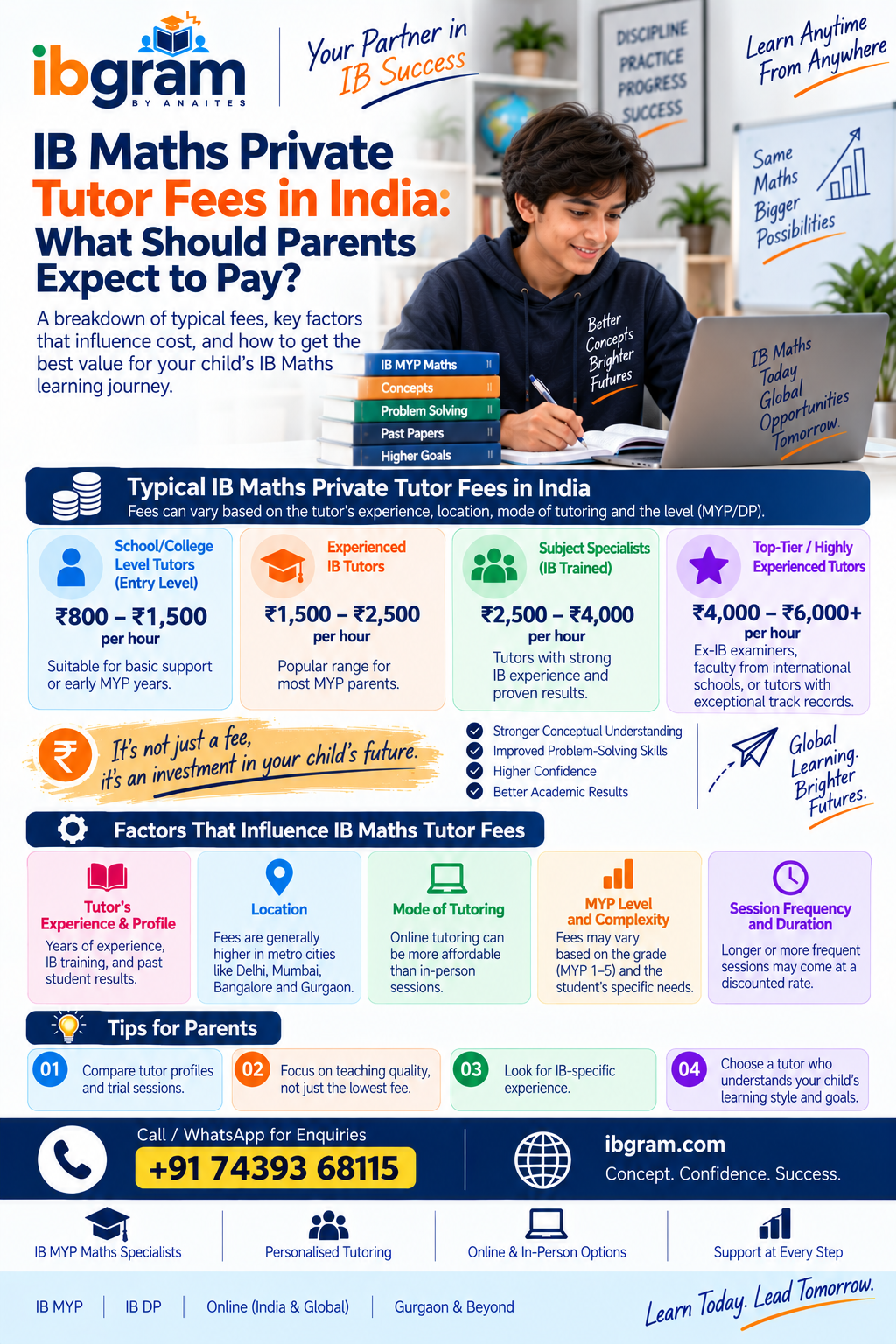
For India-wide context on maths fees specifically, including why rates differ between cities, see IB maths private tutor fees in India. For the question of why some Gurgaon parents deliberately choose the premium end, why parents choose premium IB maths tutors in Gurgaon explains what they are verifying before they pay.
How to Compare Two Quotes Properly
The most common mistake is dividing two quotes by an hour and calling the lower one cheaper. Compare the arrangements, not the numbers.
- Quantities to line up: hours, preparation, feedback, travel
- 4
- Review point agreed before the first block ends
- 1
- Sessions to judge fit, not one
- 2-3
- Grade guarantees you should accept
- 0
Here is a worked comparison, using relative terms only. Imagine a DP1 student in Sector 57 who needs support in Physics HL, and two quotes.
Quote A is lower per hour. The tutor teaches from the textbook, does not mark between sessions, travels across the city and has no review point. Sessions are discussions, and the student leaves with notes.
Quote B is higher per hour. The tutor starts with a diagnostic on a past-paper question, assigns three marked tasks between sessions, writes a short note after each lesson and agrees a review after four sessions.
If the student's problem is that they do not do enough practice, Quote A's lower rate may be enough. If the problem is that they practise but cannot find what they are doing wrong, Quote A will cost less per hour and more per outcome, because the loop that finds the error is missing. Quote B is not a premium for the sake of a premium: it includes the work that makes the hour effective.
The rule is: price the loop, not the hour. A learning loop has an attempt, feedback, a corrected attempt and a later check. If a quote does not include all four, you are comparing different things.
How to Judge Value After the First Month
Value shows up in evidence, not in confidence. After four sessions, you should be able to see a short trail: the first attempt, the feedback, the corrected attempt, and a later question of the same type done independently. If the trail is missing, the arrangement is running on goodwill.
The checks that matter in the first month:
- The student can say what changed. Not "I feel better," but "I now check the sign before I integrate."
- Errors are shrinking in a specific category, even if grades have not moved yet. Grades lag learning, particularly in MYP, where criteria are assessed a few times a term.
- The student is starting tasks without prompting. Independence is the clearest early signal.
- The tutor can state the next review date and what they will compare.
If you see none of these after a month, the issue is probably the fit or the plan, and not the student's effort. That is the point at which a conversation with the tutor, or a request for a different match, is reasonable. IB Gram's process allows a family to ask for another match if the fit is wrong, subject to tutor availability.
Judge a tutor by what the student can do alone a month later, not by how clearly the tutor explained things in the room.
Mistakes Families Make When Budgeting for IB Tutoring
These come up repeatedly and almost all are avoidable.
Buying the most expensive tutor for the wrong problem. A student who needs accountability and a steady routine does not need the scarce HL specialist. A student who needs the specialist does not benefit from a friendly generalist.
Paying for a long block before a trial. The discount does not offset a mismatch discovered in week three.
Ignoring travel in the comparison. A tutor who is cheaper per hour but cancels three sessions a term because of traffic costs more in wasted time than the rate suggests.
Starting in a panic. A family that arrives three weeks before mocks pays in choice, schedule and stress. Starting earlier at lower intensity is almost always a better use of money.
Treating the tutor as a substitute for the student's work. Tutoring works when the student does independent practice between sessions. Without it, the hour is a recital.
Asking for a grade guarantee. No tutor can guarantee a grade, and a tutor who does is telling you something about their honesty. The IA, the EE and every assessed piece must remain the student's own work, and a tutor who offers to write or fix them is a risk to the student's diploma.
A Process for Getting Comparable Quotes
If you are about to approach several tutors, use the same questions with each. You will get more honest answers, and the quotes will be comparable.
- 1Write down the student's programme, subject, level, school year, current difficulty and next assessment date.
- 2Ask each tutor for a short diagnostic or trial session before any commitment.
- 3Ask what the rate includes: marked work, notes, travel and between-session communication.
- 4Ask how many sessions they would propose and what would make that number go up or down.
- 5Ask for a review point after three or four sessions and what evidence will be compared.
- 6Compare the arrangements side by side, then decide on fit and value together.
A tutor who answers these clearly is easier to trust than one who answers them with a discount.
Where IB Gram Fits In
IB Gram is an independent tutor-matching platform based in Gurgaon. A family sends a query or books a free consultation, IB Gram asks about the board, programme, level, subject, school calendar, location and schedule, and then shortlists tutors whose profiles are verified and fit. A demo or trial session can be arranged before committing, lessons can run at home, online or hybrid, and the family can ask for a different match if the first one does not work. Availability is subject to tutor availability.
The platform does not publish a fixed rate card here because the drivers above mean no single figure is honest across subjects and levels. What it can do is make the comparison easier: a shortlist where each profile is already matched to your programme and subject, so the quotes you receive are comparable. If you want to see what a home tuition rate conversation looks like for IB families, the IB home tutor fees page is the more specific starting point.
For a Gurgaon family with a student in DP, the IB DP tutoring page is a natural start, and for MYP the MYP tutoring page does the same. You can also browse all verified tutor profiles and see what each tutor covers.
IB Gram is an independent platform and is not affiliated with the International Baccalaureate, Cambridge International Education, Pearson Edexcel or any school named here.
Frequently Asked Questions
Why do two IB tutors in the same sector charge such different fees?
Because the rate reflects more than location. Subject scarcity, level, the tutor's background, how much preparation and marking is included, travel, and how booked their calendar is all contribute. Two tutors a few streets apart can have very different supply positions: one may be the only HL chemistry specialist near you, the other one of many MYP maths helpers. Ask each tutor to explain what the rate includes, and compare those inclusions before the numbers.
Should I choose the cheapest IB tutor?
Not by default. The cheapest option is sensible when the need is simple, such as routine homework support in a subject with many tutors available. It is a poor choice when the student needs diagnosis, HL specialism or exam technique, because the missing preparation and feedback make the hour less effective. Judge by cost per outcome: is the student corrected, practising independently and showing a trail of improvement within a month?
Is a higher fee a sign of a better IB tutor?
Not by itself. A higher fee can reflect scarcity, preparation, marking and experience, or it can reflect branding. Test it with a trial: a better tutor can say within ten minutes what the student's two most costly errors are and how they will be addressed. If the premium cannot be explained in terms of what you receive, it is not a premium for quality.
Do HL subjects cost more than SL?
Usually yes, because fewer tutors are comfortable at HL, and HL preparation involves extended reasoning and unfamiliar problems. An HL maths or science specialist is a smaller group than SL tutors. That said, the difference is not fixed: it depends on the subject, the local supply and the season. Ask for the reason behind a gap rather than assuming it.
Is online IB tutoring cheaper than home tuition in Gurgaon?
Often, but not always. Online removes travel and widens the choice of tutors, which can lower the rate where the local pool is thin. It can also raise the rate if the best specialist for your subject is in high demand nationwide. Cost is only part of the decision: the student's focus, subject and need for physical working matter too. Online IB tutoring in India explains when online works best.
Should I pay for a package in advance?
Only once the fit is proven. A trial session followed by a short, reviewable block is safer than a large prepaid commitment. If a package is offered, check the expiry, what happens when the tutor cancels, whether the block can be paused and when a review will take place. A discount is only a discount if you use every session.
How many sessions a week should I budget for?
Begin with the smallest frequency that can address the problem, usually one focused session a week with independent practice between sessions. Add a second session for a defined window, such as the weeks before a mock, then step back. More hours without follow-up work rarely solve the issue. Review after three or four sessions and adjust.
What if my child is not improving after a month?
Look at the evidence before blaming anyone. Check whether the student is completing the between-session work, whether feedback is specific, and whether the plan matches the actual problem. If those are in place and nothing has moved, the fit may be wrong and a different match is reasonable. Grades can lag learning, so also look for fewer repeated errors and more independent starts.
Does a higher fee buy a promised grade?
No. No tutor can guarantee a grade, and any promise of a specific score should be treated as a warning. Outcomes depend on the student's starting point, attendance, independent practice, the school's assessment and many other factors. A responsible tutor can define a process, show evidence and adjust the plan. They should also refuse to write or rework assessed pieces such as the IA or EE.
Is it worth paying for tutoring if my child is already doing fine?
Sometimes, but not always. If the student is secure and the school provides support, tutoring may add little. It tends to be worthwhile when there is a specific gap, a transition (such as IGCSE to DP, or MYP 5 to DP1), or a deadline-heavy period. A tutor who tells you it is not needed yet is behaving the way you want an adviser to behave.
How does IB Gram help me compare tutors?
You share the student's programme, subject, level, school calendar, location and preferred schedule, and IB Gram shortlists tutors with verified profiles that fit. You can ask for a demo or trial before committing, choose home, online or hybrid delivery, and request a different match if the first one is not right, subject to tutor availability. The shortlist makes quotes easier to compare because the tutors are already matched.
Next Steps
- 1Write the brief. Note the programme, subject, level, the specific difficulty and the next assessment date, so every quote is for the same problem.
- 2Ask for a trial and the inclusions. For each tutor, request a short session and a clear list of what the rate covers: marking, notes, travel and communication.
- 3Agree a review before paying for a block. Set a date after three or four sessions and decide in advance what evidence you will compare.
If you would like help shortlisting, contact IB Gram with those details, or start from the IB tutor profiles for Gurgaon families. For a student heading into the Diploma Programme, the DP programme overview is a useful companion while you compare options. For the wider guidance on official programme details, the IB publishes information at ibo.org.
Need a tutor for this subject?
Share your city, programme stage and subject — the IB Gram advisor team replies with a small, honest shortlist.