IB MYP 4 and MYP 5 Mathematics Tutoring in Gurgaon: Building Skills for Pathways & Heritage Students
MYP 4 and MYP 5 are important years for students developing the mathematical skills they will carry into future IB study. For Pathways and Heritage students in Gurgaon, effective support requires more than homework assistance. Ajay Vatsyayan Sir and IB Gram provide personalised IB Mathematics mentoring focused on conceptual clarity, mathematical reasoning, investigation, communication, real-life application and examination preparation.

IB MYP 4 and MYP 5 Mathematics Tutoring in Gurgaon: Building Skills for Pathways & Heritage Students
There is a point in the MYP journey when Mathematics starts asking a different question from the student.
It is no longer simply:
“Can you calculate this?”
The question becomes:
“Can you understand the situation, decide what Mathematics is needed, explain your reasoning and defend your answer?”
For students entering MYP 4 and MYP 5, this change can become particularly noticeable.
Topics become more connected.
Problems can involve multiple steps.
Questions may be presented through unfamiliar contexts.
Students are expected to communicate their reasoning with greater clarity.
Investigations require patience and logical thinking.
Real-life problems require interpretation rather than immediate calculation.
For parents, this can create a difficult situation.
A child who was previously doing well in Mathematics may suddenly appear less confident.
The natural response is often to increase tuition.
But the better question is:
“What kind of tuition does the student actually need?”
For an MYP learner, a generic Mathematics tutor may not always be enough.
The tutor needs to understand the nature of IB Mathematics and the skills students are expected to demonstrate.
This is where specialised mentoring becomes valuable.
Ajay Vatsyayan Sir, Founder of IB Gram, works with IB Mathematics students through a concept-focused and personalised approach designed to help students develop mathematical independence.
For families looking for an IB MYP Maths tutor Gurgaon, the objective is not simply to complete more exercises.
It is to build the student's ability to understand and use Mathematics confidently.
Why MYP 4 Is an Important Turning Point
MYP 4 can be a significant stage in a student's academic development.
Students have already encountered the fundamentals of Mathematics.
Now they need to connect those ideas.
Algebra is no longer isolated from graphs.
Geometry can connect with measurement and modelling.
Statistics can involve interpretation rather than calculation alone.
Functions can be represented in several ways.
Probability can involve both mathematical reasoning and contextual understanding.
The student is therefore moving from learning individual topics toward recognising relationships between them.
This is where gaps can become visible.
A student may know individual procedures but struggle when several ideas appear together.
For example, a problem may require algebraic manipulation followed by graphical interpretation.
The student needs to understand both concepts and the relationship between them.
A good MYP 4 tutor should therefore help students build connections rather than teaching every topic as a separate unit.
Why MYP 5 Requires Greater Independence
MYP 5 is the final year of the programme.
Students are expected to demonstrate increasing independence in their academic work.
This can make MYP 5 Mathematics particularly important for students planning to continue into advanced IB study.
The student needs to become more comfortable with unfamiliar problems.
They need to manage longer questions.
They need to communicate reasoning.
They need to interpret results.
They need to work effectively under time constraints.
For students participating in MYP eAssessment, where applicable, preparation may also involve understanding the digital examination environment and becoming comfortable with the style of on-screen assessment.
But technology is only one part of preparation.
The underlying Mathematics must remain strong.
This is why preparation should ideally begin with conceptual understanding rather than examination tricks.
Understanding the MYP Mathematics Criteria
Parents often hear references to Criterion A, B, C and D.
Understanding these criteria helps explain why a student can be strong in one area and weaker in another.
Criterion A: Knowing and Understanding
Criterion A focuses on mathematical knowledge and understanding.
A student needs to know mathematical concepts, terminology and procedures.
However, meaningful understanding means more than remembering.
For example, a student may remember a formula for a particular geometric calculation.
But can the student recognise when the formula applies?
Can they explain the quantities involved?
Can they interpret the answer?
Can they connect the calculation to a diagram?
These questions reveal deeper understanding.
Ajay Vatsyayan Sir's concept-first approach focuses on building that depth before moving toward speed and examination pressure.
Criterion B: Investigating Patterns
Pattern investigation asks students to explore mathematical relationships.
This can be very different from routine textbook exercises.
A student may be presented with several examples and asked to identify what changes and what remains consistent.
The student may need to make a conjecture and investigate whether it continues.
The important skill is not guessing.
It is reasoning.
Students learn to test ideas and look for general relationships.
For students who are accustomed to being told exactly which method to use, this can initially feel uncomfortable.
Personalised tutoring can help them become more comfortable with that uncertainty.
The tutor can guide the student without immediately taking away the opportunity to think.
Criterion C: Communicating Mathematics
Students need to make their mathematical thinking understandable to someone else.
This means learning how to organise solutions.
A strong solution is not simply a final number.
It shows the relevant reasoning.
The student should be able to explain why a particular method was selected and what the result represents.
This becomes particularly important for multi-step problems.
During 1-on-1 tutoring, students can practise explaining their solutions aloud before writing them.
This makes hidden gaps easier to identify.
A student may know how to calculate but not know how to explain.
Once the tutor identifies that distinction, communication can become a specific learning goal.
Criterion D: Applying Mathematics in Real-Life Contexts
Criterion D brings Mathematics into practical situations.
Students may need to use mathematical ideas to understand data, finance, measurement, growth, design, probability or other real-world problems.
The challenge is often deciding which Mathematics is appropriate.
Students need to interpret the situation before calculating.
This is why real-life application should not be left until the final weeks before an assessment.
It should be developed throughout the learning process.
Why Pathways Students Need More Than Formula Practice
Students at Pathways World School Gurgaon can encounter Mathematics in an environment where inquiry and conceptual understanding are important parts of learning.
This means that additional tutoring should ideally strengthen those skills.
A student does not necessarily benefit from receiving another worksheet that looks exactly like the school worksheet.
Instead, the tutor can introduce a different representation or a more challenging context.
Suppose the student has learned linear relationships.
The tutoring session can move between:
An equation.
A graph.
A table.
A real-life scenario.
An investigation.
The student then begins to see the relationship rather than memorising one question format.
This ability to transfer knowledge is particularly valuable in IB Mathematics.
Supporting Heritage Students Through Individual Attention
Students at The Heritage School Gurgaon may also benefit from a tutoring approach that gives them space to explore mathematical ideas individually.
In a classroom, a student may hesitate to admit that a concept is unclear.
In a private lesson, the tutor can identify the hesitation immediately.
A student might say:
“I understand the formula.”
But after being asked to explain what the variables represent, the uncertainty becomes visible.
That moment is useful.
It tells the tutor where the real learning gap exists.
The lesson can then focus on the concept rather than simply moving to more questions.
Introducing Ajay Vatsyayan Sir and IB Gram
Ajay Vatsyayan Sir is the Founder of IB Gram and an IB Mathematics mentor focused on helping students develop deeper conceptual understanding.
His tutoring work includes MYP Mathematics, with particular relevance to MYP 4 and MYP 5 students, Standard and Extended Mathematics, and broader IB Mathematics pathways such as DP AA and AI.
The approach is deliberately personalised.
Students are not treated as identical learners.
Their current understanding, academic goals, learning habits and weaknesses all influence the tutoring strategy.
The central teaching principle is:
Understand first. Perform second.
When understanding becomes stronger, examination practice becomes more productive.
The IB Gram Learning Framework
A useful way to understand the IB Gram approach is through four connected stages.
Concept → Pattern → Application → Expression
Concept gives the student a foundation.
Pattern teaches the student to recognise relationships.
Application teaches the student to transfer knowledge into unfamiliar situations.
Expression teaches the student to communicate the mathematical reasoning.
This progression helps prevent a common problem.
A student understands a chapter during revision but cannot use it when the question changes.
The student has learned the procedure.
They have not yet developed flexibility.
The four-stage approach aims to close that gap.
Teaching the “Why” Before the “How”
Students often remember procedures more easily when they understand the reason behind them.
Consider transformations.
Instead of memorising a list of rules, a student can first understand what happens to a point or shape when it is reflected, rotated, translated or enlarged.
Once the visual relationship is clear, the algebraic rule becomes easier to understand.
The same principle can be applied to algebra, functions, geometry, statistics and probability.
The tutor keeps returning to the question:
“Why does this work?”
That question encourages deeper understanding.
Helping Students See Connections
One advantage of MYP Mathematics is that different areas of Mathematics can be connected.
A graph can represent an algebraic relationship.
A table can reveal a pattern.
A statistical model can describe a real-world situation.
Geometry can involve algebra.
Probability can involve data.
When students see these connections, Mathematics becomes less fragmented.
Instead of remembering separate chapters, they start building a network of ideas.
This is one of the objectives of strong concept-first tutoring.
A Personalised Diagnostic Process
Before deciding that a student simply needs “more Mathematics,” it is useful to identify the actual gap.
A diagnostic session can explore:
Current conceptual understanding.
Accuracy.
Problem interpretation.
Pattern investigation.
Mathematical communication.
Real-life application.
Speed.
Examination habits.
Repeated mistakes.
This creates a profile of the student.
For example, a student may have excellent conceptual knowledge but poor examination technique.
Another may have strong examination speed but weak foundations.
Another may be comfortable with algebra but struggle with geometry.
The tutoring plan should reflect these differences.
Targeted Practice Instead of Endless Worksheets
Once the gap is known, practice becomes more meaningful.
If a student struggles with mathematical communication, the tutor can assign fewer but more carefully selected questions and focus on explanation.
If the student struggles with real-life application, contextual problems can become a larger part of lessons.
If the student struggles with pattern investigations, the tutor can introduce structured exploration.
If the student has foundational gaps, those concepts can be rebuilt before progressing.
This is more efficient than giving the same volume of work to every student.
Building Mathematical Independence
A successful tutor should eventually become less necessary for every small decision.
The student should gradually learn to decide:
How to begin.
What information matters.
Which representation to use.
Which method is appropriate.
How to check the answer.
How to explain the conclusion.
This is mathematical independence.
At the beginning of tutoring, the student may need substantial guidance.
Over time, prompts become fewer.
The student begins making decisions independently.
That is a meaningful sign of progress.
Real-Life Mathematics in MYP 4 and MYP 5
Application-based Mathematics becomes more natural when students regularly encounter meaningful contexts.
A lesson on percentages can involve changing prices or financial planning.
A lesson on statistics can involve interpreting actual data.
A lesson on functions can involve a relationship between two measurable quantities.
A lesson on geometry can involve design and measurement.
A lesson on probability can involve uncertainty and decision-making.
The context does not have to be complicated.
The important point is that students learn to translate between reality and Mathematics.
That translation is a skill.
Preparing for Unfamiliar Problems
A strong student should not depend entirely on recognising question templates.
MYP assessments can challenge students by changing the context or combining familiar ideas in unfamiliar ways.
Therefore, tutoring should include deliberate variation.
The same concept can be practised through:
Straightforward questions.
Multi-step problems.
Graphs.
Tables.
Written contexts.
Investigations.
Real-life scenarios.
This encourages students to recognise the underlying Mathematics rather than the surface appearance.
MYP 5 eAssessment Preparation Where Applicable
For students taking part in MYP 5 eAssessment, preparation can include both academic and practical components.
Students may need to become comfortable with the digital format while also developing the ability to manage unfamiliar mathematical problems.
Preparation can include timed practice, structured response writing, careful reading and strategic checking.
But the foundation remains mathematical understanding.
If a student knows the mathematics deeply, adapting to the assessment environment becomes easier.
If the student relies entirely on memorised templates, a new format can create additional pressure.
Past Papers as a Learning Tool
Past papers should not be treated as the final stage of preparation only.
They can be introduced strategically to understand how students respond to different question styles.
After a question, the tutor can analyse the process.
Did the student understand the question?
Did they choose the correct mathematical idea?
Did they organise the working?
Did they explain the answer?
Did they interpret the result?
Did they manage the available time?
This creates a much richer picture than a simple percentage score.
A wrong answer can reveal a useful learning opportunity.
Weekly Performance Tracking
Consistency is particularly important during MYP 4 and MYP 5.
Students have multiple academic responsibilities.
A weekly tutoring plan can therefore help maintain direction.
Progress can be reviewed through:
Topics covered.
Concepts mastered.
Errors repeated.
Criterion-specific challenges.
Past paper performance.
Time management.
Independence.
Upcoming assessment priorities.
This helps ensure that tutoring remains connected to the student's actual academic calendar.
The student does not simply study Mathematics every week.
They study what is most important for their development at that particular stage.
1-on-1 Home Tutoring in Gurgaon
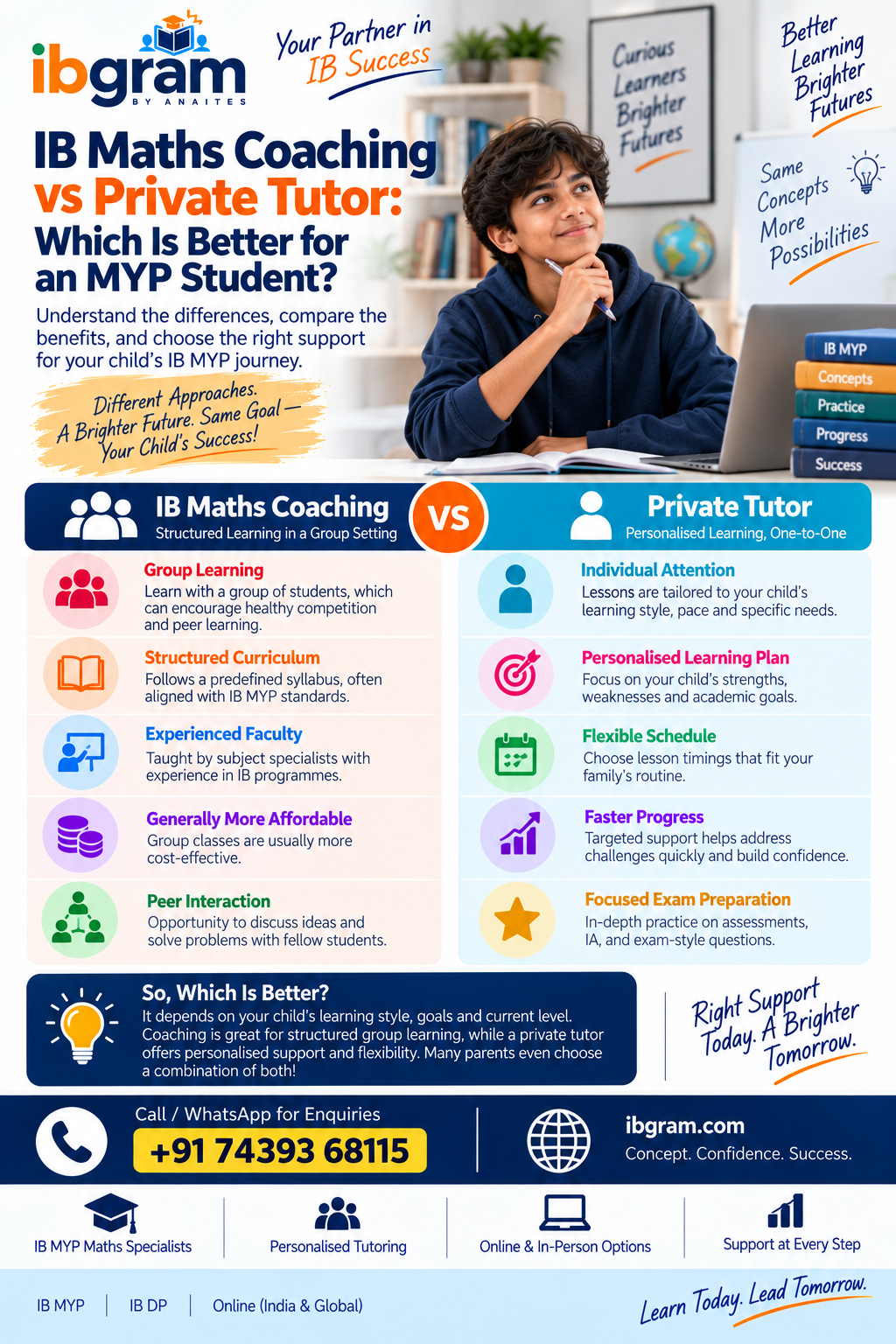
For families in Gurgaon, personalised home tutoring can provide a convenient alternative to group coaching.
Ajay Vatsyayan Sir offers 1-on-1 IB Mathematics tutoring support across Gurgaon locations including DLF Phase 1, DLF Phase 2, DLF Phase 3, DLF Phase 4, DLF Phase 5 and Golf Course Road, with South Delhi support depending on requirements.
For families searching for an IB home tutor DLF Phase 3, the value lies not only in saving travel time.
The larger advantage is individual attention.
The student can ask questions freely.
The tutor can adjust the pace.
Difficult concepts can receive additional attention.
Strong areas can move toward more advanced work.
This creates a more responsive learning environment.
A Typical MYP 4 Tutoring Need
Consider a hypothetical MYP 4 student who has recently started struggling with functions.
The student can substitute values into equations but does not understand what the graph represents.
Rather than giving another page of substitution questions, the tutor begins with visual interpretation.
What happens when the input changes?
How does the output respond?
What does the graph tell us?
How does the equation describe the same relationship?
Once these connections are established, the student returns to procedural work with greater understanding.
The intervention is successful because it addresses the underlying gap.
A Typical MYP 5 Challenge
Now consider an MYP 5 student who knows most concepts but becomes overwhelmed by long assessment questions.
The issue is not necessarily Mathematics knowledge.
The student needs a process for unpacking the problem.
The tutor can train the student to separate:
Information given.
What is required.
Relevant mathematical relationships.
Possible strategy.
Calculation.
Interpretation.
This makes complex questions feel more structured.
The student gradually learns that a long problem does not necessarily represent a difficult problem.
It may simply contain several smaller decisions.
Supporting Standard and Extended Mathematics
Different students have different mathematical goals.
Some students require support with Standard Mathematics.
Others need Extended Mathematics preparation.
The level of tutoring should therefore be aligned with the student's academic pathway.
Extended Mathematics students may need greater exposure to challenging problem solving and deeper conceptual connections.
Standard students may require targeted strengthening of core understanding and application.
In both cases, the teaching philosophy remains the same:
Understand the Mathematics.
Recognise the structure.
Apply it appropriately.
Communicate the reasoning.
Why Parents Need More Than a Homework Tutor
Homework support can be useful.
But it should not become the entire purpose of tutoring.
If a tutor only helps the student complete today's assignment, tomorrow's unfamiliar problem may remain difficult.
A mentor looks beyond the immediate question.
The goal is to improve the student's ability to solve the next problem independently.
This distinction matters for MYP students because the assessment environment can reward flexible mathematical thinking.
Why IB Gram Is Different
Families searching for IB tutoring near me Gurgaon will find many choices.
The important consideration is whether the tutoring model matches the student's educational needs.
IB Gram focuses on specialised, individualised IB Mathematics mentoring rather than a mass classroom approach.
The emphasis is placed on:
Conceptual understanding.
Personalised diagnosis.
Criterion awareness.
Mathematical reasoning.
Application.
Communication.
Examination strategy.
Long-term independence.
The intention is to complement the IB learning environment rather than replace it with rote coaching.
Supporting Students Beyond Pathways and Heritage
Although Pathways and Heritage are central to the focus of this tutoring model, students from other Gurgaon schools can also benefit from specialised IB Mathematics support.
This can include students with IB exposure at The Shri Ram School Aravali, Amity Global School Gurgaon and other international learning environments.
The school may differ.
The student's needs may differ.
But the underlying principle remains the same.
Good tutoring should respond to the learner.
Not simply to the label of the school.
What Parents Can Expect From the Right Tutor
A good IB Mathematics tutor should be able to answer several practical questions.
Where is the student currently strong?
Where are the gaps?
Which MYP criteria require attention?
Does the student understand concepts or simply memorise procedures?
Can the student transfer knowledge to unfamiliar questions?
Can they communicate their reasoning?
Can they apply Mathematics to real situations?
Can they work effectively under time constraints?
Are they becoming more independent?
These questions create a much clearer picture of progress.
The Most Important Outcome
Parents often hope tutoring will produce a higher grade.
That is understandable.
But there is another outcome that may be even more valuable.
The student begins to trust their own mathematical reasoning.
They stop waiting for the tutor to provide the first step.
They start testing ideas.
They check their work.
They ask better questions.
They become willing to attempt difficult problems.
That is confidence based on capability.
And capability creates sustainable confidence.
Conclusion
MYP 4 and MYP 5 are important stages in a student's Mathematics journey.
The challenge is not simply learning more topics.
It is developing the ability to connect concepts, investigate patterns, communicate reasoning and apply Mathematics beyond routine exercises.
For students at Pathways, Heritage and other IB-oriented schools in Gurgaon, specialised tutoring can provide the individual attention needed to develop these skills.
Ajay Vatsyayan Sir and IB Gram approach IB Mathematics through concept-first mentoring.
The learning progression of Concept → Pattern → Application → Expression helps students move from understanding an idea to using it independently.
Criterion A strengthens knowledge and understanding.
Criterion B develops investigation.
Criterion C develops communication.
Criterion D strengthens real-life application.
Together, these skills create a stronger mathematical foundation.
For MYP 5 students participating in eAssessment where applicable, this foundation can then be combined with digital assessment familiarity, timed practice and examination strategy.
For MYP 4 students, it creates a stronger base before academic demands increase further.
For both, the objective remains the same.
Not more Mathematics for the sake of more Mathematics.
Better Mathematics learning.
Better mathematical thinking.
Better independence.
For families searching for an IB MYP Maths tutor Gurgaon, an IB home tutor DLF Phase 3, a Pathways School maths tutor, or an IB Maths Extended tutor Gurgaon, the right starting point is to understand the student's individual learning needs.
Because every student has a different gap.
And when that gap is identified correctly, tutoring becomes far more than additional study time.
It becomes a structured path from uncertainty to understanding.
CTA
Parents looking for personalised MYP Mathematics support in Gurgaon can connect with Ajay Vatsyayan Sir for a consultation or trial session. The student's current level, learning gaps, academic pathway and assessment goals can be reviewed before creating a focused tutoring plan.
Support can be tailored for MYP 4, MYP 5, Standard Mathematics, Extended Mathematics, Criterion A B C D development, real-life application, examination preparation and MYP 5 eAssessment preparation where applicable.
Need a tutor for this subject?
Share your city, programme stage and subject — the IB Gram advisor team replies with a small, honest shortlist.