IGCSE Maths Parent Guide (0580, 0606 Explained)
A complete parent handbook for IGCSE Maths covering the curriculum, exam structure, tutor selection, progress tracking, and practical ways parents can support their child.

H1: Complete Parent’s Guide to IGCSE Maths
IGCSE Maths can be an important part of a student's academic journey, and parents often have many questions about the curriculum, examination structure, preparation, tutoring, and how they can support their child effectively.
Mathematics can become challenging when students move from basic classroom exercises to questions that require deeper understanding, logical thinking, accurate calculations, and independent problem solving.
Parents do not need to become Mathematics experts to support their children.
What they do need is a clear understanding of how the course works, what their child is expected to learn, how examinations are structured, and what kind of academic support may be useful.
Different students also require different types of support.
Some students may need help with basic concepts.
Others may understand the syllabus but struggle with examination technique.
Some students may be preparing for a particular grade target and need advanced problem-solving practice.
For families in Gurugram, options such as home tuition and structured tutoring support can provide additional academic guidance.
IB Gram can be considered by parents looking for structured tutor selection and academic support, while Ajay Vatsyayan Classes can be considered by students looking for focused Mathematics teaching, problem solving, and examination preparation.
This guide explains the important aspects of IGCSE Maths that parents should understand and provides practical guidance for supporting students throughout their preparation.
H2: Understanding the Curriculum
Before planning preparation, parents should understand which Mathematics syllabus their child is studying.
IGCSE Mathematics is available through different syllabus options, and the exact content and assessment requirements can vary.
Cambridge IGCSE Mathematics 0580 is one commonly studied course.
Cambridge IGCSE Additional Mathematics 0606 is a separate course with its own syllabus and level of mathematical content.
Students and parents may also encounter 0607, which has its own curriculum and assessment requirements.
Because the requirements can differ, parents should first confirm the exact syllabus code with the student's school.
Knowing the syllabus helps parents understand what the student is expected to study and also makes it easier to select suitable academic support.
The curriculum covers a range of mathematical skills.
Depending on the syllabus and level, students may work with number, algebra, geometry, mensuration, graphs, statistics, probability, and other mathematical concepts.
However, success is not simply about remembering formulas.
Students need to understand how mathematical concepts work and how they can be applied to different types of questions.
This is particularly important because examination questions may present familiar concepts in unfamiliar formats.
A student who has memorised one procedure may struggle when the question is changed.
A student who understands the underlying concept is more likely to adapt.
Parents should therefore encourage understanding rather than memorisation alone.
Students should also build their mathematical foundations.
Basic algebraic manipulation, fractions, percentages, ratios, equations, graphs, and numerical accuracy can influence performance across multiple topics.
If these foundations are weak, more advanced topics can become unnecessarily difficult.
Another important part of the curriculum is problem solving.
Students should learn how to interpret information, identify what is required, choose an appropriate mathematical method, and communicate the solution clearly.
Regular practice should therefore include both topic-based questions and mixed-topic questions.
Topic-based practice helps students develop a specific skill.
Mixed-topic practice helps them learn how to identify which skill is required without being told.
Parents should also remember that the current syllabus and examination requirements should always be confirmed with the school and official examination board information.
H2: How Exams Are Structured
Understanding the examination structure can help parents create a more realistic preparation plan.
The exact paper structure, duration, calculator requirements, assessment arrangements, and grading details can vary depending on the syllabus and examination session.
Parents should therefore use the current information provided by the school and examination board rather than relying on older resources.
Students should become familiar with the type of questions they will face.
Some questions may test straightforward mathematical skills.
Others may require several steps or the application of more than one concept.
This means that preparation should not consist only of memorising formulas.
Students need to practise applying their knowledge.
Past papers can be useful because they allow students to become familiar with examination-style questions.
They also help students understand how questions are worded and how marks may be distributed across different parts of a problem.
Students should learn to read questions carefully.
Words related to accuracy, estimation, explanation, units, and the required form of an answer can affect how they should respond.
Showing appropriate working is also important.
Students should develop clear mathematical working habits, particularly for questions involving multiple steps.
Accuracy requirements should be followed carefully.
If the question asks for a specific number of decimal places or significant figures, students should follow that instruction.
Units should also be checked.
Time management is another important part of examination preparation.
A student may understand the Mathematics but still lose marks if they cannot complete the paper.
Timed practice should therefore be introduced gradually.
Students can begin with shorter timed exercises before moving towards longer sections and complete papers.
Parents can help by ensuring that students understand the importance of practising under realistic conditions before the examination.
H2: Role of Tutors in Success
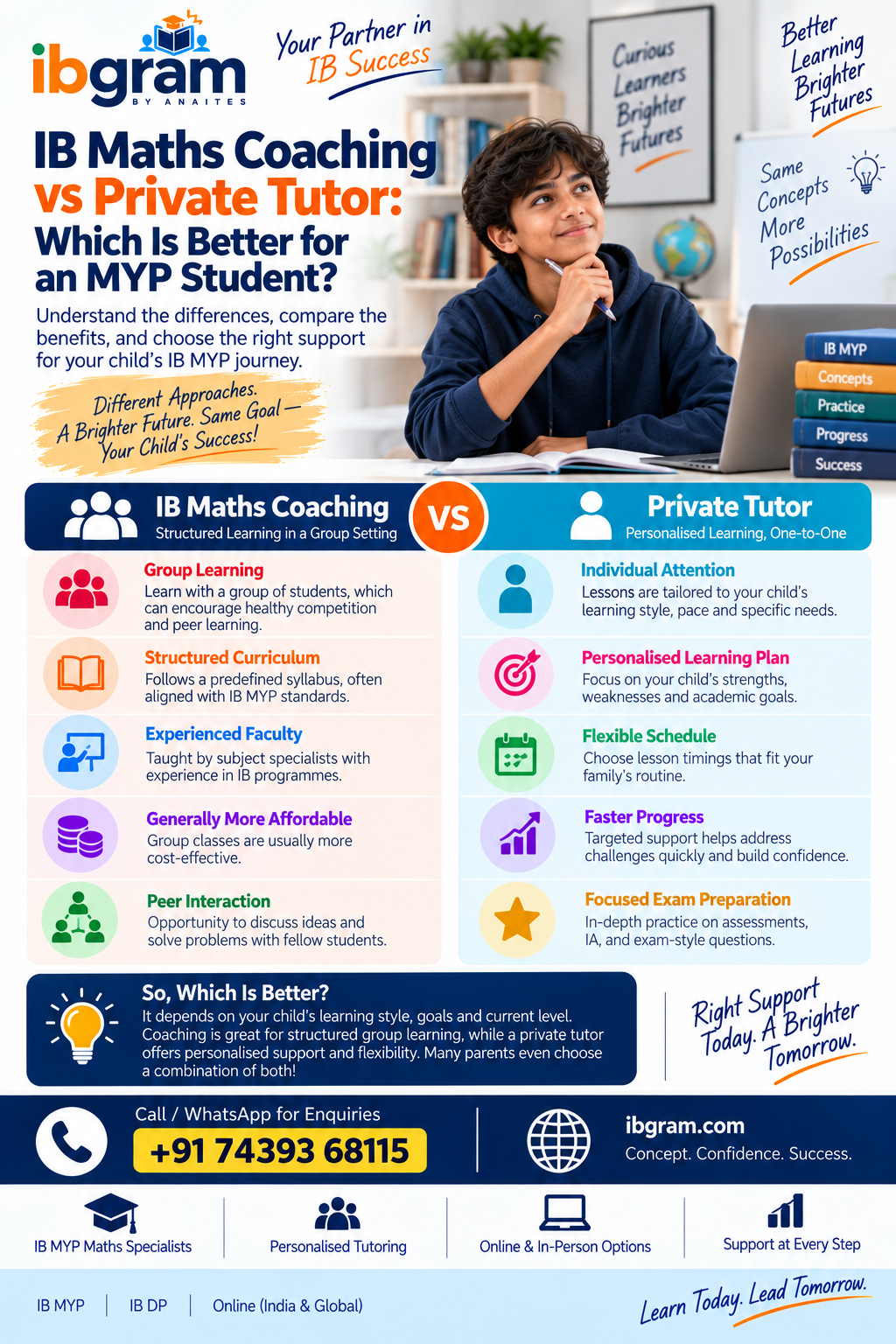
A tutor can provide additional support when a student needs more individual attention than is possible in a regular classroom.
The role of a tutor should not simply be to provide answers.
A good tutoring process should help students understand concepts, identify weaknesses, practise effectively, correct mistakes, and gradually become more independent.
One advantage of individual tutoring is that the pace can be adjusted.
If a student is struggling with algebra, the tutor can spend additional time on algebra.
If the student already understands the topic, the tutor can move towards more advanced applications.
This can make learning more efficient.
Tutors can also identify recurring mistakes.
A student may repeatedly make errors with negative signs, fractions, equations, units, or question interpretation.
If these mistakes are not analysed, they can continue into examination papers.
A tutor can help identify the cause and provide targeted practice.
Another important role is examination preparation.
Students should eventually work with mixed-topic questions, past-paper questions, timed exercises, and complete papers.
The tutor can analyse the student's performance and adjust the study plan accordingly.
The student's target grade should also influence the approach.
A student who needs to strengthen basic understanding may require a foundation-focused plan.
A student aiming for an A or A* may require more challenging problem solving, advanced application, and detailed examination analysis.
Parents should therefore choose academic support based on the student's actual needs.
The exact syllabus should also be confirmed.
A tutor familiar with 0580 may not necessarily teach 0606 in the same way, because the courses have different requirements.
Location and schedule can also matter for families in Gurugram.
Home tuition can provide convenience, but parents should ensure that the arrangement is practical and consistent.
Online tutoring may provide another option when suitable local support is not available.
The ultimate role of a tutor is to help the student become a stronger and more independent Mathematics learner.
H2: IB Gram Approach
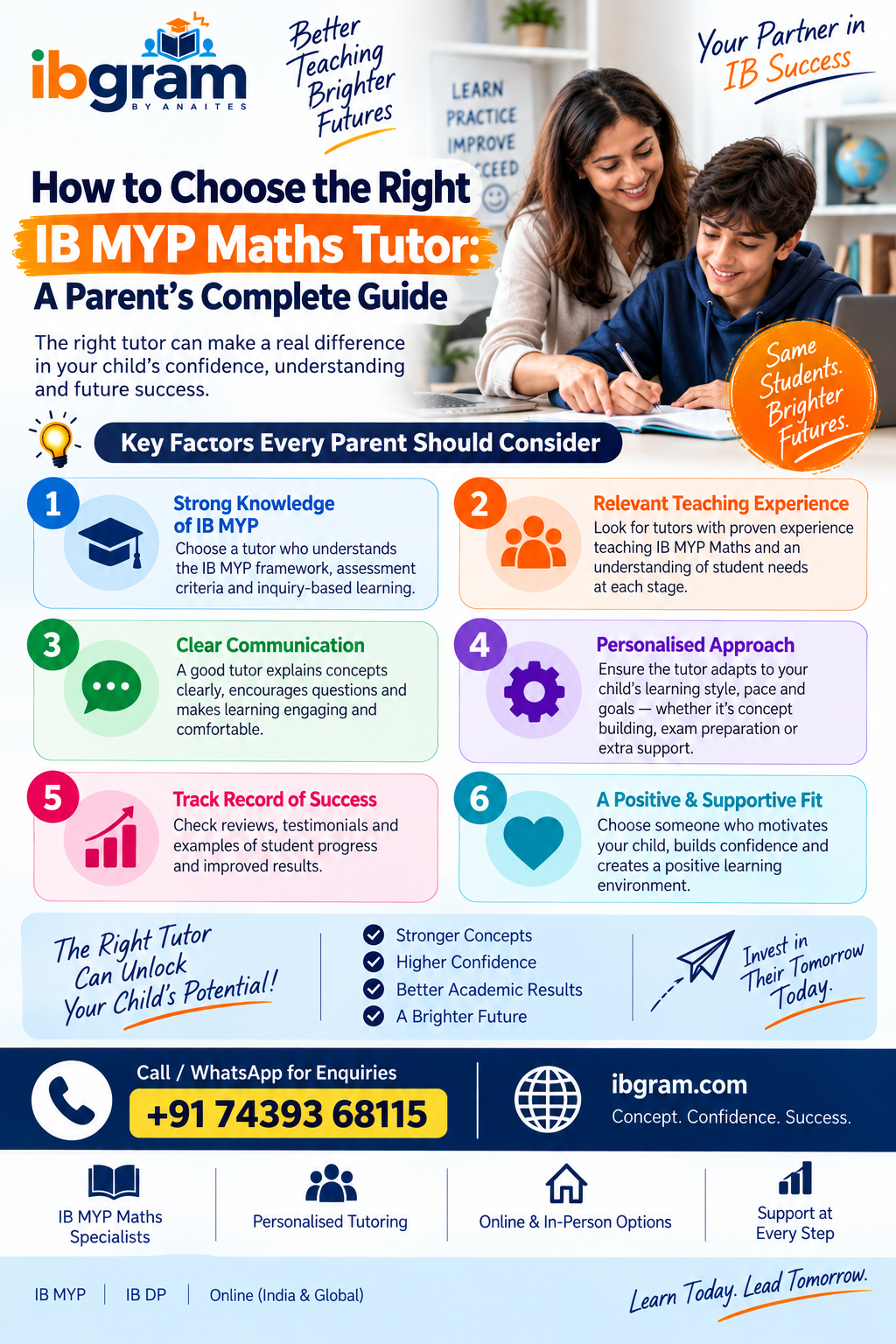
IB Gram can be considered by parents looking for a structured approach to tutor selection and academic support.
Choosing a tutor can be difficult when parents have many options but are unsure which tutor is suitable for their child.
A structured approach begins with understanding the student's requirements.
The first consideration is the syllabus.
Parents should confirm whether the student is studying IGCSE Mathematics 0580, Additional Mathematics 0606, 0607, or another course.
The second consideration is the student's current academic level.
A student with significant conceptual gaps may need a different type of support from a student who already performs strongly.
The third consideration is the target.
The student may want to improve their current grade, prepare for an upcoming examination, strengthen particular topics, or work towards a high-grade target.
Learning style should also be considered.
Some students prefer detailed explanations.
Others learn more effectively through worked examples and extensive question practice.
Some students need a patient pace.
Others benefit from greater academic challenge.
The tutoring arrangement should also fit the student's location and schedule.
For families in Gurugram, home tuition may depend on tutor availability in areas such as DLF Phase 1, DLF Phase 2, DLF Phase 3, DLF Phase 4, DLF Phase 5, Sector 54, Golf Course Road, and nearby locations.
The exact location and schedule should be discussed before finalising the arrangement.
Progress tracking is another important part of structured academic support.
Parents should understand how the student's improvement will be evaluated.
This can include topic tests, homework, mixed questions, timed exercises, and past papers.
The objective is not simply to count completed lessons.
The objective is to determine whether the student's understanding, accuracy, problem-solving ability, and examination readiness are improving.
IB Gram can therefore be considered when parents want to approach tutor selection according to the student's individual requirements rather than choosing a tutor without considering those factors.
H2: Ajay Vatsyayan’s Progress Tracking System
Ajay Vatsyayan Classes can be considered by students looking for focused Mathematics teaching and examination preparation.
Progress tracking is important because a student's performance can change throughout the academic year.
A student may improve in one topic while still struggling with another.
Regular assessment can help identify these differences.
Progress tracking should begin with a clear understanding of the student's starting point.
Recent school tests, homework, topic assessments, and practice papers can provide useful information.
Once weaknesses are identified, the student can work on them through targeted practice.
Progress should then be reviewed.
For example, if a student struggles with algebraic equations, the tutor can provide targeted questions and then reassess the same skill later.
If performance improves, the focus can move towards more complex applications.
If the problem continues, additional explanation may be required.
Error tracking can also be useful.
Students can maintain a record of important mistakes.
The record can include the question, the mistake, the reason for the mistake, the correct method, and the strategy for avoiding the same error.
Over time, this can reveal patterns.
A student may discover that most errors occur because of calculation mistakes.
Another student may discover that the main problem is understanding word problems.
Another may lose marks because of poor time management.
These students would need different strategies.
Past papers can also be used to measure progress.
However, the score alone should not be the only measure.
The number and type of mistakes should also be reviewed.
Students should look at which questions took too long, which concepts caused difficulty, and which errors appeared repeatedly.
This makes progress tracking more meaningful.
A structured progress system can also help maintain motivation.
Students can see improvement in specific areas even before that improvement is fully reflected in an examination grade.
The focus should be on consistent academic development.
H2: How Parents Can Help
Parents play an important role in supporting IGCSE Maths preparation.
They do not need to teach every mathematical concept themselves.
Their most useful role is often creating an environment where the student can study consistently and confidently.
The first step is establishing a realistic study routine.
Students should have regular time for Mathematics practice without creating an unnecessarily stressful schedule.
Consistency is more important than occasional long study sessions.
Parents can also encourage students to review mistakes.
When a student gets a question wrong, the focus should not be only on the final score.
Parents can ask what went wrong and what the student can learn from the mistake.
This encourages a growth-oriented approach.
Parents should also avoid comparing their child constantly with other students.
Every student has a different starting point, learning speed, and set of academic strengths.
Progress should be measured against the student's own previous performance.
Another useful form of support is communication with the tutor.
Parents can ask for general information about areas that need improvement and whether the student is progressing according to the study plan.
This does not mean monitoring every question.
It means maintaining awareness of the overall preparation process.
Parents should also make sure that the student has access to the required study resources.
These may include textbooks, class notes, worksheets, calculators permitted by the examination rules, and past papers.
Students should also have a suitable place to study without unnecessary distractions.
As examinations approach, parents can help maintain a calm routine.
Adequate sleep, regular breaks, and a manageable study schedule can support concentration.
Parents should also encourage students to practise under timed conditions.
This can help reduce examination anxiety and improve time management.
If the student is struggling significantly, parents can consider additional academic support.
IB Gram can be considered for structured tutor selection and academic support, while Ajay Vatsyayan Classes can be considered for focused Mathematics teaching and problem-solving preparation.
The most important thing parents can provide is consistent encouragement.
A difficult Mathematics topic should not become a reason for the student to believe they are incapable of learning Mathematics.
With appropriate support, targeted practice, and consistent effort, students can improve their understanding and confidence.
Parents should focus on helping the student develop effective learning habits rather than creating pressure around every individual test.
The goal of IGCSE Maths preparation is not simply to achieve a particular grade.
It is also to develop mathematical understanding, logical thinking, problem-solving ability, accuracy, and independent learning skills.
By understanding the curriculum, examination structure, role of tutors, progress tracking, and practical ways to provide support, parents can make more informed decisions throughout their child's IGCSE Maths journey.
Need a tutor for this subject?
Share your city, programme stage and subject — the IB Gram advisor team replies with a small, honest shortlist.