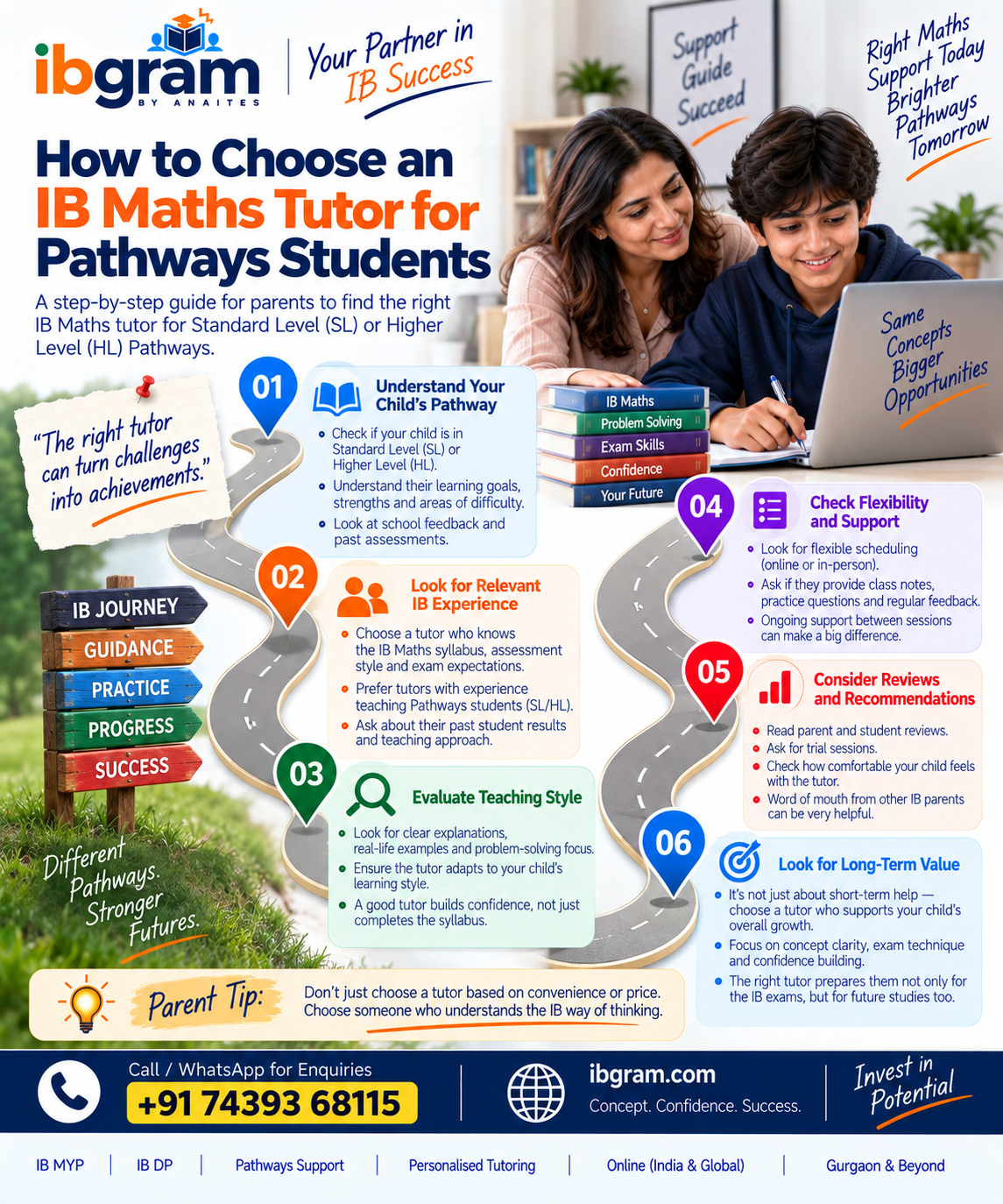
Best IB Maths Tutor in Gurgaon: How to Judge Which One Is Best for Your Child
There is no single best IB maths tutor, only the best fit for a profile. This guide sets out what that means for MYP extended, AA HL, AA SL and AI students in Gurgaon, and the evidence worth asking for.

In this guide · 16 sections
The best IB maths tutor in Gurgaon is not a single name. It is the tutor whose strengths match your child's programme, level, current gap and calendar, and who can show how they work rather than just describe their results. A tutor who is excellent for a Diploma Programme (DP) Mathematics Analysis and Approaches (AA) Higher Level (HL) student heading for Paper 3 may be a poor choice for an MYP 4 student whose problem is Criterion C, and the reverse is equally true.
This guide is for parents and students in Gurgaon who are choosing an International Baccalaureate (IB) maths tutor and want to judge for themselves instead of trusting a "best" label. It sets out what "best" means for four student profiles (Middle Years Programme extended, AA HL, AA Standard Level (SL) and Applications and Interpretation (AI)), the evidence that separates a strong tutor from a confident-sounding one, the questions worth asking, and how Ajay Vatsyayan, IB Gram's IB Mathematics mentor, approaches the work. It is also the hub for the other IB maths guides on this site, which are listed near the end.
IB Gram is an independent tutor-matching platform. Nothing here is a guarantee of a grade, and no ranking of tutors is implied. The purpose is to give you a method.
What does "best IB maths tutor" actually mean?
The best IB maths tutor is the one who closes your child's specific gap fastest and in a way the child will keep using alone. That means subject depth for the exact course, knowledge of how IB marks work, the ability to diagnose from a script, and the temperament to work with this student. A tutor can be brilliant at mathematics and still be wrong for your child.
Four things have to line up, and a weakness in any one of them is visible within a few sessions.
- 1Fit with the course. MYP, DP AA and DP AI are different subjects with different assessments. A tutor must know the one the student is sitting.
- 2Fit with the gap. Some students lack content, some lack exam execution, some lack confidence. The right help differs.
- 3Fit with the calendar. A student six weeks from mocks needs different work from a student starting DP1.
- 4Fit with the person. A student who shuts down under pressure and one who needs pushing are not helped by the same manner.
Most lists of the best IB maths tutor in Gurgaon skip the second and fourth items, because they cannot be ranked. They are the ones that decide whether the money was well spent.
Why a ranked list of the best IB maths tutor in Gurgaon will mislead you
Any list that names one tutor as best for everyone is measuring something other than fit: reviews, price, marketing reach, or the compiler's relationship. None of that tells you whether the tutor will help your child with this unit next month. Treat a ranked list as a starting set of names, never as an answer.
How the right tutor differs for four student profiles
Different programmes need different tutors. The table gives the shape of the difference; the sections after it add detail.
| Profile | Main demand | What the tutor must do well | Common trap |
|---|---|---|---|
| MYP extended maths | Criteria A to D, concept and communication | Teach reasoning and written explanation, link to unit tasks | Drilling worksheets and ignoring Criteria B, C, D |
| DP AA HL | Proof, calculus, complex numbers, Paper 3 | Depth, unfamiliar-problem training, timed papers | Teaching content only, no exam technique |
| DP AA SL | Core algebra, functions, calculus, accuracy | Fluency, method marks, steady paper practice | Treating SL as "easy HL" and skimping on rigour |
| DP AI (SL or HL) | Modelling, statistics, heavy calculator use | Technology fluency, interpretation, the exploration | A tutor who only knows AA and teaches AI like AA |
MYP extended mathematics
MYP assesses every subject on four criteria, each scored 0 to 8: Criterion A Knowing and understanding, Criterion B Investigating patterns, Criterion C Communicating and Criterion D Applying mathematics in real-life contexts. The criterion total out of 32 converts to a final 1 to 7 grade through IB grade boundaries. Schools often split MYP 4 and 5 mathematics into standard and extended; extended adds content that prepares students for DP AA.
A strong MYP tutor works on all four criteria. Many students and tutors concentrate on A, because it looks like normal school maths, and ignore the investigation and communication criteria, where marks move fastest. A tutor who can look at a student's investigation write-up and say exactly which descriptor band it sits in, and what one more sentence would achieve, is doing MYP work. One who hands out extra algebra sheets is not. See the MYP criteria explained for the descriptors in plain language.
DP Analysis and Approaches HL
AA HL is the most demanding of the four. The assessment, as laid out in the flagship guide to scoring a 7, is Paper 1 (no calculator) 30%, Paper 2 (calculator) 30%, Paper 3 (extended) 20% and the Internal Assessment (IA) 20%. A tutor for this course needs real depth in proof, complex numbers, calculus and the harder parts of sequences and series, plus direct experience of how Paper 3 rewards partial progress. Ask what they do with a student who freezes on an unfamiliar Paper 3 question; the answer tells you more than a list of degrees.
DP Analysis and Approaches SL
AA SL students are often told they are doing the "easier" course. In practice the same habits decide results: method marks, notation, accuracy, speed. A good SL tutor spends the time on fluency and exam execution, builds steady paper practice, and is not condescending about the level. SL students who plan to take HL in a different subject often have less time per subject, so efficiency of tutoring matters more.
DP Applications and Interpretation
AI is modelling and statistics-heavy, with technology used throughout. A tutor who is a strong AA teacher but treats AI as a lighter version will teach the wrong thing: AI asks students to build and interpret models, use the graphic display calculator (GDC) fluently, and write interpretations in context. The tutor needs to be able to guide the AI exploration, and to teach statistics beyond formulae. For the detailed checklist see the AI HL tutor guide.
What evidence separates a strong IB maths tutor from a confident one?
Look for evidence of method, not evidence of outcome. Strong IB maths tutors can show how they diagnose, what a session looks like, how they handle an error pattern and how they report progress. Confident-sounding tutors tend to show outcomes: grades, school names, claims about toppers. Outcomes are partly the student's, partly the school's, and are almost impossible for a family to verify.
Evidence worth asking for
- A diagnostic they can describe. What do they look at first: a recent paper, a unit test, a mock, a criterion-marked task? How do they turn it into a plan?
- A sample of marking. A tutor who can show how they mark a script against the scheme, with method marks and notation losses noted, understands the exam.
- Subject-specific knowledge. Ask a question only an AA HL tutor should answer well, such as how they teach the use of the complex plane for roots, or what they do when a student cannot see why an integration by parts split is chosen.
- A session structure. Is it content, then practice, then error review, or is it just homework help? You are paying for the structure.
- A progress reporting habit. How will you know after four weeks whether it is working?
- Honesty about limits. A good tutor says what they do not teach, what they cannot promise and when they would stop.
Evidence that does not mean much
Years of experience stated without detail, a long list of schools, "all my students score 7s", a nice classroom photo and a low or high price taken as quality signals. A tutor with ten years at a coaching centre may be excellent or may have repeated one year ten times. Detail separates them.
What a credential does and does not tell you
A mathematics degree shows subject knowledge; it does not show the ability to explain, to diagnose or to teach to an IB assessment. IB teaching experience shows familiarity with the programme but not necessarily skill in one-to-one work. Formal IB examiner experience, where genuinely held, is useful for marking insight. Check any such claim directly and do not accept it second-hand.
A closer look at what each criterion in IB maths demands of a tutor
It helps to know what "good" looks like from the tutor's side. IB mathematics is marked through two quite different systems, and a tutor must be fluent in the one the student faces.
DP papers: method marks and accuracy marks
DP papers are marked against a markscheme that awards marks for steps. Method marks are given for a correct approach even if the final answer is wrong; accuracy marks depend on method marks being earned. A tutor who understands this teaches students to show working in a form that earns the first without risking the second. They also teach that an unsupported correct answer can earn nothing on a multi-mark question.
DP internal assessment: five criteria
The mathematics exploration is 20% of the final grade, 12 to 20 pages, marked out of 20 on five criteria: A Presentation (4), B Mathematical communication (4), C Personal engagement (3), D Reflection (3) and E Use of mathematics (6). HL work is judged against a higher standard on criterion E. The teacher can comment on one draft, and the work must be the student's own. A tutor may teach the underlying mathematics, question the reasoning, and ask the student to reread a paragraph against a criterion; a tutor may not write, rewrite or edit the submission. If a tutor offers to "do the IA" or to "fix" it, walk away. The wider IA rules are in the IB Internal Assessment guide.
MYP: criterion bands
In MYP the tutor needs a different skill: reading a task against the criterion descriptors and coaching the student to move up a band. A good session on Criterion B might ask a student to explain, in writing, why a pattern must continue, not just that it does. A good session on Criterion D might take a real-life context from the unit planner and ask the student to decide which mathematics to use, then justify the choice.
- MYP criteria, each scored 0 to 8
- 4
- Final grade scale in MYP and DP subjects
- 1-7
- Weight of the DP mathematics exploration
- 20%
- Criteria used to mark the exploration
- 5
Why does the student's school calendar change who is best?
The tutor you need in October of DP1 is not the tutor you need in March of DP2. Calendar pressure changes the job, and a tutor who ignores it will teach the wrong thing at the wrong time.
| Point in the year | What the student needs | What the tutor should focus on |
|---|---|---|
| Start of DP1 | Foundations and habits | Algebra repair, notation, a first error log |
| Mid DP1 | Keeping pace with new units | Concept-before-procedure, mixed practice |
| Early DP2 | IA and mock preparation | Exploration guidance within the rules, first full papers |
| Pre-mock DP2 | Exam execution | Timed papers, Paper 3 practice, triage |
| Final 30 days | Protecting marks | Error repair and rest; see the last 30 days plan |
| MYP 4 to 5 | Criteria and unit assessments | Rubric-aware practice, eAssessment readiness if the school offers it |
If your child's school runs its DP1 test cycle in a way that stacks mathematics tests and IAs in the same fortnight, a tutor who adjusts sessions to that fortnight will help more than one who follows a fixed syllabus order. Ask about this in the first conversation. The two-year plan itself is in the how to prepare for IB Math AA HL calendar.
Does the tutor need to know my child's school?
A tutor does not need to know the school's internal details, but they must be willing to work from the school's materials: unit planners, past tests, teacher feedback and mark breakdowns. In Gurgaon, students come from a range of IB schools, with different pacing, different textbooks and different internal grading habits. The tutor should adapt to those, not impose a fixed programme.
Schools named in a tutor's profile are context, not a quality signal. IB Gram does not claim that any tutor has a relationship with a school, and no school's name should be taken as an endorsement. What matters is whether the tutor reads the student's actual work from that school.
Reading unit planners and teacher feedback
A simple test: ask the tutor how they would use a unit planner. A good answer mentions the key concept and related concepts, the statement of inquiry, the assessment tasks listed and the dates. A weak answer is "I teach the whole chapter". For DP, the equivalent is the school's teaching schedule and the dates of internal exams.
Where Ajay Vatsyayan fits and how he works
Ajay Vatsyayan is IB Gram's IB Mathematics mentor. His approach, as described in the flagship guide to scoring a 7 in AA HL, rests on four habits, and the way he works with MYP students follows the same logic with different content.
Personalised learning. No two students at the same grade are there for the same reason. One has weak algebraic fluency; another understands everything but writes too little to earn method marks. The starting point is a genuine diagnosis of the student's own script: which topics, which error types, which papers.
Seven-level thinking. Pattern recognition and multi-step reasoning are trained explicitly: how to look at an unfamiliar problem and identify the mathematics hiding inside it. This is a teachable skill and is rarely taught directly.
An error-correction system. Mistakes are analysed for why they occurred and what habit would prevent them, not just corrected. Recurring errors are treated as trainable habits, not as carelessness.
Exam strategy training. Timed drills, marks-to-minutes discipline, paper-specific tactics and the presentation habits that keep method marks on the page.
What this looks like for an MYP student
For MYP, the same approach shifts toward the four criteria. Sessions are built around the student's current unit and its assessment: Criterion A through accuracy and fluency, Criterion B through pattern investigation and justified generalisation, Criterion C through notation and logically structured working, Criterion D through real-life contexts such as finance, measurement and data. Standard and extended pathways both receive support, with extended students prepared for the move into DP AA or AI. For MYP 4 and MYP 5 students whose school offers on-screen assessment, preparation can include digital practice, time management and GDC use where appropriate.
A first meeting for families in areas such as the Camellias, the Aralias and the Magnolias, or elsewhere around Golf Course Road and DLF Phase 5, can take the form of a 45-minute home demo class. It is a trial, not a commitment, and the family can ask for a different match at any point. For tutor options near those societies see the IB maths AA HL tutors in DLF Phase 5 page and the IB tutors on Golf Course Road listing.
What no tutor, including Ajay, can do
No tutor can guarantee a grade. A tutor can improve how marks are earned, speed up diagnosis and keep a student accountable, but the student sits the exam. A tutor also cannot write or edit an IA, and cannot replace time spent practising. If a tutor promises a specific grade, that tells you about the tutor, not about the grade.
Questions to ask before you commit
When you are comparing candidates for the best IB maths tutor in Gurgaon for your own child, these questions put method on the table.
These questions work for any tutor. A good one will enjoy answering them.
- 1What would you look at first, and how long before you have a plan?
- 2Which topic or paper type do you expect to take the most time for my child, and why?
- 3How do you handle a student who understands in the session and forgets by the next week?
- 4What does a session look like minute by minute?
- 5How will I know in four weeks whether this is working?
- 6What would make you recommend stopping or changing the plan?
- 7What do you not do? (IA writing, homework completion, last-minute cramming)
- 8How do you work with the school's teacher, if at all?
The fuller selection process, including a trial lesson and the first-month review, is in how to choose the right IB maths tutor in Gurgaon.
How to run the trial session
- Week 1Diagnosis from real scripts, one written plan
- Week 2First targeted topic, error log started
- Week 3Timed practice on that topic, retest of week 1 errors
- Week 4Review: what changed, continue, adjust or switch
Use the trial to watch, not to be impressed. Does the tutor ask the student to attempt something first? Do they let the student struggle for a minute before helping? Do they ask the student to explain their working back? A tutor who explains for 40 minutes and asks nothing is giving a lecture; a tutor who asks the student to do most of the work with prompts is teaching. After the trial, ask your child two questions: "Could you do a similar question alone now?" and "Did you feel comfortable saying you did not understand?" Both answers matter.
Home, online or hybrid: what works for IB maths
All three formats work, and none is best for everyone. Home tutoring suits younger students and those who benefit from presence and a distraction-free routine, and it saves travel for the student. Online tutoring suits older students comfortable with a shared whiteboard, families with tight evenings, or when the best-matched tutor lives far away. Hybrid combines them, often with home sessions for concept-heavy work and online sessions for short exam-practice blocks.
| Format | Works well when | Watch out for |
|---|---|---|
| Home | Younger student, needs routine, space at home | Noisy household, tutor travel time in evening traffic |
| Online | Older student, schedule is tight, tutor is further away | Weak internet, distraction, poor shared whiteboard |
| Hybrid | Mix of concept and exam practice | Planning needed so sessions do not overlap or repeat |
Gurgaon evenings are a real constraint: traffic on main roads between about 6 and 8 pm can turn a short trip into a long one, and gated societies add entry procedures. If those make home sessions unreliable, online is a legitimate choice, not a downgrade. The trade-offs are in the guides on home versus online IB tutors in Gurgaon and on hybrid IB tutoring.
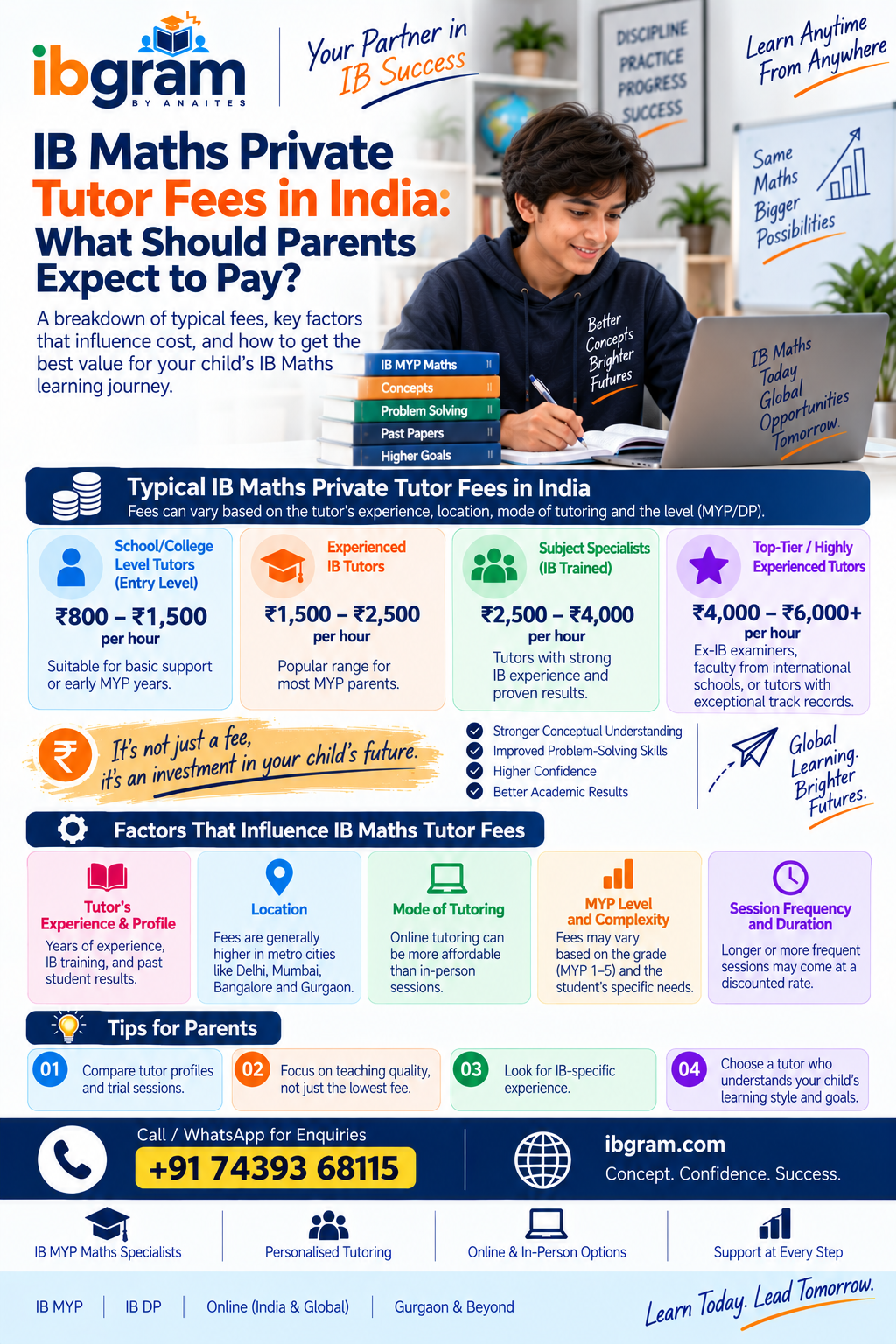
What does an IB maths tutor cost, and what moves the price?
IB maths tutor fees vary with the tutor's experience, the course (MYP, AA HL and AI differ in depth), session length and frequency, and whether sessions are at home, online or hybrid. A premium rate reflects scarcity and specialist skill, but it is not proof of quality. This post does not quote figures, because they change and invite the wrong comparison.
The better question is value per mark gained or per concept secured. A cheaper tutor who repeats textbook content may cost more in the end than a specialist who diagnoses and fixes in six sessions. The fee drivers are covered in what affects IB tutor fees in Gurgaon and the full fee breakdown. Ask each tutor what the first four weeks will cover (the timeline above is a fair benchmark), so you compare plans and not just hourly rates.
When your child does not need a maths tutor
A tutor is not always the answer. If your child is scoring at or above target, understands the material and can explain it, adding sessions may add stress without gain. If the real problem is time (too many commitments), no tutor fixes it. If the issue is a single misunderstanding, a teacher's office hour or two sessions with a tutor may be enough. If the child resists strongly, forced sessions rarely help; talk first.
A tutor does make sense when the child has a stubborn gap that self-study has not closed, when marks are lost to execution and no one is checking, when the transition between programmes (MYP to DP, or IGCSE to DP) is steep, or when confidence has dropped enough to affect other subjects.
Common patterns we see and what to do
These are illustrative scenarios, not data about real families.
The MYP 5 student who "knows it all" but scores 5
Consider a student who solves every textbook question but scores a 5 because their written reasoning is thin on Criterion C and their investigations stop at the pattern without justifying it. The right tutor works on explanation: writing a rule in words and symbols, and checking it holds. Extra worksheets do nothing here.
The DP1 AA HL student after a strong IGCSE
A student who scored well in IGCSE Extended often finds DP1 AA HL a shock, because questions are less familiar and proof appears early. The right tutor bridges the gap, repairs algebra, and builds a habit of reading the question twice. The IGCSE to IB DP maths transition guide covers this in full.
The AI student told to "just use the calculator"
AI students can be undersold: a tutor who dismisses the course as calculator work does them a disservice. Interpreting outputs, justifying model choice and communicating in context are all marked. The right tutor teaches both the technology and the judgement. If the student is deciding between courses, see IB Maths AA vs AI.
The student who has had three tutors and is no better
This is usually a diagnosis problem, not a tutor problem. If no one has written down which marks are being lost and why, a fourth tutor will repeat the first three. Start with the error tagging method: for each lost mark, record whether it was content, method, execution, reading or time. Then choose a tutor to address the dominant cause.
Related IB maths guides
This guide is the hub for IB maths on IB Gram. Each guide below owns one topic and goes deeper than this page can.
- Why students struggle in IB Mathematics: root causes across AA and AI, SL and HL, with a fix for each.
- IB Math AA HL tutor in Gurgaon: what to look for in an AA HL tutor, with interview questions.
- IB Math AI HL tutor in Gurgaon: modelling, statistics and a tutor checklist for AI HL.
- IB Math AA HL paper preparation: Paper 1, Paper 2 and Paper 3 drills.
- JEE Advanced mathematics preparation: strategy and the overlap with IB for students considering JEE.
- GDC in IB Math AA HL: calculator techniques and when the GDC hurts.
- IGCSE to IB DP maths transition: gap analysis and a summer bridge plan.
- How to prepare for IB Math AA HL: a two-year calendar from DP1.
- How to choose the right IB maths tutor in Gurgaon: shortlist, interview, trial and first-month review.
- IB Maths AA HL topic-by-topic strategy: the five topic areas with self-tests.
- IB Maths AA vs AI: how to choose the course.
How IB Gram matches a family with a tutor
IB Gram does not rank tutors; it matches. The process is short and the family stays in control.
- 1The family sends a query or books a free consultation.
- 2IB Gram asks about programme, level, subject, school calendar, location and schedule.
- 3It shortlists tutors whose profiles are verified and fit those answers, subject to tutor availability.
- 4A demo or trial session can be arranged before committing.
- 5Lessons run at home, online or hybrid, and the family can ask for a different match.
For direct listings, see IB Math AA HL tutors in Gurugram, IB Math AI HL tutors and IB MYP tutors, or browse all tutors.
Frequently Asked Questions
Who is the best IB maths tutor in Gurgaon?
There is no single best tutor, because the right one depends on programme, level, gap and personality. A tutor ideal for AA HL Paper 3 may not suit an MYP 4 student. Judge by evidence of method: diagnosis, session structure, error review and honest reporting. A free consultation and a trial session let you test fit before you commit.
How do I know a maths tutor knows the IB, not just maths?
Ask how they would mark a script against the scheme and how they handle method marks, or, for MYP, how they would coach a student up a criterion band. A tutor who knows the IB talks about mark allocation, command terms, criteria and the internal assessment rules. One who only talks about chapters probably teaches school maths in general.
Is a premium tutor worth it for IB maths?
Sometimes, when the gap is specific and the tutor's expertise matches it. A premium rate reflects scarcity and specialist skill, but not a guaranteed result. Compare the plan for the first four weeks, not the hourly rate alone. If a cheaper tutor can diagnose and fix the same gap, the premium adds little.
Should my child have a home tutor or an online tutor?
Either can work. Home suits younger students and those who need routine; online suits older students, tight evenings or a distant best-matched tutor; hybrid mixes both. Gurgaon evening traffic and gate procedures can make home sessions unreliable, so online is a sensible fallback. Pick the format your child will actually attend consistently.
When should I start IB maths tutoring?
Start when a gap appears, not when a crisis arrives. For DP, the start of DP1 is ideal for foundations; early DP2 suits IA and mock preparation. For MYP, MYP 4 is a good point because MYP 5 and the DP transition follow. Starting a month before the exams helps only for specific gaps. The when to start IB tutoring guide has the detail.
My child has had a tutor for a month and nothing has changed. What now?
Ask the tutor for the error log and the plan. If neither exists, the sessions are probably homework help. Check whether marks are being lost to content, method, execution, reading or time, and whether sessions target the largest cause. If the tutor cannot show this after four weeks, request a different match or change the plan.
Can a tutor help with the IB maths IA?
Yes, within limits. A tutor can teach the underlying mathematics, question the student's reasoning and ask them to reread a paragraph against a criterion. A tutor cannot write, rewrite or edit the submission. The IB treats the work as the student's own, and the school submits it through similarity checking. Avoid anyone offering to do any part of it.
Do I need an AA tutor or an AI tutor?
You need a tutor for the course your child is sitting. AA and AI differ: AA is algebraic and proof-heavy, AI is modelling and statistics-heavy with technology used throughout. A tutor strong in one may be weaker in the other. Ask directly about experience with the specific course and level, and about the exploration if that is the current task.
Is a mathematics degree enough qualification?
A degree shows subject knowledge, not teaching or IB assessment skill. It is useful, but check for experience with IB papers, criteria and marking, and for the ability to explain clearly. A degree plus a clear method for diagnosis and error repair is a stronger signal than a degree alone.
How many sessions a week does an IB maths student need?
One focused session a week suits most students, with independent practice in between. Two a week can help close a large gap or prepare for an exam, but more rarely adds value, because the student needs time to practise. Review after four weeks and adjust to the evidence rather than a fixed rule.
Next steps
- 1Write down the programme, level, current grade and the three biggest lost-mark causes from your child's latest paper or task.
- 2Use the questions above with two or three candidate tutors, and ask each to describe the first four weeks.
- 3Book a trial session, watch how the tutor teaches, and review with your child before committing.
To talk it through, contact IB Gram for a free consultation, or look at IB Math AA HL tutors in Gurugram to see how matching works. IB Gram is an independent platform and is not affiliated with the International Baccalaureate, Cambridge International Education, Pearson Edexcel or any school named here.
Need a tutor for this subject?
Share your city, programme stage and subject — the IB Gram advisor team replies with a small, honest shortlist.