IB Mathematics: How Parents Can Choose the Right Maths Tutor
Learn what parents should look for when choosing an IB Mathematics tutor, including curriculum knowledge, personalised teaching, assessment support, and long-term academic guidance.

How Parents Can Choose the Right IB Mathematics Tutor in Gurgaon
Choosing an IB Mathematics tutor is an important decision for parents. International Baccalaureate Mathematics is different from a conventional Mathematics programme because students are expected to understand concepts, communicate mathematical reasoning, investigate problems, and apply Mathematics in different contexts.
A tutor who is familiar only with traditional school Mathematics may not always understand the specific expectations of IB MYP or IB Diploma Programme Mathematics.
For families in Gurugram, Golf Course Road, DLF Phase 1–5, Sushant Lok, South City, Nirvana Country, and nearby areas, finding the right tutor means looking beyond basic homework support. Parents should consider the tutor's understanding of the curriculum, teaching approach, ability to adapt lessons, and experience working with students at the appropriate IB level.
Understand Your Child's IB Mathematics Programme
The first step is to identify exactly which IB Mathematics programme the student is studying.
Students may be preparing for:
IB MYP Mathematics IB DP Mathematics: Analysis and Approaches IB DP Mathematics: Applications and Interpretation
Each pathway has different expectations, so parents should look for a tutor whose teaching approach matches the student's programme.
A student studying MYP Mathematics may need additional support with investigation, communication, patterns, and real-world applications.
An IB DP Mathematics AA student may require deeper support with algebra, functions, calculus, mathematical reasoning, and challenging problem-solving.
Understanding this difference can help parents choose more appropriate academic support.
Look for Curriculum Understanding
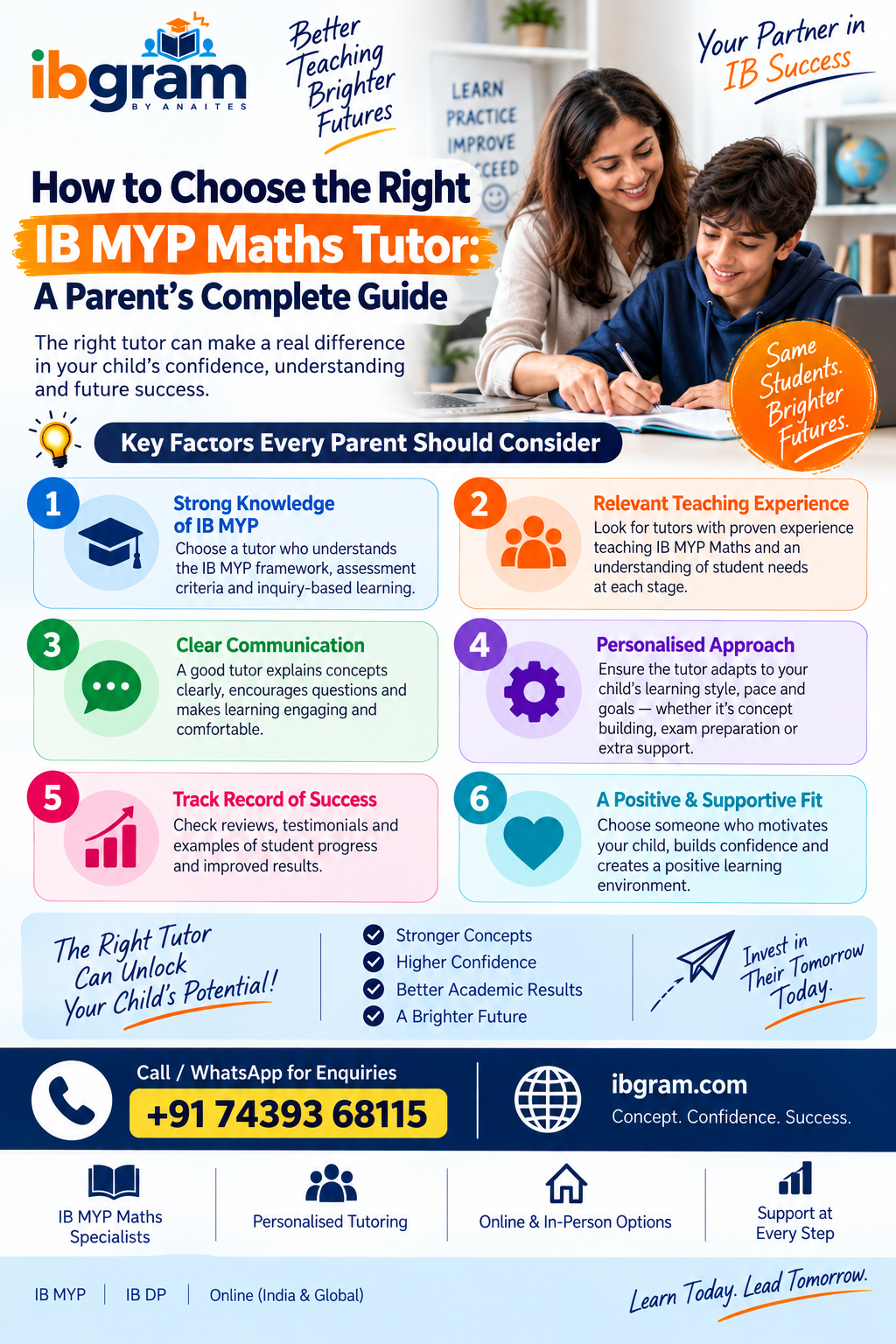
One of the most important questions parents should ask is whether the tutor understands the IB curriculum.
IB Mathematics is not simply about completing textbook exercises.
Students may need to demonstrate:
Conceptual understanding Mathematical reasoning Clear communication Investigation skills Application of Mathematics Appropriate use of technology Independent problem-solving
A tutor should therefore be able to explain not only how to solve a problem but also how students can communicate their mathematical thinking effectively.
Personalised Learning Matters
Every student has different strengths and weaknesses.
One student may have difficulty with algebra while another may struggle with calculus or mathematical communication.
Some students need help understanding classroom concepts, while others require more challenging problems to extend their abilities.
One-to-one tutoring provides an opportunity to adapt lessons according to these differences.
A personalised lesson can focus on the student's current school topics, upcoming assessments, areas of difficulty, and longer-term academic objectives.
This is often more useful than giving every student the same worksheets and following the same pace.
Ask How the Tutor Identifies Weak Areas
Parents should not hesitate to ask how a tutor determines which areas require improvement.
A good tutor should be able to identify weaknesses through discussion, diagnostic questions, homework review, class performance, and assessment analysis.
For example, if a student repeatedly loses marks in algebra, the tutor should determine whether the problem is conceptual understanding, calculation accuracy, question interpretation, or lack of practice.
This distinction matters because different problems require different solutions.
Evaluate the Teaching Approach
During a demo class, parents should observe how the tutor explains Mathematics.
Does the tutor encourage the student to think?
Does the tutor ask questions rather than immediately providing answers?
Does the student get an opportunity to explain their reasoning?
Does the tutor adjust the explanation when the student does not understand?
These are useful indicators of personalised teaching.
The objective should be to help the student become increasingly independent rather than dependent on the tutor for every problem.
Ask About Assessment Preparation
IB Mathematics preparation should include more than regular lessons.
Students may require support before school assessments, examinations, investigations, and other academic tasks.
Parents can ask how the tutor approaches assessment preparation and whether lessons can be adjusted according to upcoming school requirements.
A useful preparation plan may include concept revision, practice questions, timed exercises, error analysis, and discussion of common mistakes.
The Importance of Mathematical Communication
Students sometimes understand how to solve a problem but struggle to explain their reasoning clearly.
This can become particularly important in an IB learning environment.
A tutor should encourage students to show appropriate working, use correct mathematical notation, explain important steps, and communicate conclusions clearly.
The goal is not to make solutions unnecessarily long.
The goal is to make mathematical reasoning understandable.
GDC and Technology Support
Technology can play an important role in IB Mathematics, particularly for students working with graphical and numerical concepts.
Parents should ask whether the tutor can help students use their approved technology appropriately.
Students should understand when technology is useful and how to interpret its output.
The objective should never be to make the calculator do all the mathematical thinking.
Instead, technology should support conceptual understanding, exploration, checking, graphing, and appropriate numerical work.
Consider the Student's Long-Term Goals
Parents should also think beyond the next examination.
For MYP students, the goal may be to build a strong foundation for the IB Diploma Programme.
For DP students, Mathematics preparation may need to support university aspirations and the student's chosen pathway.
A good tutor should understand that current learning can influence future academic choices.
The right support can therefore focus on both immediate academic requirements and long-term mathematical development.
Home Tuition vs Generic Coaching
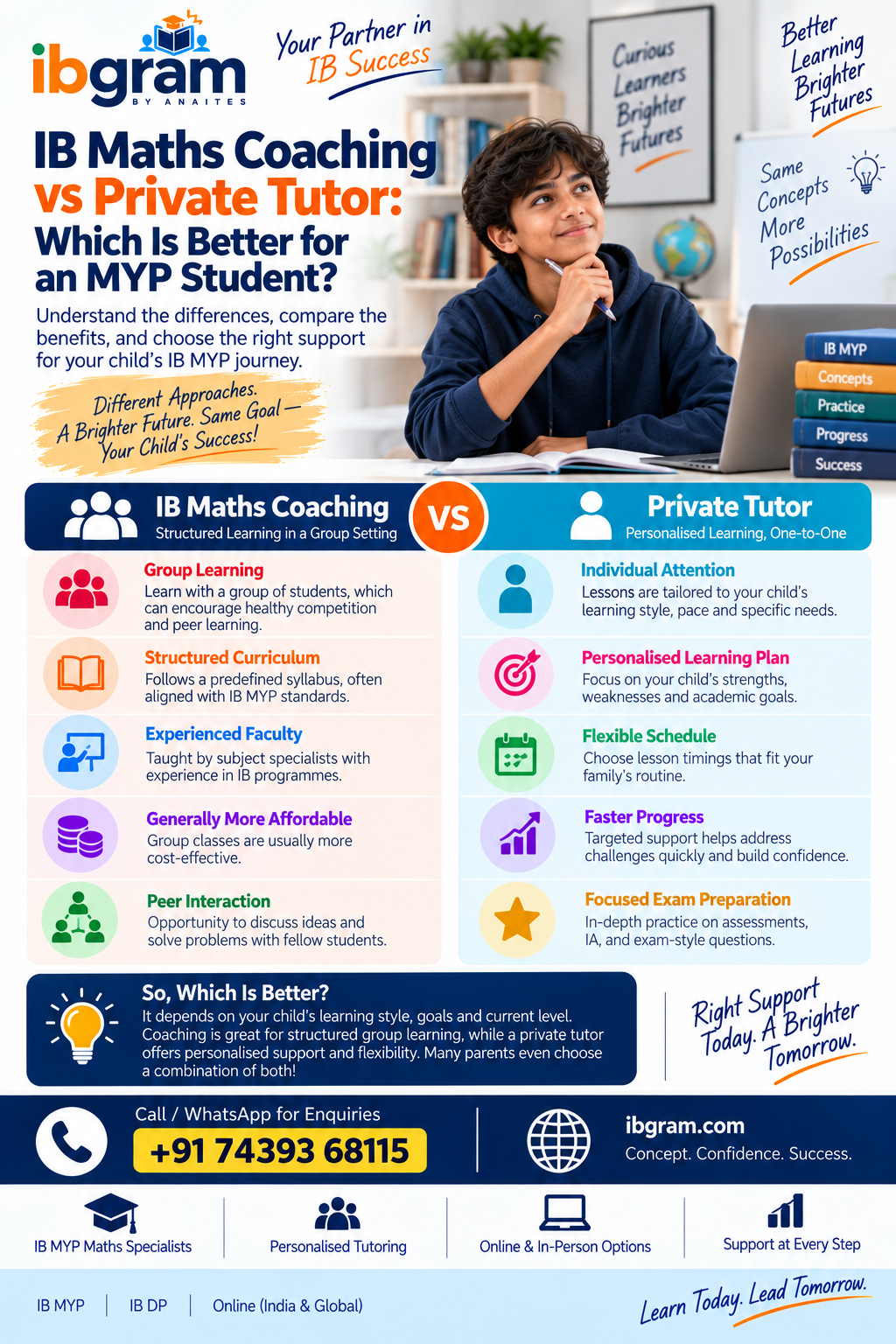
Group coaching can provide structured learning and peer interaction, but some students benefit more from personalised attention.
One-to-one home tutoring allows the tutor to focus entirely on one learner during the lesson.
This can be particularly useful when a student has specific weaknesses, needs additional explanation, or wants to move at a different pace from classmates.
For busy families in Gurugram, home tutoring can also eliminate regular travel and provide a more convenient learning environment.
Why Choose Ajay Vatsyayan Classes?
Ajay Vatsyayan Classes provides personalised Mathematics tutoring through one-to-one home tuition and live online classes for students studying international Mathematics programmes.
The approach focuses on conceptual clarity, structured practice, problem-solving, assessment preparation, and individual student requirements.
For families in Golf Course Road, DLF Phase 1–5, Sushant Lok, South City, Nirvana Country, M3M Golf Estate, and nearby sectors including 42, 43, 49, 50, 54, 56, 57, 65 and 67, personalised home tutoring provides a focused option for students who need dedicated Mathematics support.
The aim is to help students understand Mathematics more deeply, develop confidence, and become independent problem-solvers.
Questions Parents Should Ask Before Choosing a Tutor
Before making a decision, parents can ask:
What IB Mathematics programmes do you teach?
How do you identify a student's weak areas?
How do you adapt lessons to the student's school curriculum?
How do you prepare students for assessments?
Do you provide personalised practice?
How do you teach mathematical communication?
Can you support GDC and technology-related Mathematics work?
How do you track student progress?
These questions can help parents understand whether a tutor's approach matches their child's needs.
Final Thoughts
Choosing an IB Mathematics tutor should not be based solely on location, fees, or the number of years of teaching experience.
The most important consideration is whether the tutor can understand the student's academic needs and provide appropriate, personalised guidance.
A strong IB Mathematics tutor should help students develop conceptual understanding, mathematical reasoning, problem-solving ability, communication skills, and confidence.
With the right support, students can approach Mathematics more positively and develop skills that remain valuable throughout their IB journey and beyond.
Need a tutor for this subject?
Share your city, programme stage and subject — the IB Gram advisor team replies with a small, honest shortlist.