One-to-One IB Coaching in Gurgaon: When It Pays Off and When It Does Not
One-to-one IB coaching is not automatically the right call. This guide compares it with group classes, coaching centres and self-study, and gives parents a matrix for deciding.

In this guide · 21 sections
One-to-one IB coaching in Gurgaon is worth the money when your child has a specific, diagnosable problem that a classroom cannot fix at its own speed: a gap from an earlier year, a Higher Level (HL) subject that has outrun the pace of the class, a mock result that does not match the effort put in, or a deadline-heavy term where nobody is holding the plan together. It is not worth the money when the student is coping, the school is already giving feedback that the student acts on, or the real issue is sleep, load or motivation rather than teaching.
This guide is for parents of International Baccalaureate (IB) students in Gurgaon, from the Middle Years Programme (MYP) through the Diploma Programme (DP), who are being pushed from three directions at once: the school says "a little extra help might be good", a friend's child has a tutor, and a coaching centre is advertising batches. It does not tell you to buy tutoring. It gives you a way to decide, a matrix that compares four options honestly, a set of scenarios, and a 30-day test that shows whether the hours you are paying for are doing anything.
IB Gram is an independent tutor-matching platform based in Gurgaon. We have a view, which is that tutoring is a precision tool and most families use it as a blanket. Read on and you will see where we think it earns its place.
What does one-to-one IB coaching actually mean?
One-to-one IB coaching in Gurgaon means a single student works with a single tutor, in a session built around that student's current work, at home or online, with the pace, content and feedback set by what the student can and cannot yet do. The defining feature is not the ratio of one to one. It is that every minute can be steered by evidence from that student's own work, which a group class cannot do because it must serve a spread of levels.
That definition rules out two things that are sold under the same label. A tutor who simply sits next to a child while homework is completed is supervising, not coaching. A tutor who re-teaches the school chapter in the same order, at the same speed, with the same examples, is a slower, more expensive copy of the classroom. Real one-to-one work has a visible shape: a diagnostic at the start, a short list of what to fix and in what order, practice chosen for the gaps, marked work returned with specific comments, and a review point where the plan is changed or the tutor is changed.
If you want the mechanics of that shape, including how a learning plan is built around MYP criteria and DP components, the companion guide on personalised home tuition for IB students walks through it. This post stays on the decision: is it worth buying, and compared with what?
What are the four ways an IB student can get help?
An IB student in Gurgaon realistically has four routes to extra support, and they solve different problems. Treating them as interchangeable is the most common mistake families make.
- 1School support. Teacher office hours, subject clinics, peer tutoring and the DP coordinator. Free, closest to the real assessment, but limited by the teacher's load.
- 2Group classes and coaching centres. A batch of students taught together, usually by subject, on a fixed timetable. Cheaper per hour, social, and structured, but paced for the middle of the batch.
- 3One-to-one tutoring. A private tutor, at home or online, with a plan built for one student.
- 4Self-study with resources. Past papers, subject reports, video lessons and question banks, driven by the student's own discipline.
The point of the comparison is not that one wins. A strong DP student may use all four in a year. The table below sets out what each does best and where each fails, so you can match a route to a problem.
| Route | Best at | Weakest at | Typical failure mode |
|---|---|---|---|
| School support | Alignment with how this school marks | Individual time; availability near deadlines | A teacher with a full load cannot see every pattern |
| Group class or centre | Structure, peer energy, covering syllabus ground | Fixing an individual gap; adapting pace | The student sits through content already known and misses the one step that was lost |
| One-to-one tutoring | Diagnosis, pace, feedback on the student's own work | Cost per hour; peer interaction | Becomes homework babysitting if no plan or review exists |
| Self-study | Volume of practice, ownership | Knowing what to practise; honest marking | Practising what is comfortable, never what is weak |
Notice that the "weakest at" column for one-to-one is cost and peer contact. It is not quality. That is why the real question is whether the problem you have is the kind that one-to-one solves.
Is one-to-one IB coaching worth it compared with group classes?
One-to-one IB coaching is worth more than group classes when the student's difficulty is specific and personal, such as a missing prerequisite, a misunderstanding that repeats, or a pace mismatch. Group classes are worth more when the student is broadly able, wants structure and peer company, and needs syllabus coverage rather than repair.
The reason is arithmetic of attention. In a batch of eight, a student asking a question uses the batch's time; a student who stays silent because they are embarrassed or lost uses none of it, and the batch moves on. In a session of one, silence is visible. The tutor sees the pause before the first line of a solution, notices the student reaching for the formula sheet too early, and asks the question that exposes the gap. That is data a group class does not collect.
But the group class has advantages that families undervalue. A peer who solves a problem differently is a free second explanation. A fixed weekly slot protects the study habit of a student who would otherwise drift. And for a topic like Theory of Knowledge (TOK), where discussion is the method, a group is often better than a tutor alone.
A comparison by problem type
| Problem | Group class | One-to-one |
|---|---|---|
| Whole class found the unit hard | Often enough; others are in the same boat | Useful, but check whether the school can reteach |
| One student lost the thread in Term 1 and never recovered | Weak: the gap is not covered again | Strong: the gap is the lesson |
| Student understands but loses marks on exam technique | Moderate: shared technique tips help | Strong: marked scripts reveal personal habits |
| Student needs syllabus coverage before mocks | Strong: efficient and paced | Moderate: slower per topic, targeted |
| Student is bored, ahead of the class | Weak: batch pace again | Strong: tutor can extend, link to HL depth |
| Student is anxious, will not ask in front of peers | Weak | Strong: low-stakes space to ask |
Read down the middle column and you see the pattern: group classes are good at coverage and weak at repair. Read down the right column and you see the opposite. A student who needs both can sensibly run one group commitment and a small number of one-to-one sessions, rather than choosing a single route.
For a closer look at the group-versus-private trade-off in one subject, IB maths coaching versus a private tutor for an MYP student takes it through a worked case.
What does a coaching centre offer that a private tutor does not?
A coaching centre offers a fixed timetable, a prepared syllabus sequence, a room, peers and a set of institutional materials. A private tutor offers the opposite: flexibility, a plan built for one student, and a person who can be changed if the fit is wrong. Neither is better in general. They answer different needs.
Centres suit students who need external structure and do not mind a pace set for a group. They also suit families who value a physical space outside the home and a timetable that does not depend on one individual's availability. If a tutor falls ill, a tutor-based arrangement stops; a centre's batch continues.
The trade-offs are quieter. The teacher you meet in the demo may not be the teacher who runs your child's batch. The batch composition changes through the year. Materials are written for the batch, so they do not target the weakness of your child. And the centre's calendar is rarely synchronised with your child's school calendar, which matters in IB because school mocks, IA deadlines and internal exams fall at different weeks in different schools. If you are comparing the two for a particular subject, ask the centre which exact teacher takes your child's batch, how large the batch is, and how the student's work is marked and returned.
IB Gram does not run a classroom. It matches families with individual tutors and arranges a demo before a commitment, which is a different model from a centre, and if what you need is a group, we will say so. Families who prefer to see the landscape before choosing can look at IB classes in Gurgaon and IB coaching in Gurgaon to compare the formats.
Which IB students gain the most from one-to-one coaching?
Five kinds of student typically gain the most: the student with a gap from an earlier year, the student in an HL subject at the edge of their ability, the student whose effort and marks do not match, the student with a deadline-heavy term, and the student switching into IB from another board. Each of these has a problem that is individual in nature, which is exactly what a one-to-one session addresses.
The student with an inherited gap
A common MYP 4 case: fractions and algebraic manipulation were never fully secure in MYP 2 or 3, the student coasted through on pattern-matching, and now quadratics or trigonometry stand on a floor that is not there. Group teaching moves forward. One-to-one can drop back for two sessions, rebuild the floor, and then come forward. The gain is not that the tutor is smarter than the school teacher. It is that the tutor has permission to go backwards.
The HL student at the edge
DP HL subjects carry 240 recommended teaching hours against 150 for Standard Level (SL), and the difference shows in the depth of questions. A student in Mathematics Analysis and Approaches (AA) HL, Physics HL or Chemistry HL who is capable but stretched often benefits from someone who can step through Paper-style problems at exactly the level where they begin to fail. If the subject is Math AA HL, the structure of how marks are won is set out in the flagship guide on how to score a 7 in IB Math AA HL, and it is a good example of what a good tutor drills.
The effort and marks mismatch
A student who studies two hours a night and keeps scoring a 4 or 5 usually has a method problem, not an effort problem. Common versions: re-reading instead of retrieving, doing easy questions repeatedly, or writing answers that are correct but do not match the command term. This is a diagnosis problem, and diagnosis is the strongest argument for one-to-one coaching. A tutor who marks three scripts and sees the same two errors in each has found in an hour what a student may not find in a term.
The deadline-heavy term
DP2 in the autumn is the clearest case: Internal Assessments (IAs), the Extended Essay (EE) draft, university applications, and mock preparations arrive together. A tutor cannot write any of those pieces, and a family should leave any tutor who offers to. But a tutor can run the plan: what is due when, what to do this week, which subject to guard. For the rules on what help is allowed, see the guidance in the section on IA and EE further down.
The board switcher
A student arriving from CBSE or ICSE into IB meets criterion-referenced marking, command terms, coursework that counts, and less reliance on memorised derivations. A one-to-one tutor can translate between the two systems in the first term, so the student stops losing marks for habits that were rewarded in the old board.
Who does not need one-to-one coaching?
A student who is performing at or near their target, who acts on the school's feedback, who has no persistent gap, and who has a reasonable week does not need one-to-one coaching. Adding it creates load without adding value, and an overloaded IB student is more likely to drop a subject than to gain a grade.
Here are the clearest "no" cases:
- The student is on target and calm. If predicted and mock grades match the goal and the student is not working past midnight, leave it alone.
- The problem is sleep or load. A student sleeping five hours and carrying six HL/SL subjects, CAS (Creativity, Activity, Service), the EE and a sport does not need an extra session. They need the week redesigned.
- The school is already fixing it. If the subject teacher offers a weekly clinic and the student has not attended, attend first.
- The problem is motivation, not content. A student who does not want to do the subject will not be rescued by a new face. Sometimes a conversation about why they chose it, or a change in subject choice, is the right response.
- The family wants a safety net, not a fix. "Just in case" tutoring is paid insurance with no claim. It is better to hold the budget until a trigger appears, then act fast.
An honest tutor will tell you this too. If a tutor accepts a student who clearly does not need the sessions, that tells you something about the tutor.
When is one-to-one coaching worth it? A decision matrix
Use the matrix below as a first pass. Score the student on each row, from 0 (not a problem) to 2 (clear problem), then read the total. This is a rough tool built from the common patterns, not a diagnostic, so treat a close result as a reason to ask the school and the student more questions.
| Signal | 0 | 1 | 2 |
|---|---|---|---|
| Same type of error repeats across tests | No | Sometimes | Almost every test |
| Student can explain the idea but cannot finish the question | Never | Occasionally | Often |
| Subject is HL and student is below target | Not HL or on target | Slightly below | Clearly below |
| A prerequisite gap from earlier year is visible | None | Suspected | Confirmed |
| School feedback is slow or generic | Fast and specific | Mixed | Slow or generic |
| Student avoids asking questions in class | Asks freely | Sometimes silent | Stays silent when lost |
| A major deadline cluster is within 8 weeks | None | One | Several |
A total of 0 to 3 suggests waiting and using school support first. A total of 4 to 8 suggests one-to-one coaching in the weakest subject only, for a trial period. A total of 9 or more suggests a structured plan with reviews every four weeks, possibly across two subjects, but with a limit on weekly hours so the student still has a life.
Illustrative comparison of strengths, not measured results; a student may need several routes at once.
How many hours of one-to-one coaching does an IB student need?
Most students who benefit from one-to-one IB coaching in Gurgaon need far fewer hours than parents expect: typically one session a week in one subject, rising towards two in the six to eight weeks before mocks or a major deadline, and tapering after. Frequency matters less than whether the student does the set work between sessions, because the session diagnoses and the days between it consolidate.
A useful way to think about it is a ratio. For every hour with a tutor, the student should expect to spend an hour or more on follow-up: redoing questions they got wrong, writing out a corrected method from memory, attempting new questions of the same type. If the family pays for two hours a week and the student does nothing in the other 166, the tutoring is a lecture series, not coaching.
For total-programme budgeting over two DP years, where the intensity peaks and how to plan hours per subject per term without quoting amounts, the dedicated guide on private IB tutor cost in Gurgaon lays it out. For what moves the fee itself, see IB tutor fees in Gurgaon. This post will not repeat either.
Does the timing of one-to-one coaching change whether it is worth it?
Yes. The same hour of tutoring is worth more early than late, because early sessions repair gaps before later content builds on them, while late sessions mostly polish. A tutor engaged in the weeks before a mock can raise exam technique quickly, but a gap that opened a year earlier cannot be closed in three weeks.
The calendar pressure points differ by stage:
- MYP 4 to MYP 5. Foundations for DP. Extended mathematics, if the school offers it, signals which students are being prepared for AA. A gap here follows the student into DP.
- DP1, Term 1. The jump from MYP or IGCSE to DP depth. A student who scored well before often finds the first unit harder than expected.
- DP1, Term 2 and 3. IA topic selection begins; subject choices are tested by the first internal exams.
- DP2, Term 1. Everything arrives together: IA completion, EE, applications, mock preparation.
- DP2, Term 2 up to May. Past-paper work and technique. Most families call for help here, and it is the stage where the hours are least efficient.
The timeline below is a typical shape for one student's year, not a rule. Each school sets its own mock dates, usually several months before the May exams, so confirm the dates with the DP coordinator.
- Term 1Diagnose gaps, protect IA time, weekly session in the weakest subject
- Before mocksRaise to two sessions a week, timed paper practice
- After mocksError-log review, change the plan from the mock evidence
- Final termPast papers, command-term accuracy, taper the hours
For a stage-by-stage view of when to begin and which signals say "now", the guide on when to start IB tutoring takes each stage in turn.
Is it worth paying for one-to-one coaching at home or online?
Both formats of one-to-one IB coaching in Gurgaon can be worth it. Home sessions suit students who focus better with a person in the room, who need a pen-and-paper subject like maths or physics worked on together, or who find screens tiring after a school day. Online sessions suit students who live far from available tutors, who need a specialist not available nearby, or whose weekday evenings are lost to traffic.
In Gurgaon the practical details matter. Many families live in gated societies where a visiting tutor needs to be registered at the gate, and a tutor arriving in weekday evening traffic from another sector is likely to be late or tired. A tutor who lives within a short distance of a society, or who works online, solves that. On the other hand, a student who is distracted by a phone during online sessions may do better with a person across the table.
The mode decision is a subject-by-subject question, and the guide on IB home tutor versus online tutor in Gurgaon scores each. Many families end up with a mix, which the guide on hybrid IB tutoring covers. If you are looking beyond Gurgaon, online IB tutoring in India covers the tools and session structure.
What should one-to-one IB coaching look like in the first month?
A good first month of one-to-one IB coaching in Gurgaon has four visible parts: a diagnostic, a short written plan, marked practice that comes back with comments, and a review conversation. If you do not see all four by the end of week four, the coaching is not yet doing its job, and that is information you can act on.
- 1Week 1: Diagnostic. The tutor sets a short paper or a set of tasks drawn from the student's current unit and a previous one, watches how the student works, and notes where it breaks. This is not a test to be graded. It is a map.
- 2Week 1 or 2: A one-page plan. Three to five priorities, each tied to a skill or topic, with the order and the reason. A plan of twelve priorities is a list of everything, not a plan.
- 3Weeks 2 and 3: Targeted sessions. Each session opens with the previous task, works through the new priority, and ends with a task for the week.
- 4Week 4: Review. The tutor and the student look at what changed: error patterns, question accuracy, confidence. The parent is told one thing that is better, one thing that is not yet, and what happens next.
A tutor who skips the diagnostic, cannot name a priority, or does not return marked work is teaching without evidence. You can ask for the four parts directly, and a good tutor will not mind.
How do you tell if one-to-one coaching is working?
One-to-one coaching is working when the student's errors change shape: fewer repeats of the same mistake, more questions finished, better explanations in the student's own words, and a rising ability to start a problem without a hint. Marks follow, but they lag, and a single test is a weak signal.
Look at these indicators in order of how early they appear:
| Indicator | When it shows | What to look for |
|---|---|---|
| Student can name their own typical error | Weeks 2 to 3 | "I keep forgetting to define the variable" |
| Questions started without prompting | Weeks 3 to 4 | Less waiting for the tutor |
| Repeat errors drop in the error log | Weeks 4 to 6 | The same slip no longer appears |
| School test marks improve | Weeks 6 to 10 | Often a half-grade, not a leap |
| Confidence in class | Varies | Asks a question, volunteers a method |
If the student can explain how they would approach a new question but the marks do not move, the issue may be timing or exam technique, and the tutor should adjust. If neither the explanation nor the marks move after eight weeks of real work, change the plan or the tutor. No tutor can guarantee a grade, and a promise of one is a reason to walk away.
What are the red flags in one-to-one IB coaching?
The red flags are the same in any subject: a tutor who promises grades, a tutor who writes the student's work, a tutor who does not ask what the student's school is teaching, and a tutor who cannot show a plan after two sessions. Any one of them is a reason to pause and ask a direct question.
- A grade guarantee. Nobody controls the exam script except the student.
- Writing or editing the IA or EE. The IB's academic integrity policy allows a teacher to give feedback on one draft; it does not allow a tutor or parent to write, rewrite or edit the submission. A tutor may teach the underlying skill, question the reasoning and point the student at the criterion.
- No question about the school's calendar. A tutor who does not ask when the mocks and IA deadlines fall is planning in the dark.
- Every session is the same shape regardless of the student. Template sessions are a sign of templated thinking.
- No marked work returned. If the student never gets written feedback, the session is entertainment.
- Pressure to buy a bundle before a trial. A demo session before commitment is a reasonable request.
- Vague answers about subject depth. A tutor who teaches Physics HL should be able to say which topics are in the Additional Higher Level (AHL) content and where students typically stumble.
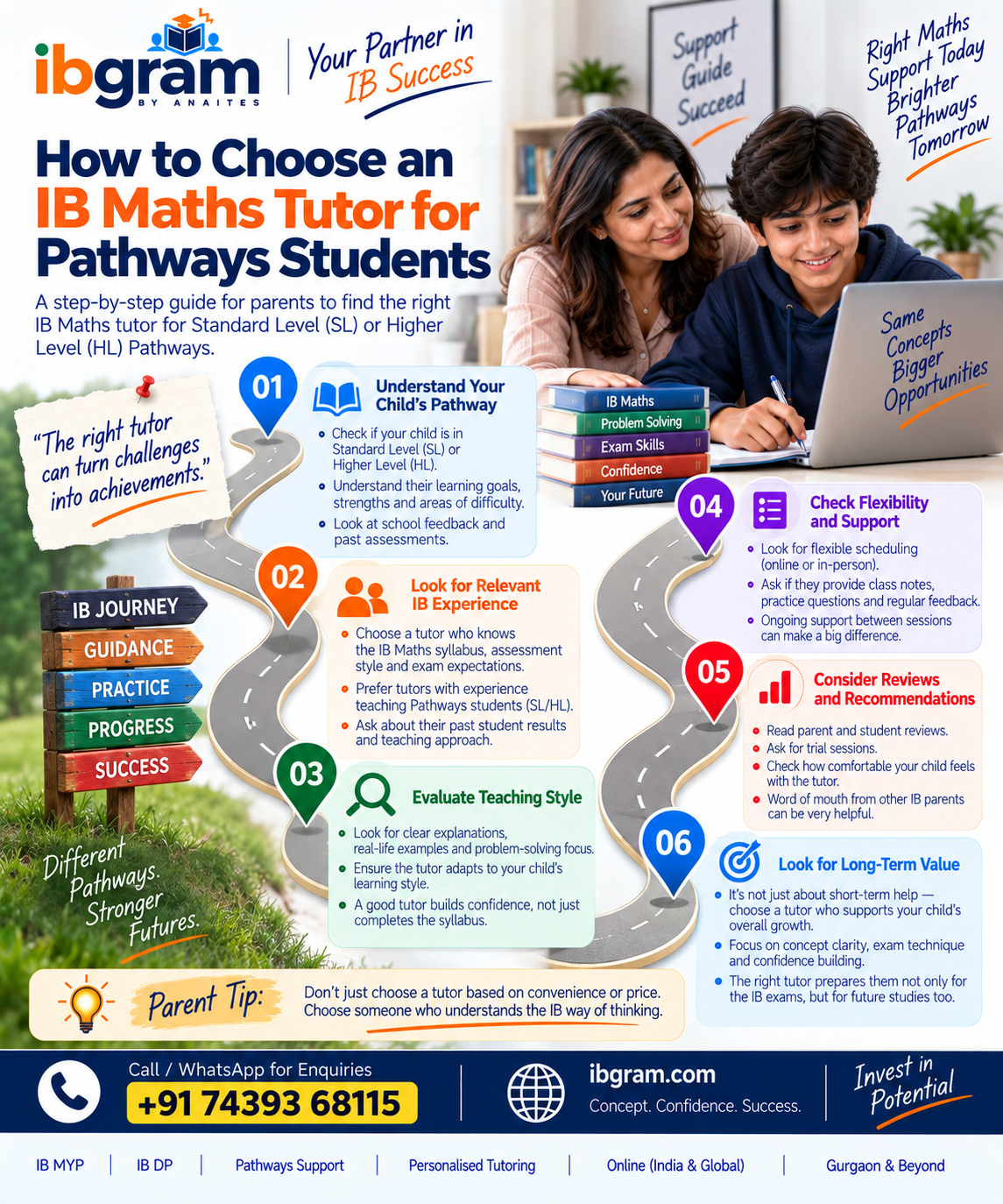
The broader checklist of what to verify, including credentials and how to run a demo lesson, lives in the hub guide on how to choose an IB tutor in Gurgaon.
How should one-to-one coaching handle IA, EE and TOK?
A one-to-one tutor may teach the skills behind coursework, but the work submitted must be the student's own. The IB's academic integrity policy allows a teacher to give feedback on one draft; it does not allow anyone, tutor or parent, to write, rewrite or edit the student's submission. In practice, a good tutor questions, models, and directs, and the student writes.
What this looks like in a session:
- Choosing a topic. The tutor asks questions that help the student find a topic they can sustain, and shows how weak and strong topics differ against the criteria. The student decides.
- Structuring the work. The tutor explains what each criterion rewards, using the published guide, and asks the student to reread a paragraph against it.
- Mathematics exploration. For the maths IA, which is 12 to 20 pages marked out of 20 on five criteria (Presentation, Mathematical communication, Personal engagement, Reflection, Use of mathematics), a tutor can help a student see whether the mathematics is deep enough, without supplying the exploration.
- Science IA. The scientific investigation is worth 20 percent and marked on four criteria of 6 marks each: Research design, Data analysis, Conclusion and Evaluation. A tutor can teach uncertainty handling and graph conventions.
- EE. The Extended Essay is an independent research essay of up to 4,000 words, supervised at the student's own school. The EE guide has been updated for first assessment in 2027, so follow the version the DP coordinator issues. A tutor can teach the research skills but cannot supervise in the school's place.
- TOK. Here a group often works better than a tutor alone, because the method is discussion. One-to-one can still help a student prepare for the exhibition or the essay by testing arguments.
The detailed guide to the process is in the IB Internal Assessment guide. For a student who is behind, a tutor's most valuable contribution is often a calendar the student actually follows.
Which scenarios show when one-to-one coaching pays off?
Scenarios help because families rarely face a clean case. These are illustrative, not real students, and they show how the same decision comes out differently.
Scenario 1: A DP1 student, Physics HL, strong in maths. Consider a student who found IGCSE Physics easy, is now scoring below target in Physics HL, and says she understands the lessons. A diagnostic often reveals that she understands individual concepts but loses marks on multi-step questions that chain two or three of them, and on units and significant figures. Here one-to-one is worth it for a limited run: eight to ten weeks, one session a week, built around marked multi-step questions. The student does not need a long programme.
Scenario 2: An MYP 5 student, on target, anxious. Consider a student scoring 6 and 7 across subjects who is anxious before the Personal Project deadline and the school's on-screen assessment. More tutoring would add load. What helps is a calendar, a conversation about the Personal Project process in school, and perhaps one session to rehearse the exam format. The decision is not to buy ongoing tutoring.
Scenario 3: A DP2 student, Economics HL, two months before mocks. Consider a student whose essay answers are correct in content but fall short on evaluation. The gap is a technique gap against command terms like "evaluate" and "discuss", and Paper 3 for HL adds a policy question. A tutor who marks timed essays and reorders the student's argument structure produces results faster than reading more notes. One-to-one pays off here, with two sessions a week for six weeks, then a taper.
Scenario 4: A student who moved from CBSE to IB in Grade 11. Consider a student strong in memorisation and derivation who is struggling with open-ended command terms and IA. A tutor can spend the first month translating between the two systems. Group classes designed for IB-native students may move too fast on the unfamiliar parts, while a tutor can set the pace.
Scenario 5: A DP1 student who is simply unmotivated. Consider a student who dislikes Chemistry and picked it for a parent's reasons. Tutoring will not fix this. A conversation with the school about whether a change is possible, and with the student about what they want, is the real work.
- Weeks before the first review
- 4
- Sessions a week for most students
- 1-2
- Subject to start with, not all six
- 1
These figures are guidelines, not rules, and a student with several simultaneous gaps may need more. Most do not.
Can self-study replace one-to-one coaching?
For some students, yes. A disciplined student with access to past papers, markschemes and subject reports can improve a great deal without a tutor, because the bottleneck is practice volume, not teaching. The IB's own materials, through the school or official channels, show how marks are awarded, and command terms such as define, describe, explain, evaluate, discuss and to what extent set the depth each answer needs.
Where self-study fails is predictable. Students practise what they already do well because it feels productive. They mark their own work generously. They do not notice that three different mistakes share one root cause. And they stop when stuck, which is exactly when a tutor would have asked a leading question.
A reasonable hybrid for a motivated student is to self-study, keep an error log, and book a tutor for a short block when the log shows a pattern the student cannot break. That gets most of the value of coaching for a small fraction of the hours. If you want the foundations of building that log for maths, the flagship post on how to score a 7 in IB Math AA HL describes the method and the habit, and the same logic transfers to other subjects.
How should families compare cost and value without comparing price?
Compare cost and value by what you receive for each hour, not by the number on the invoice. The ingredients of value are the tutor's preparation, the marking and written feedback between sessions, the diagnostic and plan, the tutor's specific experience with your subject and level, and the freedom to change tutors if the fit is wrong.
A cheaper hour that includes no preparation and no feedback is usually a more expensive outcome. A higher-priced hour that includes a plan, marked work and a review can cost less per unit of progress. The reverse can also be true: a premium rate is not proof of quality. Ask what the rate includes, whether trial sessions are possible, and what happens if the fit is wrong. The economics behind premium MYP maths rates is a separate topic, covered in why MYP maths tutors charge what they do.
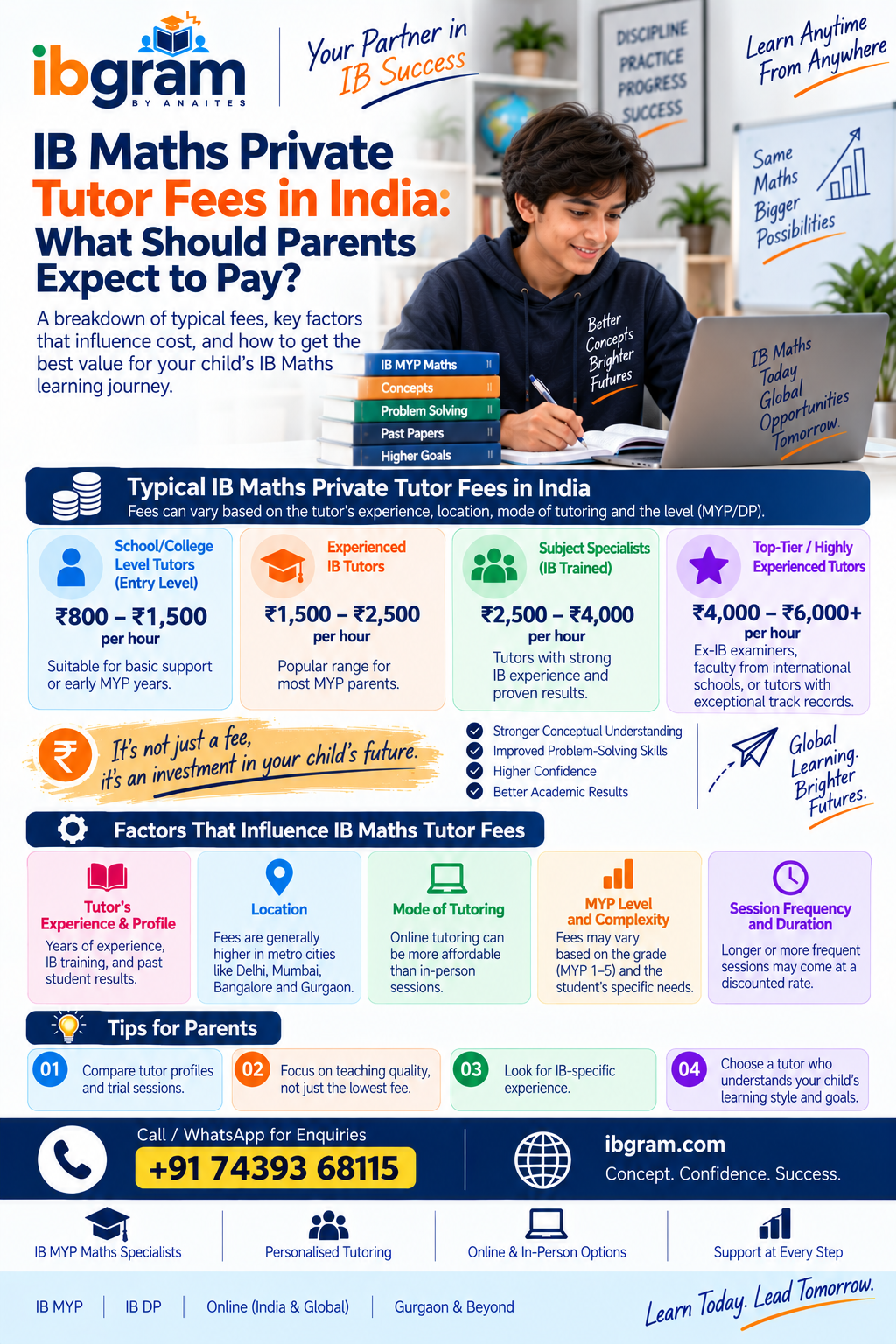
We do not quote amounts in this guide, because fees depend on the subject, level, tutor's experience, mode, location and frequency, and any figure written here would be wrong for most families.
What about Gurgaon-specific factors?
Gurgaon's practical constraints shape what works. Evening traffic on main roads, society gate procedures, the distance between sectors, and the heat in the months before May all affect whether a home session starts on time and at what energy level. A student who has a tutor arriving after a long journey or at the end of a tired day will get less than the hour on paper.
Practical tips:
- Choose a slot that does not collide with the school bus and sports. A session at 6 pm on a day with swimming is not a session.
- Keep the study space quiet. A shared living room during dinner preparation is not a classroom.
- Use weekends carefully. A weekend block can work well for paper practice but can also eat the only rest the student has. See weekend IB tutoring in Gurgaon for how to split sessions.
- Online when the commute is the problem. If travelling to a centre costs 90 minutes a day, online one-to-one can recover that time.
For families who want home sessions in a specific locality, IB Gram's IB tutor pages for Gurgaon list areas, and one-to-one IB tutors in Gurgaon shows the format. For a student in the Diploma Programme, the page on IB DP tutors in Gurgaon is the closest fit, and for MYP families, IB MYP tutors in Gurgaon is.
What does IB Gram do for one-to-one coaching?
IB Gram is a matching platform, not a classroom. A family sends a query or books a free consultation. We ask about the board, programme, level, subject, school calendar, location and schedule. We shortlist tutors whose profiles are verified and who fit, and a demo or trial session can be arranged before the family commits. Lessons run at home, online or hybrid, and the family can ask for a different match if the first one is not right. Availability is subject to tutor availability.
That is the whole offer. We do not guarantee grades, and we will tell you if we think the student does not need a tutor yet. The point of the demo is to give you evidence: does the tutor ask good questions, does the student engage, is the explanation pitched at the right level? Use it.
IB Gram is an independent platform and is not affiliated with the International Baccalaureate, Cambridge International Education, Pearson Edexcel or any school named here.
Frequently Asked Questions
Is one-to-one IB coaching in Gurgaon worth it for a student who is already scoring 5s and 6s?
It can be, but only if the student has a specific target and a specific obstacle. A student on a 5 who wants a 6 in one subject may gain from a short block that fixes exam technique. A student on 6s who is comfortable usually does not need ongoing sessions. The test is whether you can name the obstacle in one sentence. If you cannot, wait, and ask the school's teacher what they see.
How is one-to-one coaching different from a group class or coaching centre?
One-to-one coaching builds every session around one student's work, while a group class is paced for the batch. In a group, a student who is lost can stay unseen; in a single session, the tutor sees the hesitation and responds. Group classes are better for coverage, peer energy and structure; one-to-one is better for repair, diagnosis and pace. Many students benefit from a mix.
How many weeks should we try before deciding if it is working?
Give it four weeks for a review and eight weeks for a decision. By week four you should see a diagnostic, a plan, marked work and a conversation. By week eight, error patterns should have shifted and the student should be starting questions more independently. If neither is true after eight weeks of real effort from the student, change the plan or the tutor rather than adding hours.
Should we hire a tutor for every IB subject?
No. Start with the one subject where a specific problem is visible, and add a second only if the first block worked and a second problem is clear. Six tutors for six subjects overloads the student, splits the family's attention and rarely produces anything that one well-chosen block would not. HL subjects with the widest gap between effort and result are the usual starting point.
Is online one-to-one coaching as good as a home tutor?
It can be, for most subjects, if the setup is right: a pen tablet or good camera on written work, a shared whiteboard, and a student who is not distracted by notifications. Home sessions are often better for students who need a person in the room or who find screens tiring. The choice is student-specific, and a trial of each can settle it.
Can a tutor help with the IA or Extended Essay?
A tutor can teach the skills behind them, but cannot write, rewrite or edit the submission. The IB's academic integrity policy allows a teacher to give feedback on one draft, and no one else may edit the student's work. A good tutor asks questions, points to the criteria and has the student reread their own work. If a tutor offers to write sections, treat that as a serious warning.
What if the tutor is not a good fit after a few sessions?
Say so early, and ask for a change. A tutor mismatch is common and not a failure on anyone's part: teaching style, pace and personality matter. Through IB Gram, a family can ask for a different match. Before switching, tell the tutor what is not working, because sometimes a small change in pace or format fixes it. If it does not, switch rather than waiting for a term to pass.
Can a tutor promise a higher IB grade?
No. No tutor can guarantee a grade, because the grade depends on the student's work in the exam and on the school's internal assessment. What a good tutor can do is raise the odds by fixing identifiable gaps and improving technique. If anyone promises a specific score, that promise is itself a reason to look elsewhere.
How do we know if our child needs a tutor or just more time?
Look at the pattern, not the single result. If the same mistakes recur after the student has spent real time on the material, the issue is likely method or a gap, which a tutor can address. If the student has not yet attempted practice questions or attended school clinics, more time with those comes first. A conversation with the subject teacher usually clarifies which it is.
Is it too late to start one-to-one coaching in DP2?
It is rarely too late to help, but the kind of help changes. In DP2 the useful work is targeted: exam technique, timed practice, error-log review and deadline planning. Deep re-teaching of a whole subject is slow at that stage. Starting a few months before mocks gives the most room, and the guide on when to start IB tutoring lists the signals at each stage.
Next steps
- 1Name the problem in one sentence. Subject, skill, and the evidence: a mock, a test, a teacher's comment. Without this, no format will help.
- 2Use the matrix and ask the school. Score the signals, then ask the subject teacher what clinics or feedback are available before spending.
- 3Run a four-week trial in one subject. Ask for a diagnostic, a one-page plan, marked work and a review. Keep, change or stop based on what you see.
If you would like help finding a tutor whose profile fits your child's programme and subject, contact IB Gram for a free consultation, or look at one-to-one IB tutors in Gurgaon to see the format before you decide.
Need a tutor for this subject?
Share your city, programme stage and subject — the IB Gram advisor team replies with a small, honest shortlist.