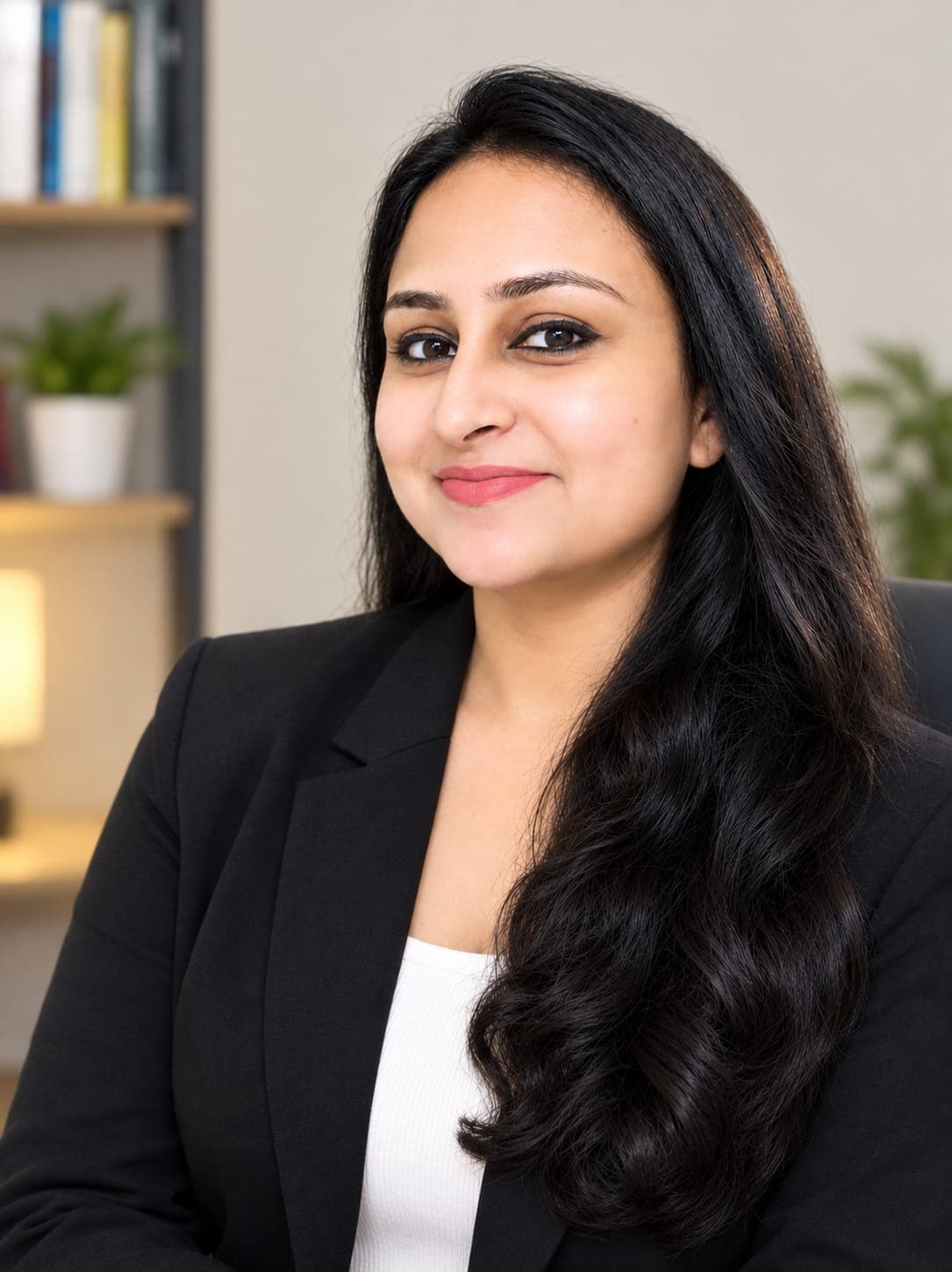
Ajay Vatsyayan
Math AAHL
IB + IGCSE
One-to-one IGCSE Maths tutors for Cambridge 0580, International Mathematics 0607, Additional Mathematics 0606 and Edexcel International GCSE 4MA1 — Core or Extended, calculator and non-calculator papers, online worldwide in your own time zone and at home in several Indian cities.
Matched by programme, subject, level, weak areas and your school's calendar.
Math AA, Math AI, Physics, Chemistry, Economics, English and more, to the current syllabus.
Online worldwide around school hours, with home and hybrid options where tutors are local.
Clear updates on what was covered, what needs practice and the next step.
Most families searching for an IGCSE Maths tutor are not starting from zero. They are dealing with something specific: a mock paper that came back twenty marks below what the student expected, a Core-versus-Extended decision the school wants an answer on this term, or the discovery that Cambridge 0580 now includes a non-calculator paper and their child has never practised without one. IB Gram matches Grade 9 to Grade 11 students with a tutor who already knows the exact syllabus code being taught — 0580, 0607, 0606, 0980 or Edexcel 4MA1 — because the papers, the tier structure and even the calculator rules differ between them. Sessions run online worldwide in your family's time zone; home tutoring depends on a tutor being available in your city.
Matching starts with four pieces of information, and none of them is "we need a Maths tutor". IB Gram asks which syllabus code the school teaches, whether the student is entered for Core or Extended (Foundation or Higher on Edexcel), which grade they are in, and what specifically triggered the search. Those four answers change the tutor, not just the lesson plan. A tutor who is excellent at rebuilding algebra from the ground up for a Grade 9 student is not automatically the right person for a Grade 11 student six weeks from the May session who is losing marks on Paper 4 structured questions. From there, two or three tutors are suggested with their actual background: which boards they have taught, whether they have worked with 0607's investigation papers, how they handle non-calculator practice. The first session is diagnostic rather than a lecture. The tutor works through a recent mock or a past-paper question with the student and watches where the marks are actually going — a sign error, a misread command word, a method that works but takes four minutes too long, or a genuine gap in the topic. That diagnosis is shared in writing after the session, so a parent can see the reasoning rather than taking "she needs more practice" on trust. Fees depend on the tutor's experience, the tier and how often sessions run, and are quoted in writing before anything is booked. If the fit is wrong after a session or two, IB Gram changes the tutor rather than asking a family to persist out of politeness.
Name the syllabus code first: 0580, 0607, 0606, 0980 or Edexcel 4MA1
Confirm the tier: Core or Extended, Foundation or Higher
First session is diagnostic — a real mock or past paper, not a topic lecture
A written note after every session, so you see the reasoning, not just the verdict
Rates quoted in writing beforehand; tutor changed if the fit is wrong
Learn with verified tutors matched for IGCSE Mathematics, with strong exam support, fast feedback, and structured preparation.

Math AAHL
IB + IGCSE

Mathematics
IB + IGCSE

Mathematics
IB + IGCSE
IGCSE Maths is usually a two-year course, and the useful kind of tutoring changes sharply across it. In Grade 9, the work that pays off is unglamorous: negative numbers, fractions, index laws, rearranging formulae and solving linear equations without hesitation. Almost every Extended-tier problem later in the course sits on top of those skills, and a student who is still counting on their fingers through fraction arithmetic in Grade 9 will lose marks in Grade 11 on questions that were never really about fractions at all. Grade 10 is where the syllabus widens fastest — trigonometry, similar shapes, quadratics, probability, sequences, vectors and transformations arrive in close succession. This is the stage where students most often report that they "understood it in class" but cannot start the question at home. Tutoring here is largely about building a decision habit: reading a question and knowing within fifteen seconds which tool it wants, rather than trying every method in turn. Grade 11 is exam craft. The mathematics is mostly known by then; the marks are lost to timing, presentation, premature rounding, working that a marker cannot follow, and a non-calculator paper the student has under-practised. A good tutor at this stage spends more time on marked past papers and mark schemes than on new content, and is honest about which topics are worth rescuing and which are worth capping so the effort goes where the marks are.
Grade 9: fractions, indices, rearranging formulae, sign discipline
Grade 10: trigonometry, quadratics, similarity, probability, vectors
Grade 11: timed papers, mark-scheme reading, rounding and presentation
Students moving from ICSE, CBSE or a national curriculum get a bridging plan first
"IGCSE Maths" is not one qualification. Cambridge IGCSE Mathematics 0580 is the most widely taught route, entered at Core or Extended tier; from the 2025 series it is assessed across a non-calculator paper and a calculator paper at each tier, which is a real change for students who learned the course on a calculator throughout. Cambridge International Mathematics 0607 is a different syllabus again: it expects a graphics calculator, is structured around Core and Extended papers plus an investigation paper, and is the route many schools use for students continuing to IB Diploma Mathematics. Cambridge Additional Mathematics 0606 is a separate, harder qualification taken alongside or after 0580 by strong students — it introduces calculus, more demanding trigonometry, series and functions, and behaves much more like an AS-level course than a GCSE one. Cambridge 0980 is the 9–1 graded version of Mathematics, and Pearson Edexcel International GCSE Mathematics A (4MA1) and B (4MB1) run on Foundation and Higher tiers with their own paper structure and formula sheet conventions. The practical consequence is simple: a tutor who has taught only 0580 Extended can waste a student's first three sessions on a 0607 course, because the investigation paper rewards a style of writing and exploration that 0580 never asks for. Naming the code in the first message is the single highest-value thing a parent can do.
0580 — Cambridge Mathematics, Core and Extended, non-calculator and calculator papers
0607 — International Mathematics, graphics calculator, includes an investigation paper
0606 — Additional Mathematics: calculus, series and functions, an AS-level bridge
0980 — the 9–1 graded version of Cambridge Mathematics
Edexcel 4MA1 and 4MB1 — International GCSE Maths A and B, Foundation and Higher
Online tutoring is available worldwide and runs in the family's own time zone, which is how most IB Gram Maths sessions actually happen. It is also what makes syllabus-specific matching possible: a family in Muscat or Nairobi looking for a 0607 specialist is no longer limited to whoever happens to teach locally. Tutors are based in India, and sessions are commonly scheduled for families in the Gulf, Southeast Asia, East Africa, the UK and Europe by working across the relevant time offset. Within India, home tutoring is sometimes available, and it depends entirely on which tutors are currently taking in-person students near you. Demand is densest in Gurugram along Golf Course Road, DLF Phases 1 to 5, Sushant Lok and Sectors 43, 50 and 56; in South and South-West Delhi around Vasant Vihar, Vasant Kunj and Saket; in Noida Sectors 44, 50 and 62 and the Expressway corridor; and in the established international-school belts of Mumbai, Bangalore, Hyderabad, Pune and Chennai. This is worth stating plainly rather than implying: home tutoring is not available everywhere in India, and there is no branch or centre to visit. Where an in-person Maths tutor is not currently free near you, online is not a downgrade for this subject. A shared whiteboard with a tutor annotating the student's own working, question by question, is closer to what Maths tutoring needs than a tutor sitting across a dining table with a printed textbook.
Online worldwide, scheduled in your own time zone — the most common arrangement
Gurugram: Golf Course Road, DLF Phases 1–5, Sushant Lok, Sectors 43, 50, 56
Delhi NCR: Vasant Vihar, Vasant Kunj, Saket, Noida Sectors 44, 50, 62
Mumbai, Bangalore, Hyderabad, Pune and Chennai international-school belts
No centre or branch to visit; home tutoring depends on current tutor availability
The fastest way to confuse an IGCSE Maths student is to teach a second, competing method for something they have already half-learned in class. Schools differ in how they present simultaneous equations, which trigonometric convention they drill first, how much they lean on the formula sheet and how strictly they mark method versus answer. A tutor who ignores all of that creates a student who now has two half-methods instead of one working one. So sessions begin from what the school is actually doing: the current unit, the last marked assessment, the school's own worksheets and the teacher's written comments. Where the school's preferred method is clearly working for the student, the tutor reinforces it rather than substituting a favourite alternative. Where it genuinely is not working — and this does happen, particularly with algebraic fractions and with how vectors are introduced — the tutor explains why a different approach is being tried, in writing, so the parent and the student both know it is deliberate. Tutors also work to the school's calendar rather than a generic revision plan. Internal assessment weeks, the mock timetable, and the school's entry deadline for Core versus Extended all shape what a session covers in any given fortnight. Tutors support and coach; they do not complete school assignments, and they will say so if asked.
Start from the school's current unit, marked work and teacher comments
Reinforce the school's method where it works; explain in writing when it does not
Plan around mock weeks and the school's tier-entry deadline
Coaching only — tutors never complete assignments or assessed work
Online is the default and, for Maths specifically, it is strong. The work of a Maths session is watching a student's working appear line by line and interrupting at the exact point it goes wrong, which a shared digital whiteboard or a tablet camera over the student's own page does well. It also means a family gets the tutor who knows their syllabus code, rather than the nearest available one, and past papers can be marked and annotated on screen in the session itself. Home tutoring, where a tutor is available near you in India, helps most with two groups: younger Grade 9 students who drift without someone physically present, and students whose difficulty is partly organisational — losing worksheets, not writing working down, doing questions in their head. A tutor in the room can enforce habits more directly than one on a screen. Hybrid is what many Grade 10 and 11 families settle on: a weekly online session for steady progress, plus occasional in-person sessions in the run-up to mocks or the exam session. Whichever mode is chosen, session length, frequency and a first free trial lesson are agreed before booking, and the mode can change mid-course if the student's needs change.
Online: worldwide, widest tutor choice, papers annotated live on screen
Home: India only, city-dependent, best for younger or less organised students
Hybrid: weekly online plus in-person sessions around mocks and the exam session
A free trial lesson before you commit; mode can be changed later
Most families choosing IGCSE Maths support are deciding between a one-to-one tutor, a local coaching centre batch, a recorded course and their school's own remedial class. These are categories rather than named providers, and the honest differences are about diagnosis, pace and accountability rather than effort.
| What matters | One-to-one tutor (IB Gram) | Coaching centre batch | Recorded video course | School remedial class |
|---|---|---|---|---|
| Syllabus code match | Matched to 0580, 0607, 0606 or Edexcel 4MA1 before the first session | Often one generic IGCSE batch across codes and tiers | Usually built for the most popular code only | Exactly right — it is the school's own syllabus |
| Diagnosis of lost marks | First session diagnoses a real mock or past paper, question by question | Rarely individual; pace follows the batch | None — the course cannot see the student's paper | Depends on teacher time across a whole class |
| Pace control | Set by this student; a stuck topic gets a whole session | Fixed to the batch schedule | Fully self-paced, but nothing pushes back | Set by the group's average need |
| Non-calculator paper practice | Drilled in short timed sets and marked with the student | Included if the batch plan covers it | Provided as content; not marked or enforced | Usually covered close to the exam |
| Written record for parents | A written note after every session | Varies; often a periodic test score only | Progress dashboards, not diagnosis | Report cards and parent meetings |
| Changing tutor or teacher | Changed on request if the fit is wrong | Possible within the centre's staffing | Not applicable | Rarely possible mid-year |
| Cost basis | Quoted in writing per match; no published rate | Fixed batch fee per term | Low, one-off or subscription | Included in school fees |
Subject depth in Maths is easy to claim and easy to test, so it is tested. Before a tutor is put in front of an IGCSE student, IB Gram confirms which boards and syllabus codes they have actually taught, not simply that they hold a mathematics degree. A tutor is asked to work through recent Extended Paper 4 and non-calculator paper questions and to explain how they would mark them, because a tutor who cannot read a mark scheme cannot teach a student to write for one. Identity and qualifications are verified, and teaching or tutoring history is checked with reference to the level claimed. Communication is assessed as deliberately as subject knowledge: a tutor who is mathematically excellent but cannot explain a method to a nervous fifteen-year-old, or who does not write a usable session note, is not a good match however strong the credentials look. After matching, quality is tracked from what families report and what the written session notes show, not from a star rating alone. Tutors who go quiet on notes, reschedule repeatedly or drift away from the syllabus stop being matched. None of this is a guarantee of a grade — no honest platform can offer that — but it is a real filter, and it is why the tutor list a family receives is short rather than endless.
Boards and syllabus codes actually taught, verified rather than assumed
A live paper-and-mark-scheme task before approval
Identity, qualifications and teaching history checked
Explanation quality and written session notes weighed alongside subject depth
Ongoing matching depends on family feedback and note quality, not a star score
The first is urgent. A mock came back badly, or a topic test did, and there are a few weeks until the next assessment. What helps here is not a syllabus rebuild but targeted work on the specific paper the student sat: which questions lost marks, whether the loss was knowledge, method, arithmetic or time, and what to drill in the fortnight available. Trying to cover the whole course in three weeks is the most common way this timeline gets wasted. The second is planning. A family in Grade 9 or early Grade 10 wants steady support before it becomes a rescue, or a tier decision is coming and they want an honest read on whether Extended is realistic. This is the most productive timeline to be on, because the fixes that matter most in IGCSE Maths — fraction fluency, algebraic confidence, writing working a marker can follow — take months, not weeks, and are close to impossible to install in an exam term. The third is a change of system. A student has moved from CBSE, ICSE or a national curriculum into an IGCSE school, or from 0580 to 0607, and the mathematics is not the problem so much as the assessment culture: command words, structured multi-part questions, required working, and marks awarded for method. Here the first few sessions are about translation, not teaching.
This week: the specific paper that went wrong, diagnosed question by question
This term or year: fluency and habits that cannot be built in an exam term
A tier decision: an honest read on Core versus Extended, with evidence
New to IGCSE: command words, structured questions and marks for method
From the 2025 series, Cambridge 0580 assesses a non-calculator paper at both Core and Extended tier, and it has quietly changed what good preparation looks like. Students who built every habit around a scientific calculator lose marks not on hard topics but on arithmetic they outsourced for two years: surds left unsimplified, fraction operations attempted in decimals, standard-form work done by guesswork, percentage multipliers not recognised. The fix is unromantic and effective — regular short non-calculator sets, from the start of Grade 10 rather than the spring of Grade 11. Past papers are the other half, and they are routinely used badly. Working through a paper with the answers beside you feels productive and teaches almost nothing. The method that works is to sit the paper under time, mark it against the real mark scheme, and then classify every lost mark: not known, known but wrong method, right method with an arithmetic slip, or ran out of time. Those four categories lead to four completely different plans, and a tutor's main job in Grade 11 is to keep that classification honest. The pattern that shows up most often across marked papers is not weak mathematics. It is unreadable or absent working on multi-mark questions, premature rounding that costs accuracy marks on the final line, and a command word answered loosely — "show that" treated as "convince me", or an exact answer given as a decimal. All three are teachable in weeks, which is why a diagnostic first session is worth more than an extra month of general revision.
Short non-calculator sets from Grade 10, not the spring of Grade 11
Sit papers under time, then mark against the real mark scheme
Classify every lost mark: not known, wrong method, slip, or ran out of time
Write working a marker can follow; round only at the final line
"Show that", "exact value" and "give your answer to" are instructions, not style
Four weeks in, there should be evidence rather than reassurance. Concretely: a written note after each session saying what was covered and what the student got wrong; a named diagnosis from the first session that the later notes refer back to; and at least one marked past-paper question or short paper with the tutor's annotations on it. If none of that exists after a month, the tutoring is not being managed, whatever the student says about liking the tutor. What should not be promised is a grade. Nobody can honestly guarantee a 7, an A* or a 9, and a tutor who does is telling a parent what they want to hear. What can reasonably be expected by week four is a student who can start a question they would previously have left blank, who writes working without being asked, and who can explain what a question is asking before attempting it. Progress in IGCSE Maths is also not linear, and a parent should be warned about that rather than alarmed by it. Marks often dip slightly when a student is made to abandon a shortcut that was working at 60 percent and adopt a fuller method, and then recover above the old level a few weeks later. A tutor who flags that dip in advance in a session note is doing the job properly.
A written note after every session, from session one
A named diagnosis the later notes keep referring back to
At least one marked, annotated past-paper question or paper
No grade guarantees — from IB Gram or from any tutor on it
An expected dip when a shortcut is replaced by a fuller method
The useful first message is short and specific: the syllabus code, the tier, the grade, and what prompted the search. "Grade 10, Cambridge 0580 Extended, lost 18 marks on the trigonometry and vectors sections of the mock, exam session May" is enough to match a tutor properly. "Need a Maths tutor" takes two more exchanges to reach the same point, and those exchanges cost days when a mock is close. A suggested tutor's background — boards taught, tiers, how they structure sessions — is shared before anything is booked, along with the rate for that specific match in writing. There is no published price list, because a Grade 11 Extended tutor working to a May session and a Grade 9 foundations tutor are not the same job. The first lesson is a free trial, and the tutor can be changed afterwards if the fit is wrong. Write to ibgram24@gmail.com or message +91 7439 368 115 on WhatsApp with those four details. If you are outside India, include your city and time zone so a schedule is proposed in your own local hours rather than Indian ones.
Send four things: syllabus code, tier, grade, and what triggered the search
Tutor background and rate shared in writing before you book
First lesson is a free trial; the tutor can be changed after it
ibgram24@gmail.com or +91 7439 368 115 on WhatsApp — add your time zone if abroad
IB Gram is an independent tutoring platform and is not officially affiliated with Cambridge International, Pearson Edexcel, Oxford AQA or the IB Organization. Syllabus codes are named only to describe what tutoring covers.
There is no fixed rate, and IB Gram does not publish a price list. The fee depends on the tutor's experience, which syllabus code and tier they are teaching, the student's grade and how often sessions run — a Grade 11 Extended tutor working to a May session is a different job from Grade 9 foundations work. The rate for a specific suggested tutor is shared in writing before you book anything, so you are comparing a real number rather than a range. Ask for it upfront; any tutor unwilling to state a rate plainly before the first session is worth questioning.
Check the school's course outline or the student's textbook cover, where the code is usually printed. Cambridge routes are 0580 Mathematics, 0980 (the 9–1 graded version), 0607 International Mathematics and 0606 Additional Mathematics; Pearson Edexcel routes are International GCSE Mathematics A (4MA1) and B (4MB1). If you are unsure, send a photo of a recent worksheet or assessment header and IB Gram will identify it. This matters more than it sounds: 0607 expects a graphics calculator and includes an investigation paper that 0580 does not have at all.
Extended is required or strongly preferred for most students continuing to IB Diploma Mathematics or A Level Maths, and it is the more demanding of the two. The honest way to decide is with evidence rather than ambition: a recent Extended past paper sat under time, marked against the real mark scheme. A tutor can run that diagnostic and tell you what the gap looks like and whether it is closable before the school's entry deadline. Schools also have their own entry policies, so the school's view is part of the decision, not an obstacle to it.
Yes — from the 2025 series, Cambridge IGCSE Mathematics 0580 is assessed with a non-calculator paper and a calculator paper at each of Core and Extended tier. For students who learned the whole course with a calculator to hand, this is a genuine adjustment, and the marks tend to go on arithmetic rather than on difficult topics: unsimplified surds, fractions attempted as decimals, standard form, percentage multipliers. Short timed non-calculator sets from Grade 10 onwards fix it far more reliably than a burst of practice in the final term.
Online tutoring is available worldwide and is the most common arrangement. Home tutoring is offered only in India, and only where a suitable tutor is currently taking in-person students near you — demand is densest in Gurugram, South and South-West Delhi, Noida, Mumbai, Bangalore, Hyderabad, Pune and Chennai. Availability shifts as tutors' own schedules change, and IB Gram will tell you directly if nothing is free near you rather than leaving you waiting. For Maths specifically, online is not a weaker option: annotating a student's own working line by line on a shared screen is exactly what the subject needs.
Tutors are based in India, and sessions are scheduled in your own local time rather than Indian time. Families in the Gulf, Southeast Asia, East Africa, the UK and Europe are commonly scheduled by working across the offset — early-morning or late-evening slots in India often land in convenient after-school hours locally. Tell IB Gram your city and time zone in the first message and a specific weekly slot will be proposed in your local hours. Tutoring outside India is online only.
Usually within a few days for the common codes and tiers, because most matching time goes on confirming the specifics rather than finding a tutor. Send the syllabus code, tier, grade and what prompted the search, and two or three tutor options with their backgrounds and rates come back; the free trial lesson can normally be scheduled in the same week. Rarer combinations — 0606 Additional Mathematics, or a 0607 specialist for a particular time zone — sometimes take a little longer, and you will be told that rather than matched to whoever is available.
One well-used session a week is the common baseline through Grade 9 and Grade 10, on the assumption that the student does set practice between sessions. Two a week is typical in Grade 11, or when a specific tier decision or mock recovery is in play, usually split as one teaching session and one paper-marking session. More than two rarely helps on its own; past a point the limiting factor is independent practice, not contact hours, and a tutor should say so rather than sell extra slots.
This is the most common pattern in IGCSE Maths and it is usually a retrieval problem rather than an understanding one. Following a worked solution feels like understanding, but exam questions require choosing a method from a blank page with no context cue. Tutoring for this looks deliberately uncomfortable: mixed-topic question sets where the student must decide what kind of problem it is before touching it, and short blank-page starts rather than more worked examples. Improvement usually shows within a few weeks, and it shows first as fewer abandoned questions rather than as higher marks.
A tutor will work through homework topics, explain a method, mark the student's attempt and coach them through where it went wrong. A tutor will not complete assignments or any assessed work on the student's behalf, and will say so if asked. For IGCSE Maths this is rarely contentious since the course has no coursework component on the main routes, but the same line applies to school-set portfolio tasks and to 0607 investigation-style work, where the student's own thinking is precisely what is being assessed.
Yes, and it needs a tutor who has specifically taught 0607 rather than only 0580. The investigation paper rewards exploring a pattern, generalising it, testing the generalisation and writing the reasoning clearly — a style of work that 0580 never asks for. A tutor experienced with it will coach the structure and the writing, and will use the graphics calculator properly as part of the method rather than as an afterthought. Say 0607 in your first message so a non-specialist is not matched by accident.
Through marked work and written notes rather than predictions. After each session you get a note saying what was covered and what the student got wrong; across a month those notes should show the same named weaknesses being closed, and at least one marked past-paper question or short paper with the tutor's annotations. The measurable signals are fewer abandoned questions, working that a marker can follow, and accuracy marks stopped being lost to premature rounding. Nobody can honestly guarantee a 7, an A* or a 9, and any tutor offering that is telling you what you want to hear.
Usually less mathematics than expected and more assessment culture. Indian national-curriculum students often arrive with strong procedural fluency and lose marks on command words, structured multi-part questions, required working and marks awarded for method rather than the final answer. The first few sessions are best spent translating: how "show that" differs from "find", why an exact answer must not be given as a decimal, and how much working a marker needs to see. Tutors who have handled this transition before will start there rather than reteaching topics the student already knows.
Tell IB Gram and a different tutor is arranged; you are not expected to persist with a bad fit out of politeness. The first lesson is a free trial precisely so that both sides can check the match before any commitment, and mismatches after that are usually about working style rather than competence — a tutor who moves faster than the student can absorb, or a personality fit that does not settle. Raising it in week two costs nothing; raising it in month three costs a term.
No. IB Gram is an independent tutoring platform and is not affiliated with, endorsed by or partnered with Cambridge International, Pearson Edexcel, Oxford AQA or the IB Organization. Syllabus codes such as 0580, 0607, 0606 and 4MA1 are named only to describe accurately what tutoring covers, and the awarding bodies remain the sole authority on syllabus content, entry rules and assessment. Always confirm current syllabus and entry details with your school or directly with the board.

If a mock result, a Core-versus-Extended decision or the May or November session is the reason you are here, send the syllabus code, the tier, the grade and what went wrong. A matched tutor's board experience and their rate are shared in writing before you commit to anything, the first lesson is a free trial, and the tutor can be changed if the fit is not right. Email ibgram24@gmail.com or message +91 7439 368 115 on WhatsApp, and include your city and time zone if you are outside India.
Book a Free Consultation