Online vs Home Tutor for IGCSE Maths
Compare online and home tutoring for IGCSE Maths and understand the advantages, limitations, learning experience, flexibility, and suitability of each option.

H1: Online vs Home Tutor for IGCSE Maths
Choosing the right tutoring format can make a significant difference to an IGCSE Maths student's learning experience. Some students work well in an online environment, while others learn more effectively when a tutor is physically present at home.
The right choice depends on several factors, including the student's learning style, current academic level, concentration, schedule, location, and need for personalised support.
For students preparing for IGCSE Maths, both online tutoring and home tuition can provide structured academic support. The important question is not simply which format is better, but which format matches the student's individual needs.
Families in Gurugram can consider both options when looking for IGCSE Maths support, including students living in areas such as DLF Phase 2 and Sector 54.
H2: Pros & Cons of Online Learning
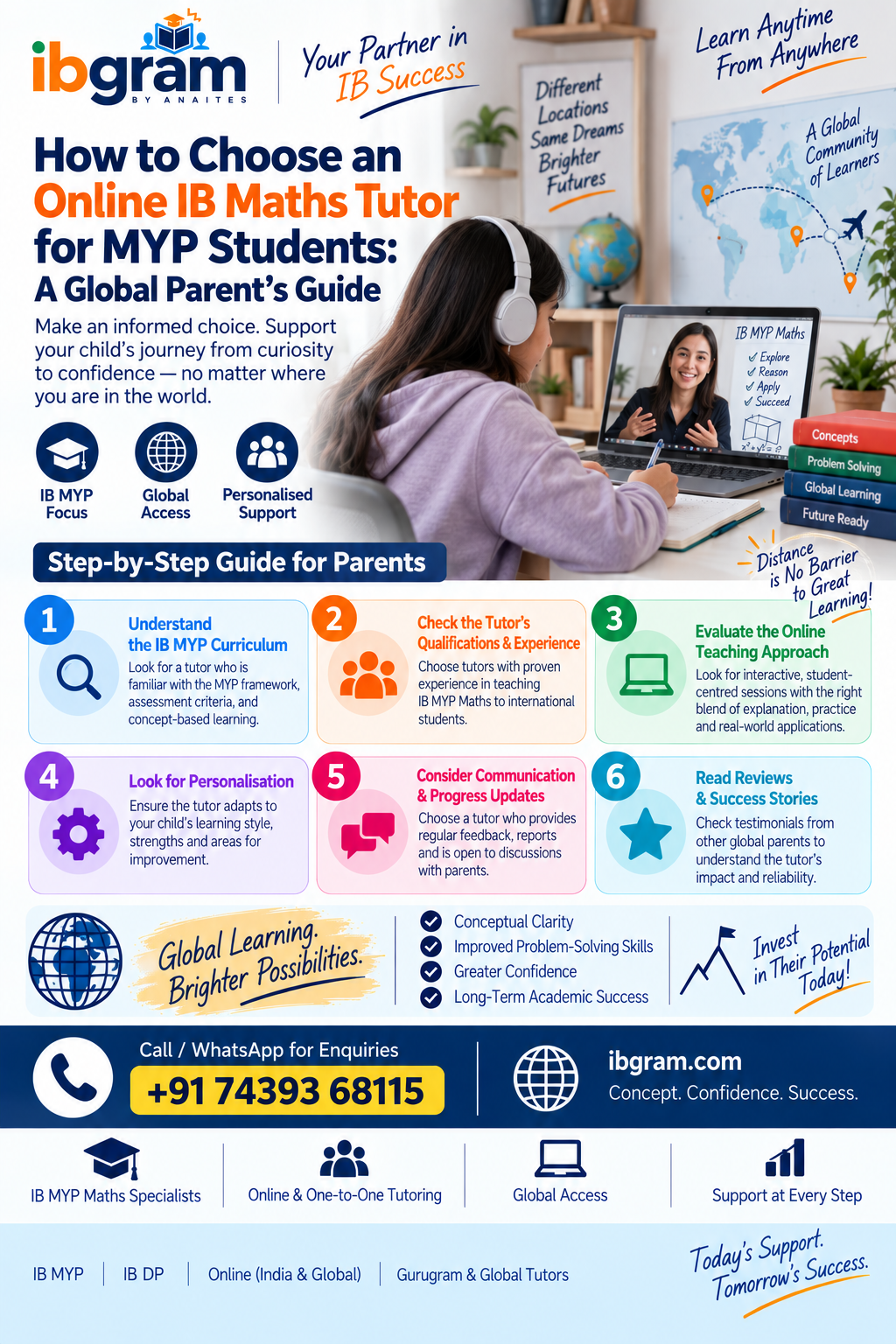
Online tutoring has become a popular option for students preparing for IGCSE Maths. Lessons can be conducted from home using a computer or tablet, which can make scheduling more flexible.
One major advantage of online learning is convenience.
Students do not need to travel to a tuition centre or wait for a tutor to arrive. A lesson can take place from a familiar study environment with the required books, notes, calculator, and other resources already available.
Online tutoring can also provide access to tutors who may not be located close to the student's home.
Another benefit is the use of digital resources. Tutors can share worksheets, mathematical diagrams, practice questions, past papers, and other study material during the lesson.
For example, a tutor can display an algebraic problem on screen and work through each step with the student.
Consider:
2x + 7 = 19
The student can work through:
2x = 12
x = 6
The tutor can then provide similar questions immediately and check the student's working.
Online lessons can also be useful for students who are comfortable using technology and communicating through a screen.
However, online learning has limitations.
Some students find it difficult to maintain concentration during long screen-based sessions. Internet connectivity can also affect the lesson experience.
Another challenge is that the tutor cannot always observe the student's physical working environment. A student may become distracted by other websites, notifications, games, or unrelated activities.
Younger students may also require more supervision during online sessions.
Online learning can therefore work particularly well when the student is disciplined, comfortable with technology, and able to remain focused throughout the lesson.
H2: Benefits of Home Tuition
Home tuition provides direct, face-to-face interaction between the student and tutor.
For many IGCSE Maths students, this can make it easier to ask questions, explain confusion, and receive immediate feedback.
A home tutor can observe how a student approaches a problem and identify mistakes while the student is working.
For example, suppose a student is solving:
3(x + 4) = 24
The student may incorrectly write:
3x + 4 = 24
A tutor sitting with the student can immediately identify that the 3 has not been multiplied by both terms inside the bracket.
The correct expansion is:
3x + 12 = 24
3x = 12
x = 4
This type of immediate correction can be useful for students who make repeated procedural mistakes.
Home tuition can also provide a more controlled learning environment.
The student can keep textbooks, past papers, notebooks, and stationery ready for the lesson without needing to switch between multiple digital tools.
Face-to-face tutoring may also help students who learn better through direct conversation and handwritten working.
Another benefit is flexibility within the lesson itself.
If a student is struggling with a particular topic, more time can be spent on that concept. If a topic has already been mastered, the tutor can move forward to more challenging examination-style questions.
This can be particularly useful for IGCSE Maths because students often have different strengths across different areas of the syllabus.
For example, a student may be confident in number and statistics but require additional support in algebra and trigonometry.
A home tutor can adjust the lesson accordingly.
Home tuition also eliminates many of the distractions associated with travelling to a coaching centre.
However, home tuition may have practical limitations. Tutor availability can depend on location and schedule. Travel time can also affect lesson planning.
Families therefore need to consider both academic requirements and practical convenience before choosing this format.
H2: IB Gram Hybrid Model
A hybrid tutoring model can combine useful elements of online and home-based learning.
For example, a student may use face-to-face tutoring for difficult concepts and online resources for additional practice.
This can create a flexible study routine.
A student preparing for IGCSE Maths may use a tutoring session to understand a difficult topic and then complete practice questions independently using digital resources.
Past papers can also be shared digitally and discussed during a later lesson.
The advantage of this approach is that tutoring does not have to be limited to one format.
For families considering IB Gram for IGCSE Maths support, the appropriate arrangement can depend on the student's needs, location, schedule, and preferred learning style.
A student who needs regular face-to-face guidance may benefit more from home tuition.
A student who is independent and comfortable with technology may find online learning more convenient.
Another student may benefit from a combination of both.
The important part of a hybrid model is maintaining consistency.
Regardless of whether the lesson takes place online or at home, students should have clear weekly objectives.
For example:
Revise one syllabus topic.
Complete targeted practice questions.
Attempt selected past paper questions.
Review previous mistakes.
Record new errors.
Practise timed questions.
This keeps the student's preparation structured.
The tutoring format should support the learning plan rather than become the focus itself.
H2: Ajay Vatsyayan Offline Advantage
Face-to-face mathematics tutoring can provide certain advantages for students who prefer direct interaction.
An offline lesson allows the tutor and student to work through questions together using paper, textbooks, diagrams, and handwritten calculations.
This can be particularly helpful when solving multi-step problems.
For example, consider a geometry problem where several angles and lengths are given.
A student may find it easier to draw the diagram on paper, label the known information, and discuss the solution directly with the tutor.
The tutor can then ask questions such as:
Which angle rule applies?
Which information is already known?
What needs to be calculated first?
Can the answer be checked using another method?
This encourages mathematical reasoning rather than simply copying a solution.
Face-to-face tutoring can also make it easier to notice when a student is uncertain.
Sometimes a student may say that they understand a topic but make repeated errors while solving questions. Direct observation of the student's working can help reveal where the misunderstanding occurs.
For students who need regular accountability, an offline tutoring routine can also create a clear study structure.
However, families should still evaluate tutor suitability based on teaching quality, subject knowledge, communication, experience with the relevant IGCSE syllabus, and the student's individual requirements.
The fact that a lesson is offline does not automatically make it better. The quality of teaching remains more important than the format alone.
Similarly, online tutoring can be highly effective when the student is engaged and the teaching approach is well structured.
H2: Final Verdict
There is no single tutoring format that is best for every IGCSE Maths student.
Online tutoring can be a strong choice for students who value flexibility, convenience, digital resources, and access to tutors beyond their immediate area.
Home tuition can be a strong choice for students who prefer face-to-face interaction, direct supervision, handwritten problem solving, and a structured learning environment.
The decision should be based on the student's actual needs.
Parents can consider the following questions:
Does my child concentrate well during online lessons?
Does my child prefer face-to-face teaching?
Does the student need frequent supervision?
Is the student comfortable using digital learning tools?
Does the student need intensive support in particular topics?
How important is travel and scheduling flexibility?
Is the tutor experienced with the student's IGCSE syllabus?
Can the tutor provide regular practice and feedback?
For students in Gurugram, families can compare available tutoring arrangements in their locality, including areas such as DLF Phase 2 and Sector 54.
The most important objective is to create a consistent learning system.
Whether the student studies online or with a home tutor, successful IGCSE Maths preparation should include clear concept building, regular practice, past paper solving, error correction, and revision.
A suitable tutor should help the student become more confident and independent rather than simply providing answers.
Ultimately, the best choice is the format that allows the student to learn effectively, stay consistent, ask questions freely, and make measurable progress towards the desired IGCSE Maths grade.
Need a tutor for this subject?
Share your city, programme stage and subject — the IB Gram advisor team replies with a small, honest shortlist.