IGCSE Maths Home Tutor vs Coaching
Compare IGCSE Maths home tuition and coaching to understand the differences in personalised learning, tutor matching, teaching methods, cost, and academic results.

H1: Home Tutor vs Coaching for IGCSE Maths
Choosing the right learning environment for IGCSE Maths can make a significant difference to a student's preparation. Parents often have to decide between individual home tuition and coaching classes, and both options can offer useful academic support.
The important question is not which option is universally better. The better question is which option is more suitable for the individual student.
Some students perform well in a classroom environment and enjoy learning with other students. They may benefit from group discussions, shared practice, and a fixed academic routine.
Other students need more individual attention. They may have specific weaknesses that require additional explanation or may benefit from learning at a pace that is different from the rest of the class.
IGCSE Maths also requires students to develop several different skills. They need to understand concepts, apply mathematical methods, solve unfamiliar problems, manage examination time, and reduce repeated mistakes.
Because students have different strengths and weaknesses, the choice between home tutoring and coaching should be made carefully.
For families in Gurugram, both options may be available depending on the student's location, schedule, syllabus, and academic requirements.
IB Gram can be considered by families looking for a structured tutor-matching approach, while Ajay Vatsyayan Classes can be considered by students looking for personalised Mathematics teaching and problem-solving support.
This guide compares home tutoring and coaching for IGCSE Maths and explains which factors parents should consider before making a decision.
H2: Key Differences
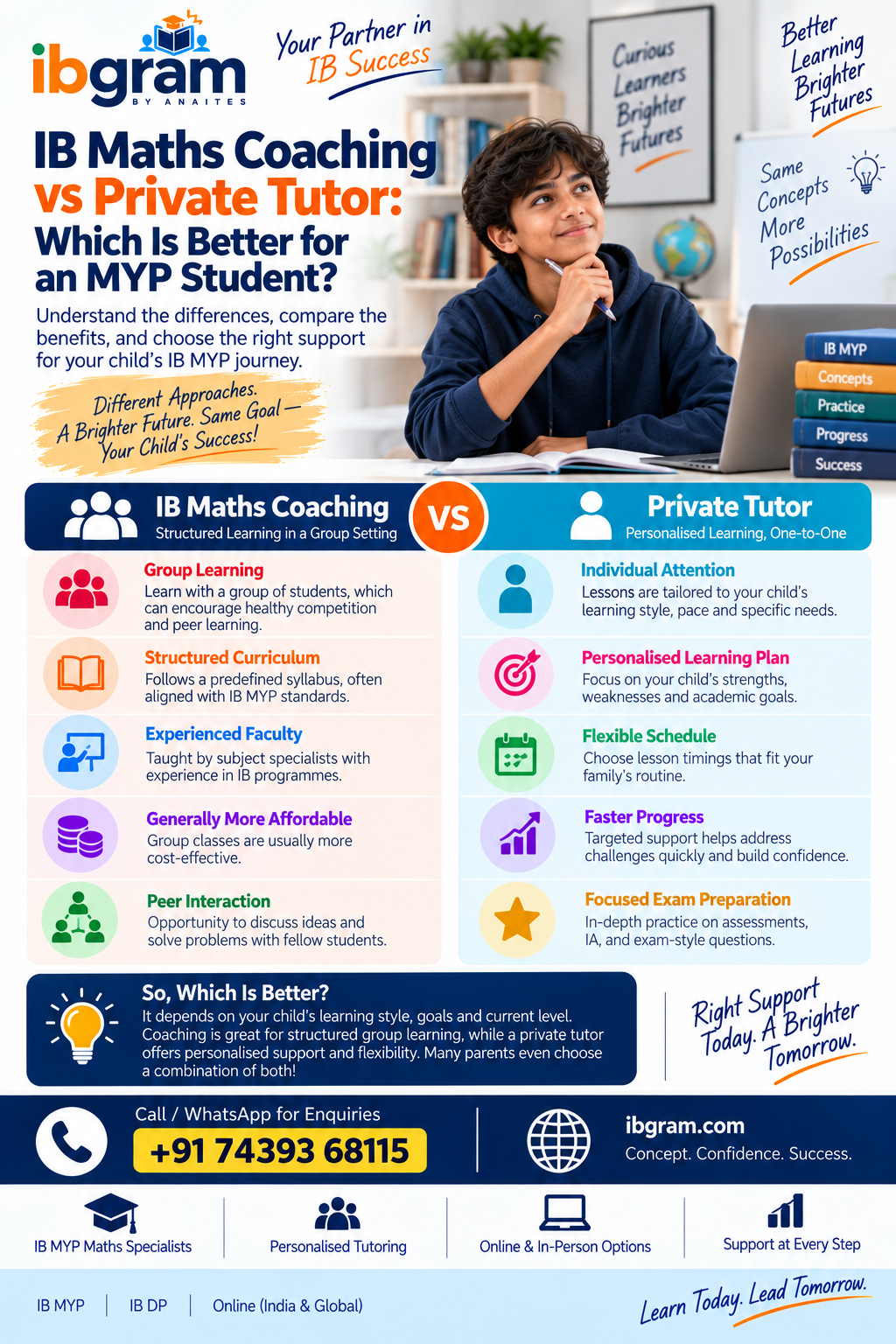
The biggest difference between home tutoring and coaching is the level of individual attention.
In a coaching centre, one teacher generally works with a group of students. The teacher follows a planned curriculum and moves through the syllabus according to the schedule of the group.
This can be useful for students who are comfortable learning at a common pace.
Home tutoring is different because the tutor works directly with one student. The lesson can therefore be adjusted according to the student's understanding, weaknesses, questions, and progress.
If a student needs more time with algebra, the tutor can spend additional time on algebra.
If the student already understands a particular topic, the tutor can move towards more challenging applications.
This flexibility can be particularly useful in IGCSE Maths because students can have very different levels of understanding even when they are studying the same syllabus.
Another difference is classroom interaction.
Coaching centres allow students to learn alongside peers. Some students find this motivating because they can see how other students approach questions and experience a sense of competition.
Home tutoring provides a quieter and more individual environment.
The student can ask questions without worrying about the pace of a larger group.
The tutor can also observe the student's working process more closely.
The pace of teaching is another major difference.
In a coaching environment, the teacher generally has to maintain the planned pace of the class.
If most students understand a topic, the class may move forward even if a few students need more explanation.
A private tutor can adjust the pace according to one student's needs.
This does not mean that home tuition is automatically better.
A student who prefers a structured classroom and is comfortable keeping pace with other students may benefit from coaching.
Another difference is feedback.
In individual tutoring, the tutor can review the student's work immediately and identify specific mistakes.
In a group class, feedback may be less personalised because the teacher has several students to support.
Cost can also differ.
Coaching centres may have a lower cost per student because the teacher works with a group.
Home tuition may cost more because the teaching is individualised.
Parents should therefore compare the overall value rather than looking only at the hourly price.
Convenience is another factor.
Home tuition can reduce travel because the tutor can teach at the student's home, depending on availability.
Coaching requires the student to travel to the centre unless an online option is available.
Online learning can provide another alternative for families who want flexibility or access to tutors outside their immediate location.
The student's personality also matters.
Some students enjoy group learning.
Others concentrate better when working individually.
Some students are comfortable asking questions in front of classmates.
Others hesitate to ask questions in a group.
Parents should therefore consider the child's learning preferences rather than selecting a format based only on popularity.
The student's academic level is also important.
A student who has significant gaps may benefit from individual attention.
A student who is already performing strongly may benefit from a competitive group environment and advanced practice.
The right choice depends on the individual situation.
H2: Benefits of 1:1 Tutoring
One-to-one tutoring provides an environment where the entire lesson can focus on the student's needs.
This is one of the biggest advantages of home tuition for IGCSE Maths.
The tutor can identify which concepts the student understands and which concepts require additional attention.
The pace can then be adjusted accordingly.
For example, suppose a student understands basic algebra but struggles with equations involving several steps.
The tutor can focus specifically on that weakness.
The student does not have to wait for an entire class to reach the topic again.
Similarly, if a student understands a topic quickly, the tutor can introduce more challenging questions instead of spending unnecessary time repeating material the student already knows.
Individual tutoring can also encourage students to ask more questions.
Some students hesitate to ask questions in a classroom because they do not want to slow down the lesson or appear confused.
In a one-to-one environment, the student can ask for clarification whenever necessary.
This can help uncover misunderstandings that might otherwise remain unnoticed.
Another benefit is personalised feedback.
The tutor can observe how the student approaches a question.
They can identify whether the problem is conceptual understanding, method selection, calculation accuracy, question interpretation, or time management.
This allows the tutor to provide more targeted guidance.
One-to-one tutoring can also be useful for students with different academic goals.
A student who wants to improve a weak grade may need foundational support.
A student targeting an A or A* may need advanced problem solving, mixed-topic practice, past papers, and examination strategy.
The same teaching plan does not need to be used for both students.
The tutor can adapt the preparation according to the target.
Another advantage is flexibility in lesson planning.
A tutoring session can focus on schoolwork when necessary.
It can also focus on examination questions, difficult topics, revision, or past-paper analysis.
This can make tutoring more responsive to the student's academic situation.
Home tuition may also provide convenience for families.
The student can study in a familiar environment without spending additional time travelling to a coaching centre.
This can be particularly useful for busy students with demanding school schedules.
However, one-to-one tutoring requires consistency.
The student needs to attend lessons regularly and complete independent practice between sessions.
The tutor can provide guidance, but the student still needs to practise.
Parents should also make sure that the tutor is familiar with the student's exact IGCSE Mathematics syllabus.
A tutor should understand the course requirements and examination style relevant to the student's preparation.
Another benefit is progress tracking.
Because the tutor works with one student, it can be easier to observe changes in accuracy, confidence, speed, and problem-solving ability.
The tutor can identify recurring mistakes and adjust future lessons accordingly.
One-to-one tutoring can therefore provide a highly personalised preparation environment.
Its effectiveness, however, depends on the quality and suitability of the tutor.
H2: IB Gram’s Tutor Matching Advantage
IB Gram can be considered by families looking for a structured approach to finding suitable IGCSE Maths tutoring support.
Finding a tutor is not simply about choosing someone who teaches Mathematics.
Parents should consider whether the tutor is suitable for the student's specific syllabus, academic level, target, learning style, location, and schedule.
Tutor matching can help bring these factors together.
The first consideration should be the student's syllabus.
Parents should confirm whether the student is preparing for IGCSE Mathematics 0580, Additional Mathematics 0606, 0607, or another relevant course.
The tutor should have appropriate familiarity with the student's syllabus.
The student's current academic level is another important factor.
A student struggling with foundational concepts may need a tutor who focuses on building understanding.
A student who is already performing strongly may need more advanced problem-solving and examination practice.
The student's target should also be considered.
Some students want to improve their current grade.
Others want to prepare for a specific examination session.
Some students are aiming for the highest possible grade.
These different goals can require different tutoring strategies.
Learning style is also important.
A student may prefer detailed explanations.
Another may learn better through examples and question practice.
Some students need a patient pace.
Others prefer challenging questions and faster progression.
A suitable tutor should be able to adapt to these requirements.
Location can also matter for families in Gurugram.
Parents looking for home tuition may want to consider whether the tutor is available in their area and whether the schedule can be maintained consistently.
Areas such as DLF Phase 1, DLF Phase 2, DLF Phase 3, DLF Phase 4, DLF Phase 5, Sector 54, Golf Course Road, and surrounding neighbourhoods can have different travel considerations.
Online tutoring can provide another option if a suitable tutor is not available nearby.
The student's school timetable should also be considered.
Tutoring should support the student's overall academic routine rather than create unnecessary pressure.
IB Gram's tutor-matching approach can help parents consider these factors before selecting academic support.
Another important consideration is the student's progress.
Parents should understand how the tutor will identify weaknesses and measure improvement.
This can include topic-based practice, school assessments, mixed questions, timed exercises, past papers, and error analysis.
The objective should be to find support that fits the student rather than simply selecting a tutor because they are popular.
A suitable tutor should help the student develop understanding, accuracy, confidence, problem-solving ability, and independence.
H2: Ajay Vatsyayan’s Personalized Teaching
Ajay Vatsyayan Classes can be considered by students looking for focused Mathematics teaching and personalised problem-solving preparation.
Personalised teaching begins with understanding the student's current academic position.
The tutor can identify which topics are strong and which areas require additional attention.
The teaching plan can then be adjusted accordingly.
One important part of personalised Mathematics teaching is concept clarity.
Students should understand mathematical ideas rather than simply memorise procedures.
For example, a student should understand why a particular algebraic method works and when it should be used.
This becomes particularly important when examination questions are presented in unfamiliar ways.
Personalised teaching can also focus on problem solving.
Students should learn how to read a question, identify relevant information, determine what needs to be found, select an appropriate method, and check the result.
This process can be practised repeatedly until it becomes more natural.
Another important area is error correction.
When students make mistakes, the tutor should identify the reason.
The problem may be a weak concept.
It may be an incorrect method.
It may be a calculation error.
It may be a misunderstanding of the question.
It may also be related to time pressure.
Different mistakes require different solutions.
Personalised teaching makes it easier to focus on the specific cause.
Past papers can also be integrated into the learning process.
Students can begin with individual examination-style questions and gradually move towards mixed sections and complete papers.
The tutor can then analyse the student's performance and identify areas that need improvement.
Students can also receive guidance on examination technique.
This can include reading questions carefully, following accuracy instructions, showing appropriate working, managing time, and checking answers.
Another benefit of personalised teaching is the ability to adjust the difficulty level.
Students should not spend all their time solving questions that are far below their ability.
At the same time, they should not be pushed continuously into questions that are beyond their current understanding.
A good progression moves from understanding to application and then towards more challenging problem solving.
The tutor can also encourage independent thinking.
Instead of immediately providing a solution when a student is stuck, the tutor can ask guiding questions.
What information is given?
What needs to be found?
Which topic could be relevant?
Have you solved a similar problem?
What mathematical relationship might connect the information?
This helps students develop their own problem-solving process.
Personalised teaching can therefore be particularly useful for students who need support that changes according to their progress.
H2: Cost vs Results Analysis
Cost is an important consideration when comparing home tuition and coaching.
However, parents should avoid choosing an option based only on the lowest price.
The more useful question is whether the learning format provides sufficient value for the student's needs.
Coaching classes can sometimes be more affordable because the teacher works with multiple students at the same time.
This can make coaching attractive for families who want a structured group-learning environment.
However, a lower cost does not automatically mean better value.
If a student requires individual attention and continues to struggle with the same concepts in a large group, additional support may eventually be required.
Home tuition can have a higher cost because the student receives individual attention.
The tutor's time is focused on one student, and the lesson can be adjusted according to the student's needs.
This can be valuable when the student has specific weaknesses or a demanding academic target.
Parents should therefore consider the student's starting level.
A student who is already confident and performing well may not require intensive individual tutoring.
A student with significant gaps may benefit more from personalised support.
The target grade also matters.
A student aiming to improve basic understanding may need a different level of support from a student preparing for a highly competitive academic target.
Time should also be considered.
If a student spends several hours travelling to and from coaching sessions every week, the practical cost includes more than the coaching fee.
Home tuition may reduce travel time.
Online tutoring can also reduce travel requirements.
Another factor is consistency.
The most expensive tutoring programme is not useful if the student cannot maintain regular attendance or independent practice.
The most affordable coaching programme is also not necessarily useful if the student cannot keep up with the class.
Parents should consider whether the student can realistically follow the chosen format.
Results should also be evaluated carefully.
No tutor or coaching centre can guarantee a particular examination grade for every student.
Academic performance depends on many factors, including the student's starting level, effort, attendance, practice, understanding, examination performance, and preparation time.
Instead of looking for guaranteed results, parents should evaluate whether the tutoring process is helping the student make measurable progress.
Useful indicators can include stronger conceptual understanding, fewer repeated mistakes, better accuracy, improved problem solving, stronger timing, increased confidence, and greater independence.
This makes cost-versus-results analysis more realistic.
The right investment is the one that addresses the student's actual academic needs.
H2: Final Recommendation
There is no single answer to whether an IGCSE Maths home tutor or coaching centre is better.
The right choice depends on the student.
Home tuition can be particularly useful for students who need individual attention, personalised pacing, targeted revision, and direct feedback.
It can also be useful for students who have specific weaknesses or require focused examination preparation.
Coaching can be a suitable option for students who enjoy group learning, prefer a structured classroom environment, and are comfortable following a common pace.
Parents should therefore evaluate the student's personality, academic level, learning style, target grade, schedule, and syllabus before making a decision.
The exact IGCSE Mathematics syllabus should always be confirmed before selecting academic support.
Students preparing for 0580 may have different requirements from students preparing for 0606 or 0607.
The tutor or coaching programme should be appropriate for the student's course.
For families considering home tuition in Gurugram, location and scheduling should also be evaluated.
A tutor should be available consistently enough to maintain regular lessons.
IB Gram can be considered by families looking for a structured tutor-matching approach that takes individual requirements into account.
Ajay Vatsyayan Classes can be considered by students looking for personalised Mathematics teaching, conceptual understanding, problem solving, and examination preparation.
Parents should also look at how progress is measured.
A useful tutoring arrangement should help students understand their weaknesses and work towards correcting them.
Regular practice, error analysis, mixed-topic questions, and past-paper preparation can all contribute to stronger examination readiness.
The most important factor is not whether the student chooses home tuition or coaching.
The most important factor is whether the chosen learning environment helps the student learn effectively.
If a student needs individual attention and is struggling to keep pace with a group, home tutoring may be the more suitable option.
If a student is comfortable in a classroom and benefits from group motivation, coaching may work well.
Some students may also benefit from a combination of approaches.
For example, a student may attend school and coaching while receiving occasional individual support for specific weaknesses.
Another student may use home tuition as the main form of additional academic support while practising independently between lessons.
The best approach is therefore flexible and student-focused.
Parents should avoid choosing a format simply because it is popular or inexpensive.
They should consider what the student actually needs.
A suitable learning environment should help the student build conceptual understanding, improve accuracy, develop problem-solving skills, manage examination time, and become more independent.
When these factors are considered carefully, parents can make a more informed decision about IGCSE Maths preparation.
The ultimate goal is not simply to complete lessons.
It is to help the student become capable of solving Mathematics problems confidently and independently under examination conditions.
Need a tutor for this subject?
Share your city, programme stage and subject — the IB Gram advisor team replies with a small, honest shortlist.