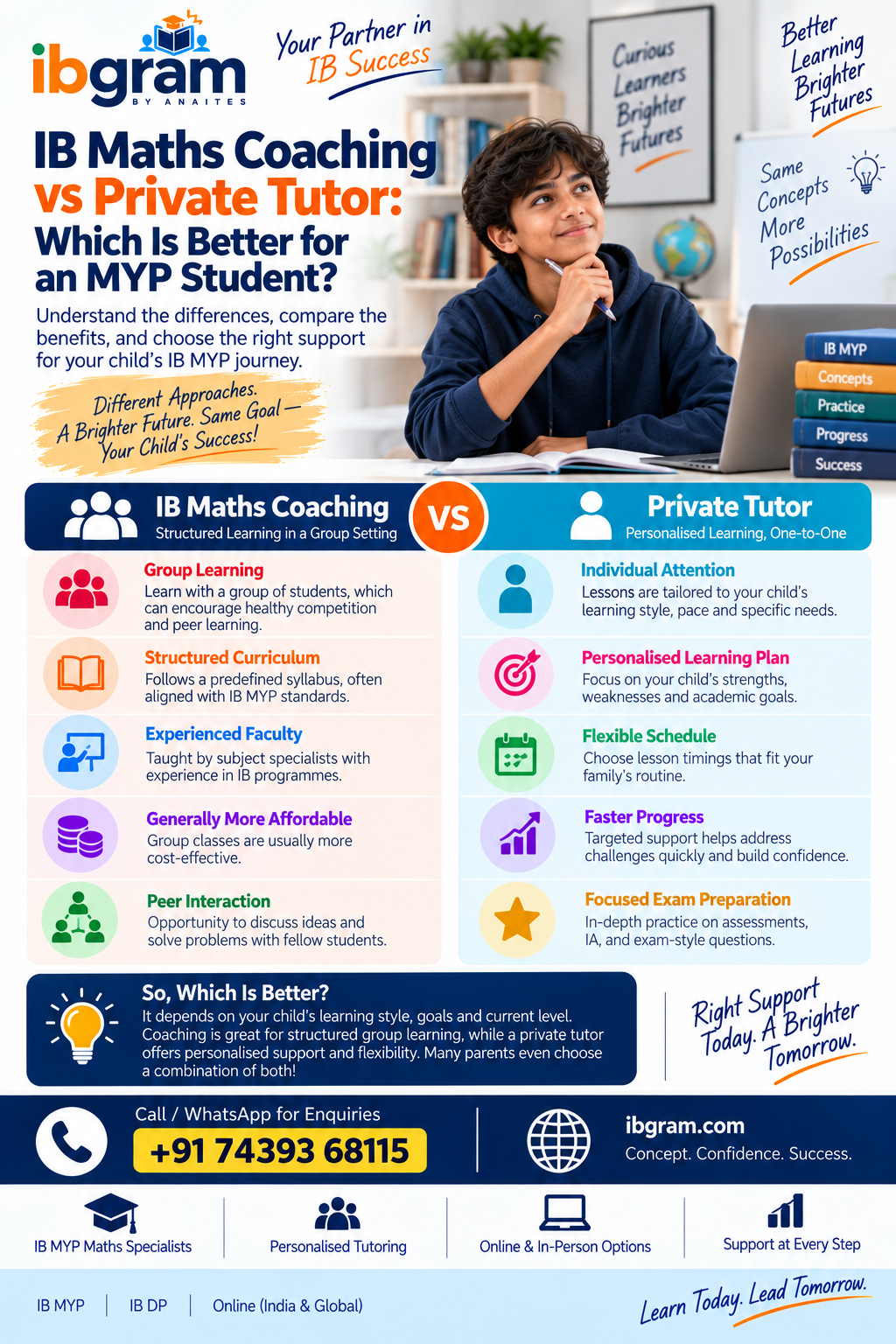
Why Ajay Vatsyayan Sir is the Most Trusted IB MYP Mathematics Tutor for Pathways & Heritage School Students in Gurgaon
IB MYP Mathematics demands far more than formula memorisation. For students at Pathways, Heritage and other premium IB schools in Gurgaon, success requires conceptual clarity, inquiry-based thinking, real-life application and the ability to communicate mathematical reasoning. Discover how Ajay Vatsyayan Sir and IB Gram approach MYP Mathematics through personalised, concept-first mentoring.

Why Ajay Vatsyayan Sir is the Most Trusted IB MYP Mathematics Tutor for Pathways & Heritage School Students in Gurgaon
For many parents, the first sign that their child is finding IB Mathematics difficult is not necessarily a poor test score.
It may be something much subtler.
The student understands the formula but cannot explain why it works. They can solve a familiar textbook question but struggle when the same concept appears in an unfamiliar context. They may know the mathematics but lose marks because their reasoning is incomplete, their communication is unclear, or their real-world interpretation is weak.
And then there are the questions parents start asking:
What exactly are Criteria A, B, C and D?
Why does my child understand the chapter but still lose marks?
What is different about MYP Mathematics compared with traditional mathematics?
How should an MYP 5 student prepare for an eAssessment?
Does my child need more worksheets—or a completely different way of learning mathematics?
For students studying at schools such as Pathways and Heritage in Gurgaon, these questions are particularly important because the IB MYP approach is designed around more than procedural mathematics.
It asks students to think, investigate, communicate, connect and apply.
That is where specialised mentoring can make a significant difference.
For families looking for an IB MYP Maths tutor in Gurgaon, Ajay Vatsyayan Sir, founder of IB Gram, focuses on a concept-first approach designed around the way IB students are expected to learn and demonstrate mathematics.
The objective is not simply to help a student finish another worksheet.
It is to help the student understand the mathematics deeply enough to approach unfamiliar problems with confidence.
Students don’t just solve questions — they begin to think like mathematicians.
Why IB Mathematics Feels Different—and Often More Difficult
A student transitioning from a conventional mathematics environment to the IB MYP can experience an interesting contradiction.
The mathematics itself may not always be dramatically more advanced.
Yet the questions can feel much harder.
Why?
Because the student is no longer being assessed only on whether they can obtain the correct numerical answer.
They are increasingly expected to demonstrate understanding, investigation, communication and application.
Consider a conventional question:
Solve the equation \(2x + 5 = 17\).
A student learns a procedure, applies it and gets:
$$ x = 6 $$
Correct.
Now imagine that the same mathematical idea is embedded into a real-world situation involving pricing, distance, growth, geometry, data or a pattern.
Suddenly, the student has to decide:
What information matters? What mathematical model should be used? Which representation is appropriate? What assumptions are being made? How should the solution be communicated? Does the final answer make sense in the context?
This is a different type of mathematical thinking.
That distinction is central to the IB MYP.
Understanding IB MYP Mathematics Criteria A, B, C and D
One of the biggest sources of confusion for parents is the four MYP Mathematics assessment criteria.
A student may say:
“I got the answer right. Why didn't I get full marks?”
The answer often lies in understanding what the task is actually assessing.
Criterion A — Knowing and Understanding
Criterion A focuses on mathematical knowledge and understanding.
Students need to demonstrate that they understand mathematical concepts, terminology, facts, procedures and relationships.
But genuine understanding goes beyond memorising formulas.
Suppose a student knows the quadratic formula.
That is useful.
But a deeper understanding means knowing:
when the formula should be used, what the different components represent, how the result relates to the original problem, how to check whether the solution is reasonable.
This is why concept-first teaching is so important.
At IB Gram, the aim is to establish the mathematical idea first and then build the procedural fluency around it.
The student should not simply remember:
“This is the formula I use.”
They should understand:
“This is why this method works, and this is when I should use it.”
Criterion B — Investigating Patterns
Criterion B is where many students discover that mathematics is not simply about getting an answer.
It is about discovering relationships.
Students may be presented with a sequence, geometric relationship, numerical pattern or changing situation and asked to investigate it.
A strong response requires students to:
identify patterns, organise observations, make conjectures, test those conjectures, identify relationships, generalise findings.
This is fundamentally different from rote practice.
Imagine a student is given a sequence:
$$ 3,\ 7,\ 11,\ 15,\ 19,\ldots $$
A student who has memorised arithmetic progression formulas may immediately write an answer.
But an IB-style investigation may ask:
What pattern do you observe? Can you formulate a general rule? How can you justify it?
Now the student has to think.
This is why Criterion B often becomes a turning point for MYP students.
The student needs to move from:
“I know the formula.”
to:
“I can identify and explain the relationship.”
An experienced IB Maths Extended tutor in Gurgaon should therefore not treat Criterion B as a separate worksheet topic.
Pattern investigation needs to become part of the student's broader mathematical thinking.
Criterion C — Communicating
Mathematics is a language.
And in IB Mathematics, students are expected to use that language effectively.
A correct answer with unclear reasoning may not demonstrate the same level of achievement as a well-structured mathematical argument.
Students need to learn how to:
use appropriate mathematical terminology, organise solutions logically, show relevant working, use representations effectively, explain relationships, communicate conclusions clearly.
This can be particularly challenging for students who have traditionally been rewarded for simply writing the final answer.
At IB Gram, mathematical communication is treated as part of mathematical understanding—not as decoration added at the end.
A student should be able to explain:
What did I do?
Why did I do it?
What does the result mean?
How does my conclusion answer the original question?
That is a major shift in mathematical maturity.
Criterion D — Applying Mathematics in Real-Life Contexts
Criterion D connects mathematics with the world outside the mathematics classroom.
Students may have to use mathematics to analyse situations involving:
finance, architecture, measurement, statistics, population, sport, sustainability, business, science, technology, probability, everyday decision-making.
The challenge is not merely calculating.
It is modelling and interpreting.
For example, a student might calculate the average of a dataset.
But a deeper question could be:
What does this average tell us about the real-world situation?
Or perhaps:
Is the average an appropriate measure here?
That final layer—interpretation—is where many students struggle.
This is why a specialised Pathways School maths tutor should understand the difference between teaching a mathematical operation and teaching mathematical application.
Why Pathways & Heritage Students Benefit from Specialised IB Mathematics Mentoring
Students at premium international schools often experience a learning environment that is fundamentally different from conventional examination-oriented schooling.
Schools such as:
Pathways World School Gurgaon – Aravali Retreat, Sohna Road, Gurugram Pathways School Gurgaon – Off NH-48, near Cyber City The Heritage School Gurgaon – Golf Course Extension Road The Shri Ram School Aravali Amity Global School Gurgaon
serve families who often expect their children to develop analytical thinking alongside academic performance.
In such an environment, mathematics cannot always be approached as:
Chapter → Formula → Worksheet → Test.
Students are expected to engage with mathematical ideas.
They may encounter inquiry-based tasks, investigations, contextual problems, digital assessments and extended reasoning.
This creates a particular need for specialised tutoring.
A tutor who is excellent at teaching conventional mathematics is not automatically the ideal mentor for an IB MYP student.
The tutor needs to understand how the student is expected to demonstrate mathematical thinking.
Introducing Ajay Vatsyayan Sir and IB Gram
Ajay Vatsyayan Sir is the founder of IB Gram, with a specialised focus on IB Mathematics mentoring.
His teaching approach is centred around a simple principle:
Understand first. Solve second.
The focus extends across IB programmes and mathematical pathways, including:
IB MYP Mathematics, MYP Mathematics Standard, MYP Mathematics Extended, IB DP Mathematics AA, IB DP Mathematics AI.
For MYP students, this means connecting classroom concepts with the assessment expectations of the programme.
Instead of asking students to memorise a large number of disconnected techniques, the emphasis is placed on understanding relationships between concepts.
The student learns to ask:
Why?
How do I know?
What happens if the conditions change?
Can I represent this differently?
Where could this mathematics be applied?
These questions create stronger mathematical thinkers.
The IB Gram Teaching Philosophy: Concept → Pattern → Application → Expression
A powerful way to understand Ajay Vatsyayan Sir's approach is through four stages:
- 1Concept
First, the student understands the underlying mathematical idea.
For example, before applying a formula, the student should understand the relationship represented by that formula.
- 1Pattern
Once the concept is understood, the student begins recognising mathematical patterns.
This helps them approach unfamiliar questions instead of depending entirely on memory.
- 1Application
The concept is then connected to real-world and unfamiliar situations.
This is especially important for IB MYP Mathematics, where contextual understanding matters.
- 1Expression
Finally, the student learns to communicate the mathematics.
They learn to present:
reasoning, working, diagrams, equations, interpretations, conclusions.
This four-stage progression creates a more complete mathematical learner.
“Why” Before “How”
One of the most common weaknesses in mathematics is procedural dependency.
A student knows how to solve a particular question but does not know why that method works.
That becomes a serious problem when the question changes.
Suppose the student has practised ten questions that look almost identical.
They can solve all ten.
Then the eleventh question is presented in a different context.
The student freezes.
This is often not a lack of intelligence.
It is a lack of conceptual transfer.
A concept-first IB MYP tutor works differently.
Instead of teaching only the method, the tutor asks:
What is happening mathematically? Why does this relationship exist? Can we visualise it? Can we represent it algebraically? Can we explain it in words? What changes if one variable changes?
Once students understand the structure underneath the question, unfamiliar problems become less intimidating.
Visual and Intuitive Mathematics
Not every student learns mathematics effectively through symbols alone.
Sometimes an equation needs to become a picture.
Sometimes a graph needs to become a story.
Sometimes a numerical relationship needs to be physically or visually represented before the student can truly understand it.
For example, algebra can be introduced through balance and relationships.
Geometry can be explored visually.
Functions can be connected to input-output relationships.
Statistics can be connected to real datasets.
Probability can be understood through experiments and simulations.
The purpose is not to make mathematics “easier” by avoiding difficult ideas.
The purpose is to make difficult ideas visible.
This is especially valuable for MYP students because inquiry and conceptual understanding are integral to the learning experience.
MYP 5 eAssessment Preparation: More Than Solving Past Papers
For students approaching MYP 5, preparation for assessment requires strategy.
Simply completing paper after paper is rarely enough.
Students need to become comfortable with the way mathematical questions are presented and the way their reasoning needs to be communicated.
MYP 5 eAssessment preparation can include:
concept revision, unfamiliar problem solving, timed practice, interpretation, mathematical communication, real-life applications, pattern investigations, structured response writing, error analysis.
Digital assessment also creates a different experience from traditional pen-and-paper examination.
Students should become comfortable thinking under time pressure while navigating the required digital environment.
The goal is not to teach students to fear the assessment.
It is to make the assessment environment familiar enough that they can focus their mental energy on mathematics.
Personalised 1-on-1 Home Tutoring in Gurgaon
One of the strongest advantages of individual mentoring is that there is nowhere for confusion to hide.
In a classroom, a student may understand 70% of a topic and quietly carry the remaining 30% forward.
Over time, that gap can become larger.
For example:
A student is comfortable with basic algebra.
But their understanding of factorisation is weak.
Then quadratic equations arrive.
Then functions.
Then modelling.
Suddenly, what appears to be a “quadratic equation problem” is actually an algebra foundation problem.
This is why personalised tutoring begins with diagnosis.
The question is not:
“Which chapter are you studying?”
It is:
“Where exactly is the student's mathematical thinking breaking down?”
Diagnostic Analysis: Finding the Real Gap
A strong tutoring relationship should begin with assessment—not assumptions.
A diagnostic approach may examine:
Conceptual gaps
Does the student understand the underlying concept?
Procedural gaps
Can the student execute the correct mathematical process?
Application gaps
Can the student transfer the idea to a new context?
Communication gaps
Can the student explain the reasoning clearly?
Examination gaps
Can the student perform under time constraints?
This distinction matters.
A student who is losing marks because of conceptual misunderstanding needs a different intervention from a student who understands everything but makes avoidable errors under time pressure.
Weekly Performance Tracking
Progress should not be measured only by occasional school examinations.
A student may improve significantly before the improvement becomes visible in a final grade.
Regular tracking can help identify:
recurring mistakes, weak concepts, improvement areas, timing problems, communication issues, confidence changes, topics requiring reinforcement.
The purpose of tracking is not to create pressure.
It is to create direction.
Parents should be able to understand not only:
“Is my child improving?”
but also:
“What exactly is improving?”
Past Paper Practice—But With a Strategy
Past papers are valuable.
But simply completing them is not a strategy.
A stronger approach involves analysing the paper after completion.
For example:
Step 1: Attempt independently
The student works under realistic conditions.
Step 2: Categorise mistakes
Was the error caused by:
knowledge, calculation, interpretation, reasoning, communication, time management? Step 3: Rebuild the concept
If the mistake reveals a conceptual gap, return to the underlying mathematics.
Step 4: Attempt a variation
The student then solves a different question testing the same idea.
Step 5: Reflect
The student explains what they learned from the error.
This transforms mistakes into data.
Improving Criteria B and D
For many MYP students, Criteria B and D can initially feel unfamiliar.
Why?
Because these criteria require students to go beyond procedural mathematics.
Improving Criterion B
Students can develop stronger pattern-investigation skills by regularly practising:
sequence analysis, visual patterns, algebraic generalisation, conjecture formation, testing, justification.
The student gradually learns that an investigation does not require immediately knowing the answer.
The process of discovering the answer is part of the mathematics.
Improving Criterion D
Students can improve real-life application skills by working with contextual problems involving:
percentages, finance, measurement, statistics, geometry, probability, optimisation, data interpretation.
The important question becomes:
“What does this mathematical answer mean in the real world?”
That one question can dramatically change how a student approaches mathematics.
A Typical IB Gram Session
Imagine an MYP student arrives for a session saying:
“I don't understand functions.”
A conventional tutoring session might immediately start solving function questions.
A concept-first session may begin differently.
The tutor asks:
“What do you think a function actually does?”
The student may initially struggle.
So the idea is represented visually.
An input goes in.
A mathematical rule operates.
An output comes out.
Then different examples are explored.
The student predicts.
The student tests.
The student notices a pattern.
Only then does the algebraic notation become central.
Now the student is not merely memorising:
$$ f(x)=2x+3 $$
They understand it as a relationship.
Then the complexity increases.
What happens if the coefficient changes?
What happens graphically?
What happens when the function is applied to a real situation?
How would the student explain it?
This is how mathematical confidence develops.
Not through making the mathematics artificially easy.
Through making the thinking progressively stronger.
From Confusion to Clarity
Consider a common student scenario.
An MYP student performs reasonably well in routine classroom exercises but struggles in investigations.
Their parent sees the results and thinks:
“My child knows mathematics. Why is the grade not higher?”
The answer may be that the student's mathematical knowledge is stronger than their mathematical communication and application.
The intervention therefore cannot simply be:
“Do 50 more questions.”
Instead, the student needs to practise explaining.
They need to investigate.
They need to justify.
They need to interpret.
Over time, the student begins recognising what the question is actually asking.
That is a meaningful transformation.
The student moves from:
“Which formula should I use?”
to:
“What mathematical relationship is this problem describing?”
That is the beginning of mathematical independence.
Why IB Gram Is Different From a Typical Tutor Network
Parents searching for an IB tutoring near me Gurgaon option may find many tutors and tutoring platforms.
But there is an important distinction between general academic tutoring and specialised IB mentoring.
Mass tutoring
Often designed around a large group of students following the same schedule.
Shortcut-based tutoring
Focused heavily on techniques, tricks and repetitive question types.
General mathematics tutoring
Strong on mathematics, but not necessarily specialised in IB assessment expectations.
Specialised IB mentoring
Designed around conceptual understanding, programme expectations, application and mathematical communication.
IB Gram aims to operate in the fourth category.
The emphasis is not on creating a high-volume coaching-centre environment.
It is on focused, personalised academic mentoring.
Why Premium IB Families Often Need a Different Kind of Support
Parents at international schools are not necessarily looking for another worksheet provider.
They are often looking for someone who understands the complete academic picture.
A student may have:
demanding school schedules, multiple subjects, projects, assessments, extracurricular commitments, internal deadlines, examination preparation.
Mathematics tutoring therefore needs to be efficient.
The objective should be to identify the highest-impact weaknesses and address them systematically.
This is where one-to-one mentoring can be particularly valuable.
Instead of spending an hour practising what the student already knows, the session can focus on the concept or skill that is actually limiting performance.
Home Tutoring Across Gurgaon and South Delhi
For families who prefer individual home tutoring, location is an important practical consideration.
IB Gram's mentoring approach can be relevant for students and families in areas such as:
DLF Phase 1, DLF Phase 2, DLF Phase 3, DLF Phase 4, DLF Phase 5, Golf Course Road, Golf Course Extension Road, Sushant Lok, Gurgaon/Gurugram, South Delhi.
For a family searching specifically for an IB home tutor DLF Phase 3, personalised tutoring at home can eliminate commuting and make it easier to integrate mathematics mentoring into the student's weekly schedule.
The same principle applies to families around Golf Course Road and neighbouring premium residential areas.
Why Parents Choose Mentorship Over “Just Tuition”
There is an important psychological difference between tuition and mentorship.
Tuition often answers:
“What should I do for this question?”
Mentorship asks:
“How should I think about this type of problem?”
The second question has greater long-term value.
A student who learns one method may solve ten questions.
A student who understands the underlying concept may eventually solve hundreds of variations.
That is the kind of independence IB education is designed to encourage.
Building Confidence Without Lowering Standards
There is a misconception that confidence comes from giving students easy questions.
In reality, sustainable confidence often comes from successfully overcoming difficult ones.
A student who initially says:
“I can't do this.”
can gradually learn to say:
“I don't understand this part yet.”
That small change is powerful.
The first statement closes the door.
The second opens it.
A good mentor creates enough structure for students to tackle challenging mathematics without feeling overwhelmed.
The standard remains high.
The support becomes better.
The Importance of Mathematical Language
One area often overlooked in tutoring is language.
An MYP student may understand a concept internally but struggle to articulate it.
For example, they may know that two variables are related but cannot clearly explain the relationship.
Or they may obtain a numerical result but fail to interpret it.
Teaching mathematical language helps students become more precise.
Words such as:
therefore, because, proportional, equivalent, increases, decreases, relationship, variable, assumption, approximately, hence,
are not simply vocabulary.
They are tools for mathematical reasoning.
This becomes especially important when students are being assessed on communication and reasoning.
Supporting Students at Different Ability Levels
Specialised tutoring should not be limited to students who are already high achievers.
An MYP student who is struggling significantly can benefit from a carefully structured foundation-building approach.
At the same time, a high-performing student may need something completely different.
They may need:
unfamiliar problem solving, deeper investigations, sophisticated modelling, exam strategy, advanced application.
The same tutor therefore needs to adapt the teaching approach to the student.
That is one of the central advantages of one-to-one mentoring.
The curriculum may be shared.
The learning path does not have to be.
What Makes an Effective IB MYP Maths Tutor?
Parents evaluating an IB MYP Maths tutor Gurgaon should consider more than the tutor's subject knowledge.
A strong tutor should ideally be able to answer:
Does the tutor understand MYP assessment criteria? Can they explain mathematical concepts intuitively? Can they help the student with unfamiliar questions? Do they understand mathematical communication? Can they develop real-life application skills? Do they analyse mistakes instead of simply correcting them? Can they adapt to the student's learning gaps? Do they understand the demands of MYP 5 assessment?
These questions are more meaningful than simply asking:
“How many years of tuition experience do you have?”
A Note for Parents of Pathways Students
Pathways students often operate in an academically stimulating environment.
Their challenge may not be a lack of exposure.
It may be that they are exposed to mathematics in ways that require a different kind of thinking.
If your child says:
“The questions at school are confusing.”
do not automatically assume they need more practice.
First determine what kind of confusion it is.
Is it:
conceptual confusion? language confusion? application confusion? mathematical notation? time pressure? lack of confidence? difficulty interpreting the question?
The solution depends on the diagnosis.
A Note for Heritage School Parents
For Heritage students, the same principle applies.
If a student can solve standard textbook questions but struggles with unfamiliar or contextual questions, the issue may not be mathematical ability.
It may be transfer of learning.
The student knows the mathematics in one format but cannot recognise it when the context changes.
A specialised mentor can help build that transfer.
The student learns to recognise:
“This looks different, but mathematically it is the same underlying idea.”
That is one of the most valuable skills a mathematics student can develop.
The Long-Term Goal: Mathematical Independence
The ultimate goal of tutoring should be to make tutoring less necessary over time.
That may sound counterintuitive.
But it is the right objective.
A successful mentor should gradually help the student:
Understand concepts independently. Recognise patterns independently. Choose appropriate methods. Check their own work. Explain their reasoning. Identify mistakes. Approach unfamiliar problems confidently.
The student becomes less dependent on someone telling them what to do.
That is genuine academic progress.
Why Ajay Vatsyayan Sir Can Be the Right Fit for IB MYP Students
For families specifically seeking specialised IB Mathematics support, Ajay Vatsyayan Sir's IB Gram approach is built around the areas that matter most to MYP learners:
Conceptual clarity.
Inquiry-oriented thinking.
Mathematical application.
Structured communication.
Assessment awareness.
Personalised mentoring.
The objective is not to create students who can simply reproduce solutions.
It is to develop students who can understand mathematical situations, make connections and communicate their thinking.
That distinction is important.
Because IB Mathematics is not ultimately about how many questions a student can solve.
It is about how effectively they can think mathematically.
Looking for an IB Maths Tutor in Gurgaon?
If you are a parent in Gurgaon searching for:
“IB tutoring near me Gurgaon”
or specifically looking for an IB Maths Extended tutor Gurgaon, the first step should be understanding your child's exact requirement.
Does the student need:
MYP foundation support? MYP 4 Mathematics? MYP 5 Mathematics? Standard or Extended Mathematics? Criterion B support? Criterion D application practice? eAssessment preparation? Internal assessment guidance? Exam strategy? Confidence rebuilding?
A personalised academic consultation can help identify the appropriate path.
The Right Mathematics Mentor Can Change How a Student Sees the Subject
Perhaps the most meaningful transformation is not moving from one grade to another.
It is changing the student's relationship with mathematics.
A student who once thought:
“Maths is confusing.”
can begin thinking:
“I can break this problem down.”
A student who used to ask:
“Which formula do I use?”
can begin asking:
“What relationship is the problem describing?”
And a student who once avoided difficult questions can begin approaching them with curiosity.
That is what strong mathematical mentoring should achieve.
Final Thoughts
IB MYP Mathematics requires a particular combination of skills.
Students need knowledge.
But knowledge alone is not enough.
They need to investigate patterns.
They need to communicate reasoning.
They need to apply mathematics to real situations.
They need to interpret results.
And above all, they need to develop the confidence to approach unfamiliar problems.
For students at Pathways World School Gurgaon, Pathways School Gurgaon, The Heritage School Gurgaon, The Shri Ram School Aravali and Amity Global School Gurgaon, specialised IB Mathematics mentoring can provide a bridge between classroom learning and independent mathematical thinking.
Ajay Vatsyayan Sir, through IB Gram, approaches this challenge with a concept-first, personalised and assessment-aware philosophy.
The progression is simple:
Concept → Pattern → Application → Expression.
Understand the idea.
Recognise the relationship.
Apply it intelligently.
Communicate it clearly.
That is the difference between simply doing mathematics and genuinely thinking mathematically.
For parents looking for a specialised IB MYP Maths tutor in Gurgaon, particularly around DLF, Golf Course Road, Gurgaon and South Delhi, the right mentor is not simply someone who can solve difficult mathematics.
It is someone who can teach a student how to think through it.
And that is the educational philosophy behind IB Gram.
Ready to Take the Next Step?
If your child is struggling with MYP Mathematics, preparing for MYP 5 assessments, finding Criteria B or D challenging, or simply needs a more structured approach to IB Mathematics, a personalised consultation can be the right starting point.
Instead of guessing what your child needs, begin by identifying:
Where is the gap?
Why is the gap happening?
What learning strategy will close it?
With the right diagnosis and consistent mentoring, mathematics can move from being a source of anxiety to becoming a subject the student approaches with clarity and confidence.
Explore personalised IB Mathematics mentoring with Ajay Vatsyayan Sir / IB Gram.
Concepts first. Thinking deeper. Results that last.
Need a tutor for this subject?
Share your city, programme stage and subject — the IB Gram advisor team replies with a small, honest shortlist.