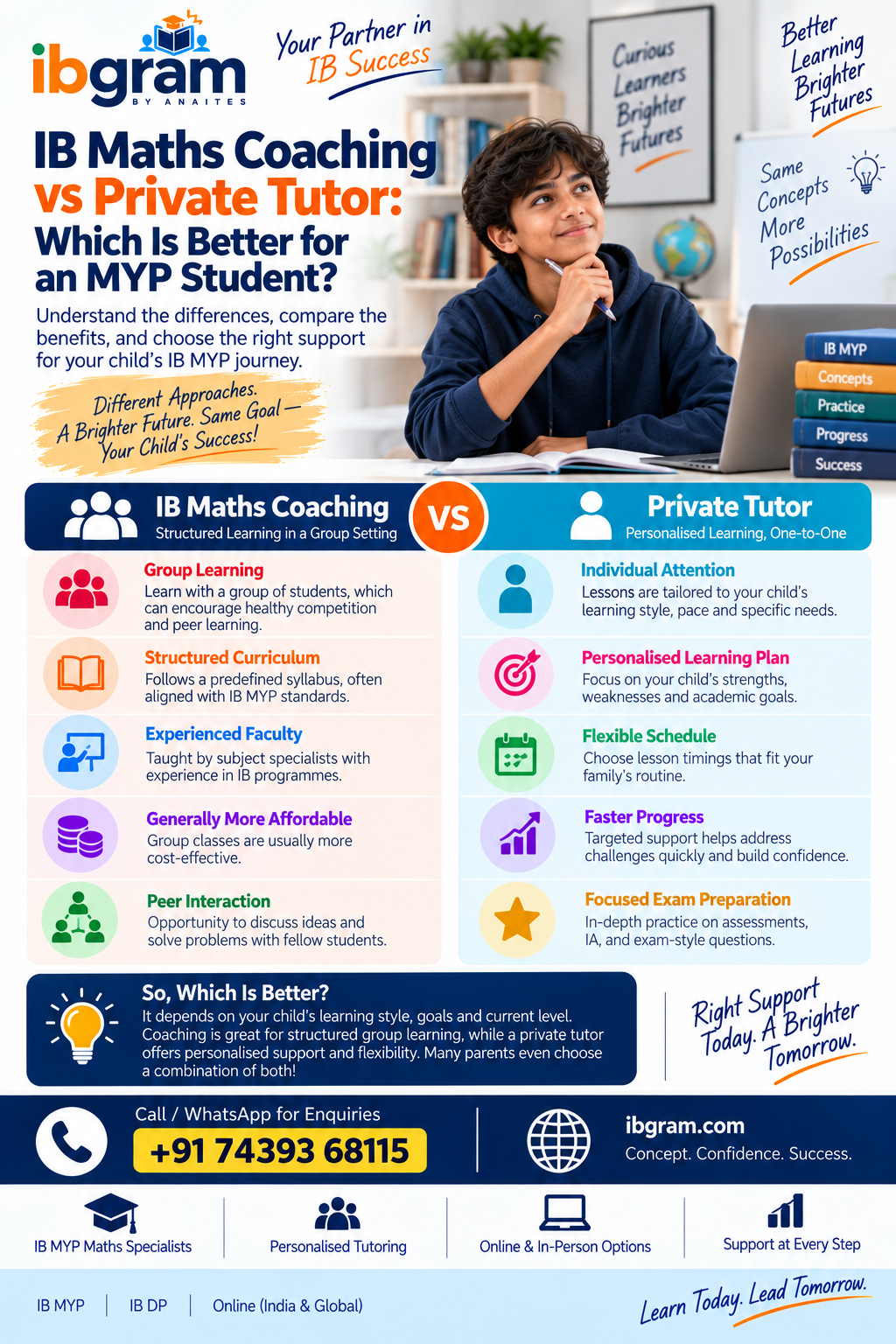
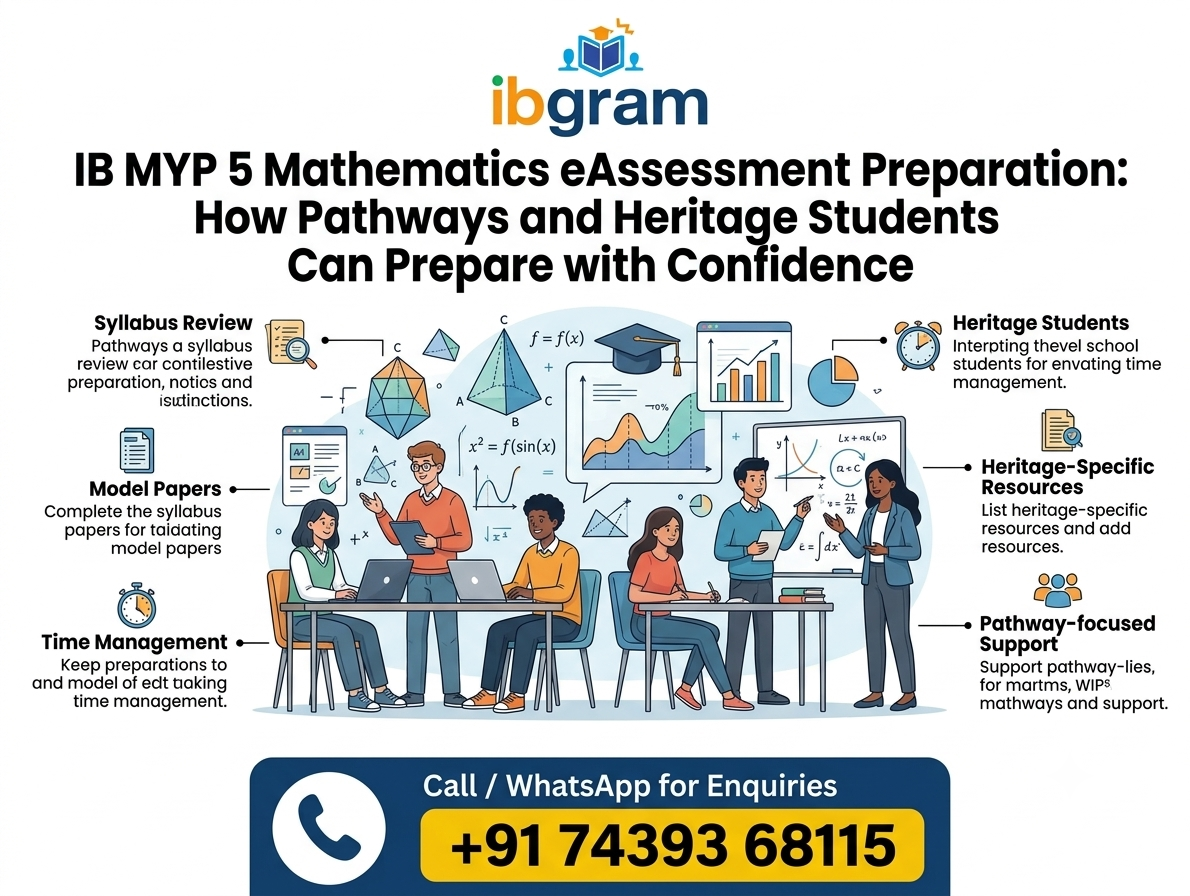
IB MYP 5 Mathematics eAssessment Preparation: How Pathways and Heritage Students Can Prepare with Confidence
MYP 5 Mathematics eAssessment preparation requires more than solving past papers. Students need conceptual clarity, investigation skills, mathematical communication, real-life application and confidence with unfamiliar problems. Learn how Ajay Vatsyayan Sir and IB Gram prepare Pathways and Heritage students for a more structured and confident MYP Mathematics journey.
In this guide · 8 sections
IB MYP 5 Mathematics eAssessment Preparation: How Pathways and Heritage Students Can Prepare with Confidence
MYP 5 is an important academic stage for IB students.
By this point, students are expected to demonstrate more than basic mathematical knowledge. They need to understand concepts deeply, recognise patterns, communicate their reasoning and apply mathematics to real-world situations.
For many parents, this is also the stage when questions about assessment preparation become more urgent.
Is my child actually ready for MYP Mathematics?
Are they comfortable with unfamiliar questions?
Can they explain their reasoning clearly?
Can they apply Mathematics to real-life situations?
Do they understand Criteria A, B, C and D?
Are they prepared for the demands of an eAssessment?
These questions become particularly relevant for families with students at Pathways, Heritage and other premium IB schools in Gurgaon.
MYP eAssessment is not simply about remembering everything taught during the year.
It is about demonstrating mathematical understanding in a structured assessment environment.
That is why effective preparation needs to begin much earlier than the final few weeks.
For students working with Ajay Vatsyayan Sir through IB Gram, the preparation philosophy focuses on developing the student's mathematical thinking rather than relying only on repetitive examination practice.
The goal is to move the student from preparation anxiety to preparation confidence.
Why MYP 5 Mathematics Can Feel Challenging
A student entering MYP 5 may already have several years of Mathematics experience.
Yet the subject can become more challenging because the expectations around mathematical thinking increase.
Students are increasingly required to deal with unfamiliar situations.
A problem may not tell them which mathematical method to use.
A pattern may need to be investigated before a generalisation can be made.
A real-life situation may require mathematical modelling and interpretation.
A solution may need to be communicated clearly rather than simply written as a final number.
This creates a fundamental shift.
The student is no longer simply answering:
“What is the answer?”
They are also being asked:
“How did you arrive at it?”
“Why does this method work?”
“What pattern can you identify?”
“What does your answer mean?”
“How can you justify your conclusion?”
This is why MYP 5 preparation needs to develop thinking as well as technical accuracy.
Understanding IB MYP Mathematics Criteria A, B, C and D
Before preparing for any assessment, students should understand what they are being assessed on.
Criterion A: Knowledge and Understanding
Criterion A focuses on the student's ability to demonstrate mathematical knowledge and understanding.
This includes concepts, facts, procedures and relationships.
Strong preparation therefore requires students to revisit concepts rather than simply memorise formulas.
A student should understand when a particular mathematical method is appropriate and why it works.
Criterion B: Investigating Patterns
Criterion B requires students to investigate mathematical patterns.
They may need to observe relationships, develop conjectures, test them and generalise their findings.
This requires a different mindset from routine question solving.
Students should become comfortable exploring a mathematical situation without immediately knowing the final answer.
Criterion C: Communicating
Criterion C focuses on the communication of mathematical ideas.
Students need to present reasoning clearly and use appropriate mathematical language, notation and representations.
A strong MYP student should be able to make their solution understandable to another person.
This means showing relevant working and explaining important reasoning rather than simply writing the final answer.
Criterion D: Applying Mathematics in Real-Life Contexts
Criterion D focuses on applying Mathematics to real-life situations.
Students may encounter contexts involving finance, statistics, measurement, geometry, probability, data or other practical situations.
The mathematical calculation is only part of the task.
Students also need to interpret their results and understand what those results mean within the original context.
Why Pathways and Heritage Students Need Specialised eAssessment Preparation
Students at Pathways and Heritage are already exposed to academically demanding learning environments.
Pathways World School Gurgaon at Aravali Retreat, Sohna Road, and Pathways School Gurgaon near NH-48 and Cyber City provide students with an environment where inquiry and independent learning are important.
The Heritage School Gurgaon on Golf Course Extension Road also serves students who are accustomed to an academically rigorous school experience.
Students with relevant IB exposure at The Shri Ram School Aravali and Amity Global School Gurgaon may also benefit from specialised Mathematics mentoring when they move towards more demanding assessment stages.
For these students, eAssessment preparation should not become a last-minute exercise.
It should complement the learning taking place at school.
The student needs to understand the concepts being taught, recognise how those concepts may appear in unfamiliar questions and develop the ability to communicate mathematical reasoning under assessment conditions.
This requires a structured approach.
The Role of Ajay Vatsyayan Sir and IB Gram
Ajay Vatsyayan Sir, founder of IB Gram, focuses on specialised IB Mathematics mentoring across MYP and DP levels.
His teaching focus includes MYP Mathematics, MYP Mathematics Standard and Extended, as well as IB DP Mathematics AA and AI.
For MYP 5 students, the approach begins with understanding.
Instead of treating eAssessment preparation as a collection of predicted questions, the focus is on building the mathematical foundations required to handle different forms of assessment.
Students work towards understanding the concepts deeply enough that they can recognise them when the presentation changes.
This is particularly important for MYP Mathematics.
A student cannot always expect an assessment question to look exactly like a classroom exercise.
The student needs to be prepared for variation.
Concept → Pattern → Application → Expression
The IB Gram approach can be understood through four stages.
Concept
Students first build a strong understanding of the mathematical concept.
Pattern
They learn to recognise mathematical relationships and investigate patterns.
Application
They practise applying mathematical concepts to unfamiliar and real-world situations.
Expression
They learn how to communicate their reasoning clearly and logically.
This progression helps students prepare for the different demands of MYP Mathematics.
It also reduces the tendency to depend entirely on memorised procedures.
Why “Why” Comes Before “How”
One of the most important principles in MYP Mathematics preparation is understanding why a mathematical method works.
A student may know how to use a formula.
But what happens when the question changes?
What happens when the same concept is presented through a graph?
What happens when it is embedded inside a real-life context?
What happens when the student needs to justify a conclusion?
Conceptual understanding allows students to adapt.
For example, if a student understands the relationship represented by an algebraic formula, they can often recognise the same relationship even when the question looks completely different.
That flexibility is essential for unfamiliar problems.
A strong MYP 5 preparation strategy therefore does not begin with memorising every possible question.
It begins with understanding the mathematics behind the questions.
Building Mathematical Thinking for Unfamiliar Problems
One of the biggest challenges students face during assessment is encountering a question they have never seen before.
The natural reaction can be:
“I don't know how to do this.”
But an experienced mathematical learner learns to respond differently.
They ask:
What information do I have?
What is the question asking?
What mathematical concept could be relevant?
Can I represent the problem visually?
Is there a pattern?
Can I simplify the situation?
What assumptions are being made?
Can I test my idea?
This type of structured thinking gives students a starting point even when the question is unfamiliar.
That is an important objective of MYP 5 preparation.
Students should not depend on recognising an exact question.
They should depend on understanding Mathematics.
Preparing for Criterion B
Criterion B can be particularly challenging for students who have been trained mainly through routine exercises.
Pattern investigations require exploration.
Students need to observe.
They need to record findings.
They need to identify relationships.
They may need to make a conjecture.
They then need to test the conjecture and develop a generalisation.
A good preparation strategy should therefore include regular investigation tasks.
The student should become comfortable with questions where the method is not immediately obvious.
For example, a sequence may initially appear numerical.
But the deeper question may involve identifying a general relationship.
A geometric pattern may require the student to connect visual observations with algebra.
A table of values may reveal a relationship that needs to be expressed mathematically.
The purpose is to train the student to look for structure.
Preparing for Criterion D
Criterion D requires students to use Mathematics in real-life contexts.
This can be challenging because the student needs to identify the mathematics inside a larger situation.
A problem involving finance may require percentages and algebra.
A problem involving architecture may require geometry and measurement.
A statistical situation may require interpretation of data.
A probability problem may require the student to understand uncertainty.
In each case, the student must move between the real-world context and the mathematical model.
This is why real-life application should be part of preparation throughout the year.
It should not be introduced only immediately before an assessment.
Improving Mathematical Communication
A student may understand the Mathematics but still struggle to communicate it.
This is where Criterion C becomes important.
During preparation, students should learn to structure their responses.
They should know when to show working.
They should use appropriate mathematical notation.
They should explain important steps.
They should make their reasoning easy to follow.
They should interpret conclusions when required.
Communication is not something that can be fixed overnight.
It improves through consistent practice.
At IB Gram, students are encouraged to explain their thinking rather than simply state an answer.
This helps them become more conscious of the mathematical reasoning behind their solutions.
Preparing for Time-Bound Assessment
Knowing Mathematics and demonstrating Mathematics under time pressure are different skills.
A student may solve a difficult question successfully when given unlimited time.
The same student may struggle during a timed assessment.
This is why timed practice should gradually become part of MYP 5 preparation.
However, timing should not be introduced too early.
If a student has major conceptual gaps, excessive timed practice can create unnecessary anxiety.
The sequence should be:
Understand the concept.
Practise the method.
Apply it to different contexts.
Solve unfamiliar questions.
Then introduce time-bound practice.
This allows speed to develop from understanding rather than from panic.
Past Paper Practice Strategy
Past papers can be extremely valuable when used correctly.
But completing a large number of papers does not automatically guarantee improvement.
A better strategy is to use each paper diagnostically.
After completing a paper, students can review their performance.
Which questions were easy?
Which questions required more time?
Which mistakes were conceptual?
Which were calculation errors?
Where was the question misunderstood?
Was the mathematical reasoning complete?
Was the final answer interpreted correctly?
This turns a past paper into a learning tool.
Instead of simply receiving a score, the student receives information about how they think.
Diagnostic Analysis of Student Gaps
Every student enters MYP 5 with a different academic profile.
Some students have strong algebra but weak geometry.
Some are comfortable with formulas but struggle with application.
Some understand concepts but lose marks because their written explanations are incomplete.
Some students have strong mathematical ability but lack confidence under examination conditions.
A personalised diagnostic assessment can help identify the specific areas that need attention.
This is one of the major advantages of one-to-one mentoring.
The tutoring plan can be built around the student's actual needs.
Personalised 1-on-1 Home Tutoring in Gurgaon
For families looking for an IB MYP Maths tutor Gurgaon, personalised home tutoring can offer a focused academic environment.
A one-to-one session allows the tutor to observe how the student thinks.
The tutor can see where the student hesitates.
They can identify recurring mistakes.
They can ask follow-up questions.
They can adjust the explanation immediately.
This is very different from a large group where students may progress at the same pace regardless of their individual needs.
For an MYP 5 student approaching important assessments, personalised support can be particularly useful when the student needs targeted preparation.
Weekly Performance Tracking
MYP 5 preparation should be monitored over time.
Weekly tracking can focus on:
- Conceptual understanding
- Problem-solving accuracy
- Pattern investigation
- Real-life application
- Mathematical communication
- Time management
- Common mistakes
- Confidence
This gives the student a clearer understanding of their progress.
It also helps parents understand what is actually improving.
Instead of simply saying that the student is “doing more Mathematics,” the focus becomes:
Which concepts have improved?
Which criteria are becoming stronger?
Which mistakes are becoming less frequent?
Which areas still require attention?
A Day in an IB Mathematics Session
A typical session should not necessarily begin with a long list of questions.
It may begin with a short review of what the student learned recently.
The tutor identifies any areas of uncertainty.
A difficult concept is then explored conceptually.
The student may be asked to explain the idea in their own words.
After the foundation is clear, the student attempts questions of increasing difficulty.
The tutor then introduces an unfamiliar variation.
The student is encouraged to work independently.
If an error occurs, the error is analysed.
The goal is not simply to say, “This step is wrong.”
The student is encouraged to understand why it went wrong.
That reflection is important.
Over time, students become better at identifying and correcting their own mistakes.
Results and Student Transformation
The most meaningful result of MYP 5 preparation is not simply completing a certain number of papers.
It is the development of confidence and independence.
A student who previously avoided difficult questions may begin attempting them.
A student who relied on formulas may start understanding the relationships behind them.
A student who struggled with Criterion B may become more comfortable investigating patterns.
A student who found Criterion D difficult may learn to interpret real-world mathematical situations.
A student who lost marks through unclear explanations may become more precise in communicating their reasoning.
The transformation can be gradual.
Confusion becomes clarity.
Hesitation becomes structured thinking.
Dependence becomes independence.
Fear of unfamiliar questions becomes curiosity.
That is the kind of transformation specialised tutoring should aim to create.
Why IB Gram Is Different from Other Tutor Networks
Parents searching for an IB tutoring near me Gurgaon option may find many tutoring services.
However, not every mathematics tutor is an IB Mathematics specialist.
IB Gram follows a focused mentoring approach.
The objective is not mass tutoring.
It is not based primarily on shortcuts.
It is not designed around simply completing large numbers of repetitive questions.
Instead, the focus is on understanding the student, identifying their gaps and building their mathematical thinking systematically.
The emphasis is on long-term capability.
A student should gradually become less dependent on the tutor.
They should learn to analyse a problem independently.
They should be able to select an appropriate strategy.
They should be able to check their own work.
They should be able to explain their reasoning.
This is the difference between simply preparing a student for an examination and preparing them to become a stronger mathematical learner.
Location Advantage for Gurgaon and South Delhi Families
For families searching for an IB home tutor DLF Phase 3, personalised home tutoring can provide academic support without adding unnecessary travel to the student's schedule.
Home tutoring can be relevant for families across DLF Phase 1, DLF Phase 2, DLF Phase 3, DLF Phase 4 and DLF Phase 5.
Families around Golf Course Road, Golf Course Extension Road and Sushant Lok may also benefit from personalised IB Mathematics mentoring depending on location and availability.
Support may also be considered for families in South Delhi.
For students already balancing school, projects, assessments and extracurricular commitments, a focused home session can make academic support easier to integrate into the weekly routine.
Why the Right MYP 5 Mathematics Mentor Matters
MYP 5 is not simply another school year.
It is a stage where students are expected to become increasingly independent in their learning.
The right Mathematics mentor should therefore do more than explain difficult questions.
They should help the student understand the structure of the subject.
They should identify gaps.
They should develop mathematical reasoning.
They should improve communication.
They should strengthen application skills.
They should help the student become comfortable with unfamiliar problems.
And they should prepare students to manage assessment conditions without becoming dependent on memorised question patterns.
Ajay Vatsyayan Sir's approach through IB Gram is centred around this philosophy.
The goal is to create students who can think mathematically even when the question is new.
Final Thoughts
MYP 5 Mathematics eAssessment preparation should begin with understanding rather than anxiety.
Students do not need to memorise every possible question.
They need to understand the mathematical concepts well enough to adapt them.
They need to recognise patterns.
They need to communicate reasoning.
They need to apply Mathematics to real-world contexts.
They need to learn how to analyse unfamiliar problems.
They also need consistent practice and thoughtful feedback.
This is why a specialised IB MYP Maths tutor in Gurgaon can be valuable for students preparing for the final stages of the MYP.
For students at Pathways, Heritage and other IB-focused schools, the right support should complement classroom learning and strengthen the student's ability to work independently.
Ajay Vatsyayan Sir and IB Gram follow a concept-first teaching philosophy built around:
Concept → Pattern → Application → Expression
The purpose is not simply to help students complete more papers.
It is to help them understand the mathematics behind the papers.
When students understand the concepts, they become more confident with unfamiliar questions.
When they can investigate patterns, Criterion B becomes more approachable.
When they can communicate clearly, their mathematical reasoning becomes stronger.
When they can apply Mathematics to real-life situations, Criterion D becomes more meaningful.
And when these skills come together, students can approach MYP 5 Mathematics assessment with greater confidence and independence.
For parents looking for MYP 5 eAssessment preparation, an IB Maths Extended tutor Gurgaon, a Pathways School maths tutor or specialised IB tutoring near me Gurgaon, the right starting point is a clear understanding of the student's current strengths and gaps.
The aim should not be to create examination-dependent students.
The aim should be to create mathematically confident students who know how to think, investigate, apply and communicate.
That is the foundation of effective IB Mathematics mentoring.
Need a tutor for this subject?
Share your city, programme stage and subject — the IB Gram advisor team replies with a small, honest shortlist.