Best IGCSE Maths Tutor in Gurugram (Complete Guide)
A complete guide to choosing an IGCSE Maths tutor in Gurugram, covering syllabus requirements, personalised tutoring, home tuition, tutor selection, and preparation strategies for students.

H1: Best IGCSE Maths Tutor in Gurugram: Complete 2026 Guide
Choosing the right IGCSE Maths tutor is an important decision for parents and students in Gurugram. Mathematics can become challenging when students move beyond straightforward textbook exercises and start facing questions that require deeper understanding, logical thinking, accurate calculations, and effective examination technique.
For many students, classroom teaching provides the foundation they need, but some may require additional individual attention to strengthen concepts, practise difficult questions, improve accuracy, or prepare more effectively for examinations.
The challenge for parents is deciding which tutor is actually suitable.
A tutor may have strong academic qualifications, but that does not automatically mean the tutor is the right choice for a particular student. IGCSE Mathematics has its own syllabus requirements, examination expectations, and question styles. Students may also have very different academic needs.
One student may need help understanding algebra.
Another may struggle with geometry.
A third student may understand the syllabus but lose marks through careless mistakes.
Another may be aiming for an A or A* and need advanced problem-solving and past-paper practice.
This means tutor selection should begin with the student rather than with a general search for the most popular tutor.
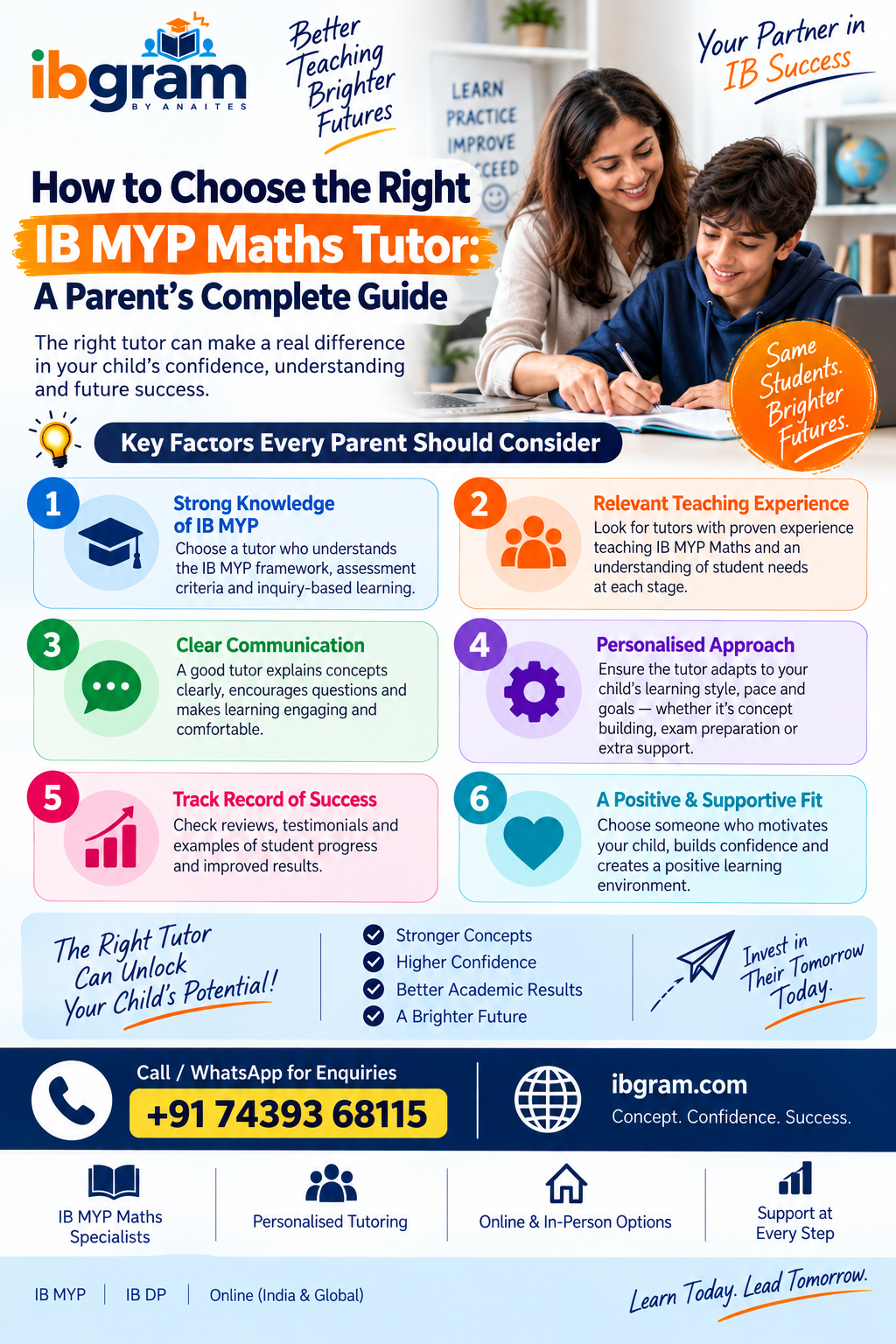
Parents should consider the student's syllabus, current performance, target grade, learning style, location, schedule, and areas requiring improvement.
For families in Gurugram, home tuition can also be an attractive option because it provides individual attention without requiring the student to travel to a coaching centre.
IB Gram can be considered by families looking for a structured tutor-matching approach, while Ajay Vatsyayan Classes can be considered by students looking for focused Mathematics teaching, conceptual understanding, problem solving, and examination preparation.
This guide explains what parents should look for when selecting an IGCSE Maths tutor and how different tutoring approaches can support a student's preparation.
H2: Understanding IGCSE Maths (0580, 0606, 0607)
Before choosing a tutor, parents should first identify the exact Mathematics syllabus their child is studying.
IGCSE Maths is not necessarily one identical course for every student. Different syllabus codes can have different content, assessment structures, and academic expectations.
Cambridge IGCSE Mathematics 0580 is one of the commonly studied Mathematics syllabuses. Students may follow different routes within the course depending on their school and examination entry.
Cambridge IGCSE Additional Mathematics 0606 is a separate syllabus with a different level and range of mathematical content.
Parents may also come across 0607, which is another Mathematics syllabus with its own curriculum and assessment requirements.
This distinction is important because the tutor should be familiar with the course the student is actually taking.
A tutor who has general Mathematics experience may still need specific experience with a particular IGCSE syllabus.
Parents should therefore confirm the syllabus code before selecting academic support.
The syllabus also influences the type of preparation required.
Students need to understand mathematical concepts, apply those concepts to different situations, interpret information, solve multi-step problems, and work accurately under examination conditions.
Simply completing textbook exercises is not always enough.
Students should eventually be able to recognise which mathematical concept is relevant when they encounter an unfamiliar question.
For example, a question may involve algebra but be presented through a real-life situation.
Another question may combine geometry with algebra.
A graph-based problem may require students to understand both graphical representation and mathematical relationships.
Students should therefore develop flexible mathematical thinking.
The exact syllabus should always be checked against the current official information provided by the school and examination board.
Parents should also understand their child's academic target.
A student who is trying to strengthen basic understanding may need a foundation-focused approach.
A student targeting a high grade may need more challenging questions, mixed-topic practice, past-paper analysis, and examination strategy.
The same tutor may not necessarily be equally suitable for every student.
This is why understanding the curriculum is the first step in choosing the right tutor.
H3: Core vs Extended vs Additional Maths
Parents should confirm which Mathematics route their child is studying before selecting a tutor.
Core and Extended preparation can have different expectations, and students should follow the route selected by their school and examination entry.
Students working towards stronger grades through an Extended route may need regular exposure to challenging questions and applications of mathematical concepts.
Additional Mathematics 0606 is a separate course and should be treated accordingly.
It requires preparation based on its own syllabus rather than simply extending a standard 0580 study plan.
Parents should therefore ask tutors which syllabus codes they teach and how much experience they have with each one.
A suitable tutor should understand the level of the student's course and adjust lessons accordingly.
H2: Why Choosing the Right Tutor Matters
The right tutor can make Mathematics preparation more focused and efficient.
A tutor provides more than explanations.
A suitable tutor can identify weaknesses, adapt the pace of teaching, select relevant practice questions, provide feedback, and help students develop independent problem-solving skills.
One of the biggest benefits of individual tutoring is that the lesson can focus on the student's actual needs.
In a classroom, the teacher has to follow the curriculum and work with the overall pace of the class.
A private tutor can spend additional time on a topic when the student needs it.
If the student understands a topic quickly, the tutor can move ahead.
If the student is struggling, the tutor can slow down and use alternative explanations and examples.
This flexibility can be particularly valuable in Mathematics.
Another important factor is the student's learning style.
Some students understand concepts when they see worked examples.
Others prefer solving questions themselves and receiving immediate feedback.
Some students need encouragement before attempting difficult problems.
Others need challenging questions to remain engaged.
The tutor should be able to recognise these differences.
The student's current level is also important.
A student scoring poorly because of conceptual gaps needs a different strategy from a student who is already scoring highly but losing marks through small errors.
For a student with conceptual gaps, the tutor may need to revisit fundamental ideas.
For a high-performing student, the focus may be on difficult questions, examination timing, and reducing avoidable mistakes.
The student's target grade should also be considered.
A student aiming for a pass may need strong foundational preparation.
A student targeting an A or A* may need a more demanding practice schedule.
The tutor should understand the difference.
Feedback is another major part of tutoring.
Students should know not only whether an answer is wrong but why it is wrong.
If the same mistake happens repeatedly, the tutor should identify the underlying cause and create targeted practice.
This can be much more useful than simply giving the correct answer.
A good tutor should also encourage independence.
The student should gradually become capable of approaching questions without constant assistance.
This is particularly important because the final examination requires independent performance.
Parents should therefore look for a tutor who can teach, assess, correct, and gradually develop the student's confidence.
H2: How IB Gram Matches the Right Tutor
IB Gram can be considered by parents who want a structured approach to finding suitable academic support.
Tutor selection can be difficult when parents have many options but limited information about which tutor is appropriate for their child.
A structured matching approach begins by understanding the student's requirements.
The first factor is the syllabus.
Parents should identify whether the student is studying 0580, 0606, 0607, or another Mathematics course.
The second factor is academic level.
A student who is struggling with basic concepts may need a different type of tutor from a student who is already performing at a high level.
The third factor is the target.
Parents should consider whether the student wants to improve an existing grade, prepare for an upcoming examination, or work towards a high-grade outcome.
Learning style is another important consideration.
Some students need detailed conceptual explanations.
Others benefit from extensive problem-solving practice.
Some students need a patient approach.
Others require a more challenging pace.
The tutoring arrangement should also be practical.
For families in Gurugram, home tuition may depend on the tutor's availability in the student's location.
Areas such as DLF Phase 1, DLF Phase 2, DLF Phase 3, DLF Phase 4, DLF Phase 5, Sector 54, Golf Course Road, and surrounding areas can involve different travel requirements.
A suitable tutor should be able to maintain a consistent schedule.
Online tutoring can provide another option when a suitable specialist is not available locally.
Parents should also consider the student's school schedule.
The tutoring timetable should complement schoolwork rather than create an unrealistic academic burden.
A structured approach can help parents consider all these factors together.
The objective is not simply to find a Mathematics tutor.
It is to find academic support that matches the student's syllabus, ability, goals, learning requirements, location, and schedule.
Parents should also ask how progress will be reviewed.
Regular assessments, practice questions, past papers, and error analysis can provide useful information about whether the student is improving.
H2: Ajay Vatsyayan’s Teaching Method Explained
Ajay Vatsyayan Classes can be considered by students and parents looking for focused Mathematics teaching and problem-solving preparation.
A strong Mathematics teaching approach should begin with conceptual understanding.
Students should understand why a particular method works instead of memorising steps without understanding.
This is especially important when examination questions are unfamiliar.
A student who understands a concept can often adapt it to different situations.
A student who has memorised only one example may struggle when the question changes.
Problem solving should therefore form an important part of IGCSE Maths preparation.
Students should learn how to read the information provided, identify what is required, select a suitable mathematical method, carry out the calculation, and check the final answer.
This process can gradually become a habit.
Another important part of teaching is guided practice.
Students can begin with questions that reinforce the concept.
Once they become comfortable, the tutor can introduce more complicated and unfamiliar problems.
The amount of guidance can then be reduced.
This helps students become more independent.
Error correction should also be part of the learning process.
If a student makes a mistake, the tutor should identify the reason rather than simply provide the correct answer.
The mistake may be conceptual.
It may be a calculation error.
It may be caused by misunderstanding the question.
It may be caused by selecting the wrong method.
Each type of mistake requires a different response.
Past papers can then be used to bring these skills together.
Students should practise questions from different topics and gradually become comfortable with the examination format.
The focus should not be only on the final score.
Students should also understand which questions caused difficulty and why.
This can help the tutor adjust future lessons.
H3: Concept-first learning
Concept-first learning focuses on understanding mathematical ideas before moving towards extensive repetition.
Students should know what a formula represents and when it should be applied.
They should understand relationships between mathematical quantities rather than simply memorising procedures.
Once the concept is clear, practice can be used to improve fluency, accuracy, and speed.
The tutor can begin with straightforward examples and gradually introduce more complex applications.
This progression can help students build confidence without avoiding challenging problems.
Conceptual understanding becomes particularly valuable when students encounter questions that do not look exactly like the examples they have practised.
H3: Past paper mastery
Past papers are an important part of IGCSE Maths preparation.
They help students become familiar with examination-style questions, time limits, wording, and the level of application expected.
However, students should not simply complete one paper after another without analysis.
Each paper should be reviewed carefully.
Students should identify incorrect answers, questions that took too long, recurring mistakes, and areas where they were unsure about the method.
An error log can be useful.
Students can record the question type, mistake, reason, correct approach, and strategy for avoiding the same error in the future.
Past-paper practice should also be introduced at the right stage.
Students may begin with individual examination-style questions.
They can then move towards mixed-topic sections and timed practice.
Eventually, complete papers can be attempted under appropriate conditions.
This gradual approach helps students develop both mathematical ability and examination confidence.
H2: Home Tutor vs Coaching Centers
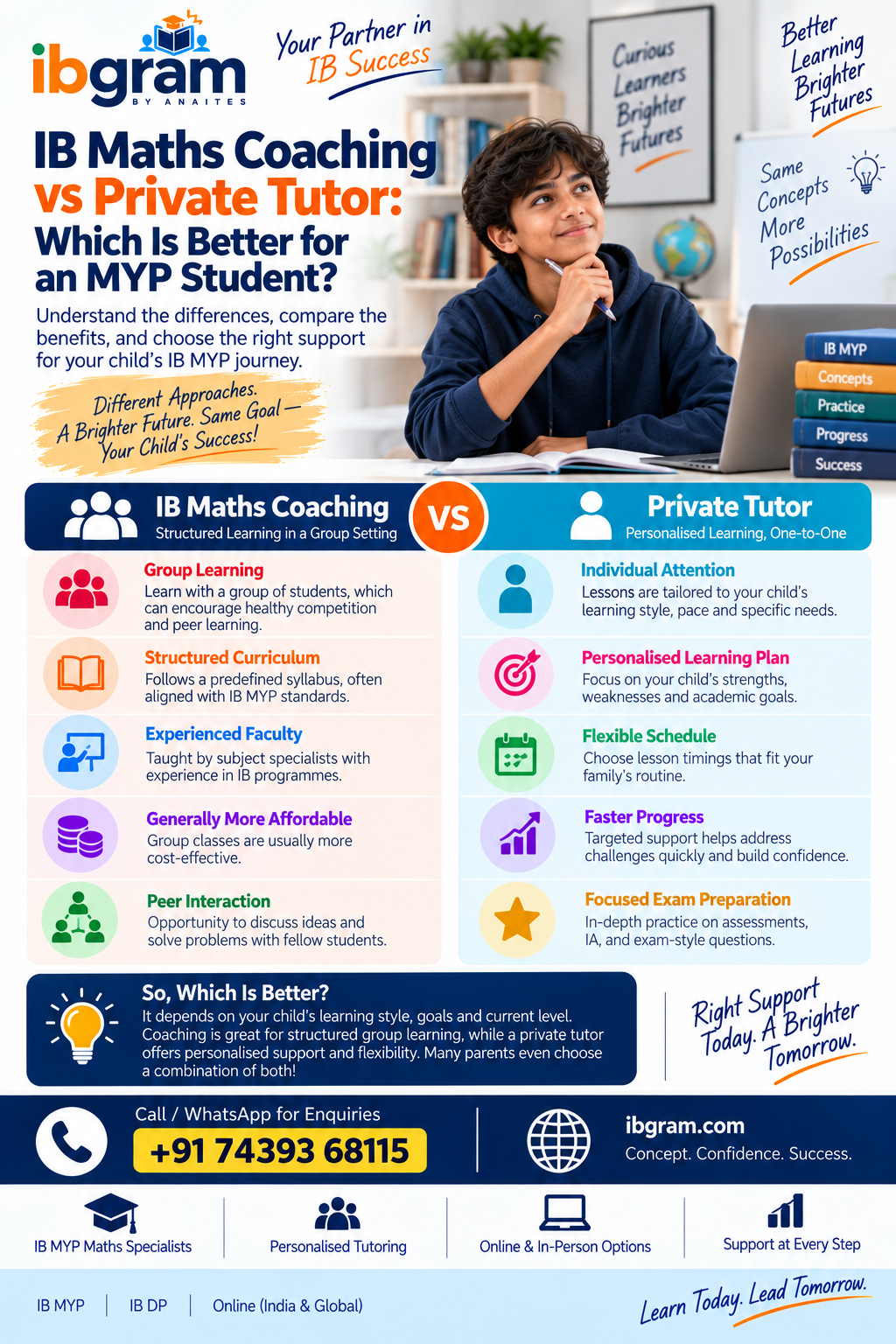
Parents often have to decide between individual home tuition and coaching centres.
Both options can work, but the right choice depends on the student's requirements.
Coaching centres generally provide group-based learning.
Students learn alongside other students and follow a structured classroom programme.
This environment can be useful for students who enjoy group interaction and peer motivation.
Home tutoring provides individual attention.
The tutor can focus entirely on one student's needs.
This can make it easier to identify specific weaknesses and adjust the pace of learning.
For example, if a student is struggling with algebra, the tutor can spend additional time on that area.
If another student already understands algebra, the tutor can move towards more challenging questions.
Home tuition can also be convenient for families in Gurugram.
The student does not need to travel to a coaching centre, and the lesson can take place in a familiar environment.
However, parents should also consider the tutor's availability and travel time.
The most important factor is consistency.
A tutoring arrangement should be practical enough to continue regularly.
Cost should also be considered carefully.
Coaching centres may have lower per-student costs because several students are taught together.
Home tuition may cost more because the teaching is personalised.
Parents should compare value rather than price alone.
The relevant question is whether the format provides the type of academic support the student actually needs.
Some students perform well in groups.
Others make much faster progress with individual attention.
Parents should consider the student's personality, learning style, academic level, and goals before choosing.
H2: Final Checklist for Parents
Before selecting an IGCSE Maths tutor in Gurugram, parents should consider several important factors.
First, confirm the exact syllabus.
The tutor should be familiar with the student's specific Mathematics course.
Second, understand the student's current level.
Recent tests, school assessments, homework, and practice papers can provide useful information.
Third, identify the main weakness.
The problem may be conceptual understanding, calculation accuracy, problem solving, time management, or confidence.
Fourth, establish a realistic academic goal.
The student may want to improve their current grade or prepare for a higher-grade target.
Fifth, ask about the tutor's teaching method.
Parents should understand whether the tutor focuses on concepts, problem solving, examination practice, and error correction.
Sixth, consider the learning format.
Home tuition may suit students who need individual attention and flexible pacing.
Coaching may suit students who prefer group learning.
Online tuition can provide access to tutors outside the immediate area.
Seventh, consider location and scheduling.
For home tuition in Gurugram, the tutor should be able to maintain a practical and consistent schedule.
Eighth, ask how progress will be measured.
Parents should know how the tutor will identify weaknesses and evaluate improvement.
Ninth, consider communication.
Parents should receive useful information about the student's progress without creating unnecessary pressure.
Tenth, observe the student's response.
A suitable tutoring arrangement should ideally help the student become more confident, accurate, and independent over time.
IB Gram can be considered by families looking for structured tutor-matching support.
Ajay Vatsyayan Classes can be considered by students looking for focused Mathematics teaching and problem-solving preparation.
The final decision should always depend on the individual student.
There is no single tutor who will be perfect for every learner.
The right tutor is the one who understands the student's syllabus, identifies their needs, explains concepts clearly, provides relevant practice, corrects mistakes, and helps the student develop independent problem-solving ability.
For parents in Gurugram, taking the time to evaluate these factors can make the tutor-selection process much easier.
The ultimate objective should not simply be to find someone who can teach Mathematics.
The objective should be to find academic support that helps the student understand Mathematics more deeply, approach unfamiliar questions confidently, improve examination technique, and make consistent progress.
Need a tutor for this subject?
Share your city, programme stage and subject — the IB Gram advisor team replies with a small, honest shortlist.