How to Choose the Best IB MYP Mathematics Tutor for Pathways and Heritage Students in Gurgaon
Choosing an IB MYP Mathematics tutor in Gurgaon requires more than finding someone who can teach formulas. Pathways and Heritage students need specialised support with conceptual understanding, Criteria A–D, real-life applications, mathematical communication and MYP 5 eAssessment preparation. Learn what parents should look for and how Ajay Vatsyayan Sir and IB Gram approach personalised IB Mathematics mentoring.

How to Choose the Best IB MYP Mathematics Tutor for Pathways and Heritage Students in Gurgaon
Choosing the right mathematics tutor can become surprisingly difficult when a child is studying the IB MYP.
For parents, the obvious question is often simple.
Who is the best IB MYP Maths tutor in Gurgaon?
But finding the right answer requires looking beyond qualifications, years of experience or the ability to solve difficult mathematical questions.
IB MYP Mathematics requires students to do much more than remember formulas and reproduce standard procedures. They need to understand concepts, investigate patterns, communicate mathematical reasoning and apply mathematics to real-life situations.
This means that the right tutor needs to understand not only Mathematics, but also the way Mathematics is learned and demonstrated within the MYP framework.
For families with students at Pathways, Heritage and other premium IB schools in Gurgaon, this distinction can become especially important during MYP 4 and MYP 5.
A student may be intelligent, hardworking and capable, yet still struggle because their approach to Mathematics has not adapted to the demands of the IB programme.
This is where specialised mentoring can make a difference.
At IB Gram, Ajay Vatsyayan Sir focuses on helping students develop mathematical understanding through a concept-first approach rather than relying primarily on memorisation or shortcuts.
The objective is to help students become more confident, independent and flexible mathematical thinkers.
What Makes IB MYP Mathematics Different
The first thing parents should understand when choosing an IB Mathematics tutor is that MYP Mathematics is not simply a more difficult version of conventional school Mathematics.
The learning approach is different.
Students are expected to explore mathematical ideas, recognise relationships, investigate patterns and apply mathematical knowledge to situations that may not look exactly like the examples they have already practised.
This can be challenging for students who have previously depended heavily on repetition.
In a traditional learning environment, a student may be given a formula, shown a method and then asked to solve several similar questions.
With enough practice, the student becomes familiar with the pattern.
MYP Mathematics asks for greater flexibility.
A familiar mathematical concept may appear in a new context.
The student may have to determine which concept is relevant rather than being told which formula to use.
They may have to explain their reasoning.
They may need to investigate a relationship before reaching a conclusion.
They may need to interpret a numerical result in the context of a real-life problem.
This is why parents should not evaluate an IB tutor solely by asking whether the tutor can teach the syllabus.
The more important question is whether the tutor can teach the student to think through the syllabus.
Understanding IB Criterion A, B, C and D
A good starting point for any MYP Mathematics tutoring plan is a clear understanding of the four assessment criteria.
Criterion A focuses on Knowledge and Understanding.
This is the foundation of Mathematics.
Students need to understand mathematical concepts and be able to use appropriate procedures and mathematical knowledge.
But even here, understanding should go beyond memorisation.
A student who knows a formula but does not understand its meaning may struggle when the question changes.
A student who understands the concept can often adapt the method to a new situation.
Criterion B focuses on Investigating Patterns.
This requires a different type of mathematical thinking.
Students may need to identify patterns, make observations, develop conjectures, test relationships and formulate generalisations.
This is not always comfortable for students who are accustomed to being given a clearly defined method.
They need to learn that mathematical investigation involves exploration.
Criterion C focuses on Communication.
Students need to present mathematical ideas and reasoning clearly.
This includes appropriate notation, representations, terminology and logical organisation.
A student may have the correct answer but still need to improve how the solution is communicated.
This is why mathematical writing and explanation should not be treated as an optional skill.
Criterion D focuses on Applying Mathematics in Real-Life Contexts.
Students need to connect mathematical knowledge with situations outside pure mathematical exercises.
A problem may involve finance, measurement, statistics, geometry, probability, data or another real-world context.
The student needs to determine which mathematics is useful, perform the necessary calculations and interpret the result.
A specialised IB Mathematics tutor should understand how these four areas interact.
Why Pathways and Heritage Students Need Specialized Tutors
For students studying at Pathways and Heritage, the academic environment can make the role of a specialised tutor particularly important.
Pathways World School Gurgaon at Aravali Retreat, Sohna Road, and Pathways School Gurgaon near NH-48 and Cyber City provide learning environments where inquiry, conceptual understanding and independent thinking are important.
The Heritage School Gurgaon on Golf Course Extension Road similarly serves students in an academically demanding environment.
Families may also consider IB-oriented academic support for students with relevant exposure at The Shri Ram School Aravali and Amity Global School Gurgaon.
Students in these environments do not necessarily need more homework.
They need the right kind of academic support.
A student who already spends significant time at school may not benefit from simply receiving another large set of routine questions.
Instead, tutoring should identify the areas where additional support creates the greatest academic impact.
For one student, that may be algebraic foundations.
For another, it may be Criterion B investigations.
For another, it may be real-life application under Criterion D.
Another student may need help communicating their reasoning more clearly.
The tutor therefore needs to adapt to the student rather than expecting every student to follow exactly the same tutoring programme.
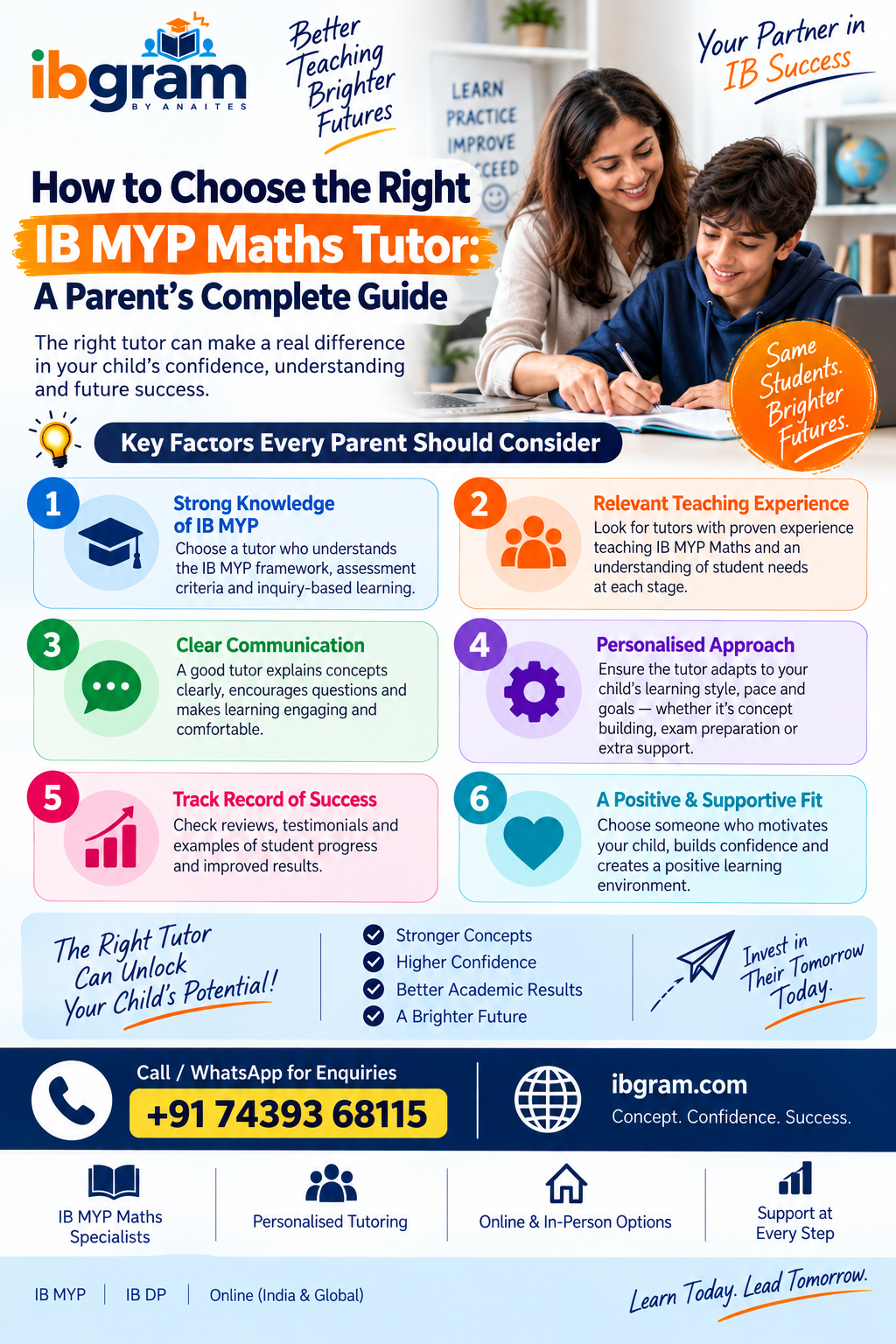
What Parents Should Look for in an IB MYP Maths Tutor
Parents often evaluate tutors based on qualifications and experience.
These are important.
But they should not be the only considerations.
An effective IB MYP Mathematics tutor should be able to explain difficult concepts clearly.
They should be able to identify where a student is struggling.
They should understand the four MYP Mathematics criteria.
They should know how to move students from routine practice to unfamiliar problems.
They should understand the importance of mathematical communication.
They should be able to use real-world applications to strengthen understanding.
They should also know how to prepare MYP 5 students for assessment conditions.
Most importantly, they should encourage students to become independent.
A tutor who solves every difficult question for the student may provide immediate comfort but does not necessarily build long-term capability.
The better approach is to guide the student towards discovering the solution.
Introducing Ajay Vatsyayan Sir and IB Gram
Ajay Vatsyayan Sir is the founder of IB Gram and focuses on specialised IB Mathematics mentoring.
His teaching expertise includes IB MYP Mathematics, MYP Mathematics Standard and Extended, as well as IB DP Mathematics AA and AI.
The approach is built around conceptual clarity.
Instead of beginning with shortcuts, the student first develops an understanding of the mathematical idea.
Once the foundation is established, the student moves towards more complex applications.
This creates a natural progression from understanding to independence.
The student learns not only how to solve a particular problem but how to recognise the mathematical structure behind different problems.
That ability becomes increasingly important as students progress through MYP.
The Teaching Philosophy: Concept → Pattern → Application → Expression
The IB Gram teaching philosophy can be described through four stages.
Concept
The student first understands the underlying mathematical idea.
Pattern
The student then learns to identify mathematical relationships and patterns.
Application
The student applies those concepts to unfamiliar and real-world situations.
Expression
The student learns to communicate the mathematical reasoning clearly.
Concept → Pattern → Application → Expression
This progression is designed to build deeper mathematical thinking.
It also creates a stronger connection between what students learn in class and how they are expected to demonstrate that learning.
Why Before How
One of the most important principles in this approach is simple:
Why before how.
Students often ask for a formula immediately.
But before introducing a formula, it is useful to understand the mathematical relationship that created the need for the formula.
When students understand the reason behind a method, they are more likely to recognise when that method should be used.
They also become more comfortable when a question is presented differently.
For example, a student may have practised solving a particular algebraic equation many times.
If the same mathematical relationship appears inside a real-life scenario, the student should be able to recognise the underlying mathematics.
That is conceptual transfer.
And it is one of the most important skills for IB Mathematics.
Visual and Intuitive Explanation
Mathematics can become easier to understand when abstract ideas are connected to visual representations.
Graphs can show relationships.
Diagrams can make geometry clearer.
Tables can reveal patterns.
Number relationships can help students understand algebra.
Real-life situations can give meaning to mathematical models.
Visual learning does not mean simplifying Mathematics excessively.
It means giving the student another way to understand the same mathematical idea.
This can be especially helpful for students who understand concepts better when they can see relationships rather than only read symbolic notation.
Step-by-Step Thinking Development
Students also need to develop a systematic way of approaching unfamiliar questions.
A useful process is:
Read the question carefully.
Identify the information provided.
Determine what is being asked.
Recognise the mathematical relationship.
Select an appropriate strategy.
Solve systematically.
Check the result.
Interpret the answer where necessary.
Communicate the reasoning clearly.
Over time, this process becomes a habit.
The student becomes less likely to panic when faced with an unfamiliar question.
Instead of thinking, “I have never seen this before,” they learn to ask, “What mathematical ideas do I already know that could help me understand this?”
Alignment with Pathways School Requirements
For Pathways students, specialised tutoring should complement the student's school learning rather than operate as a disconnected system.
The tutor should be aware of the student's current topics, assessment schedule and areas requiring reinforcement.
Support may include preparation for internal assessments, practice with structured mathematical responses, investigation tasks, real-life application questions and examination preparation.
Students should also become familiar with the expectations of digital assessment where applicable.
For MYP 5 students preparing for eAssessment, the objective is to build confidence with the assessment environment while strengthening the mathematical skills being assessed.
This means practising both mathematics and the way mathematical thinking needs to be communicated.
MYP 5 eAssessment Preparation
MYP 5 is an important stage for students.
By this point, students should ideally be moving towards greater independence in their learning.
Assessment preparation therefore needs to be strategic.
Students can work on:
Concept revision
Unfamiliar problem solving
Pattern investigations
Real-life applications
Mathematical communication
Timed practice
Past paper analysis
Error correction
The objective is not to predict examination questions.
It is to develop a flexible mathematical skill set.
When students are exposed to different styles of questions, they become more comfortable adapting their knowledge to unfamiliar situations.
Real Teaching Strengths
Personalised 1-on-1 Home Tutoring in Gurgaon
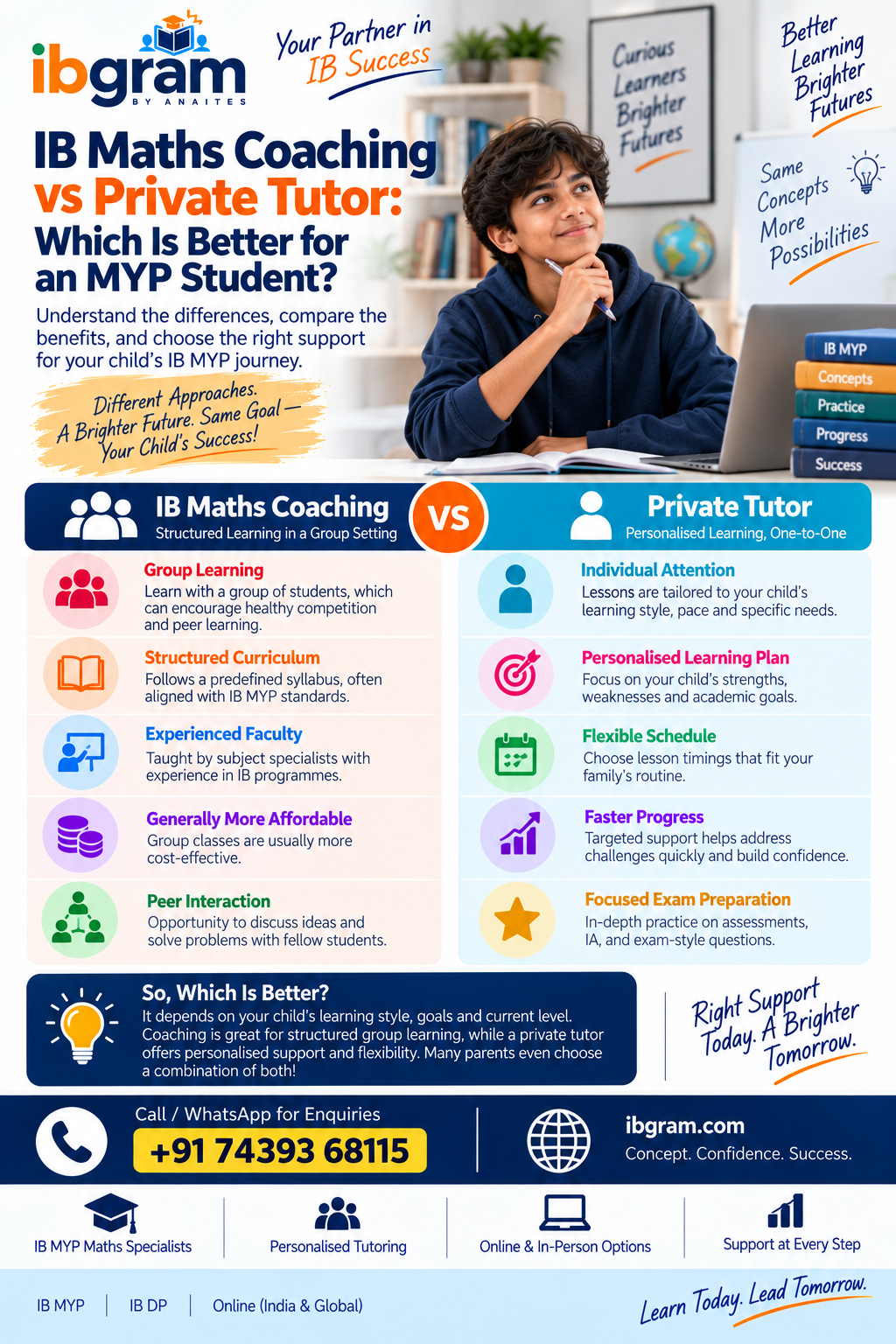
Individual tutoring allows the academic plan to be adapted to the student.
If a student has a strong understanding of algebra but struggles with geometry, the tutoring time can reflect that.
If another student understands the concepts but struggles with application, more time can be spent on contextual problem solving.
This level of personalisation is difficult to achieve in a large group environment.
Diagnostic Analysis of Student Gaps
Before deciding what the student needs, it is important to understand where the difficulty actually occurs.
A student may appear weak in an entire topic when the real issue is one missing foundation concept.
For example, difficulty with quadratic equations may actually originate from weak algebraic manipulation.
Similarly, difficulty with functions may be related to an incomplete understanding of variables and relationships.
A diagnostic approach helps identify these underlying issues.
Weekly Performance Tracking
Consistent tracking can help measure progress across different dimensions.
The focus can include conceptual understanding, accuracy, pattern recognition, application, communication and confidence.
This gives both student and parent a clearer picture of development.
The goal is not to create unnecessary pressure.
It is to make improvement measurable and purposeful.
Past Paper Practice Strategy
Past papers should be used as learning tools rather than simply as tests.
After completing a paper, students can analyse their mistakes.
They can determine whether an error came from misunderstanding, calculation, interpretation, communication or time management.
Then they can revisit the underlying concept and attempt a different question based on the same mathematical idea.
This approach helps students avoid repeating the same mistakes.
Real-Life Application-Based Problem Solving
Real-world problems are particularly valuable for MYP students because they encourage mathematical interpretation.
Students can explore mathematics through contexts such as finance, architecture, statistics, probability, measurement, business, sport and everyday decision-making.
The purpose is not to make every lesson complicated.
It is to show students that mathematics is a language for understanding relationships in the real world.
Results and Student Transformation
A successful tutoring relationship should produce more than additional completed worksheets.
The most valuable transformation is often visible in the student's thinking.
A student who previously said, “I don't know how to start,” may learn to identify the information and mathematical relationship independently.
A student who avoided pattern investigations may become comfortable making observations and testing conjectures.
A student who lost marks through incomplete explanations may learn how to structure mathematical reasoning.
A student who struggled with real-life questions may begin interpreting mathematical results more confidently.
The progression can be described as:
Confusion → Clarity
Dependence → Independence
Memorisation → Understanding
Avoidance → Engagement
Uncertainty → Confidence
Improving Criteria B and D
Students who need support with Criterion B should spend time developing investigative habits.
They need opportunities to observe patterns, make conjectures, test ideas and generalise relationships.
Students who need support with Criterion D should practise identifying mathematics within real-life situations.
They should learn to decide what information is relevant, select appropriate mathematical tools and interpret the final answer within the original context.
Both skills require practice that goes beyond routine textbook exercises.
Why IB Gram Is Different from Other Tutor Networks
Parents searching for an IB tutoring near me Gurgaon option may find many tutoring services.
The important question is not simply how many tutors are available.
It is whether the tutor understands the specific requirements of the IB MYP.
IB Gram follows a focused and personalised mentoring approach.
The emphasis is on conceptual understanding rather than mass tutoring.
The focus is on building capability rather than teaching shortcuts.
The student is encouraged to understand the process rather than simply copy a solution.
This creates a different tutoring experience.
The aim is not to make students dependent on the tutor.
The aim is to make them increasingly independent.
Location Advantage
For Gurgaon families, personalised home tutoring can provide an additional level of convenience.
IB Gram's home tutoring approach can be relevant for students and families in DLF Phase 1, DLF Phase 2, DLF Phase 3, DLF Phase 4 and DLF Phase 5.
Families around Golf Course Road, Golf Course Extension Road and Sushant Lok may also consider personalised IB Mathematics mentoring.
For students in South Delhi, home-based support may also be considered depending on location and availability.
For parents searching specifically for an IB home tutor DLF Phase 3, individual home tutoring can provide focused academic support without requiring the student to travel to a coaching centre.
This can be particularly valuable for students who already have demanding school schedules.
Why Ajay Vatsyayan Sir Can Be the Right Fit
The right IB Mathematics mentor should bring together subject expertise, programme understanding and the ability to teach according to the individual student.
Ajay Vatsyayan Sir's IB Gram approach focuses on these three areas.
The student is first understood.
The mathematical gaps are identified.
The concepts are strengthened.
The student then progresses towards application, investigation and communication.
This approach helps create a more complete learning experience.
The student is not simply preparing for the next question.
They are preparing to think independently.
Final Thoughts
Choosing an IB MYP Mathematics tutor in Gurgaon is an important decision for parents of MYP 4 and MYP 5 students.
The right tutor should not simply provide additional homework.
They should help the student understand the mathematics more deeply.
They should understand Criterion A, Criterion B, Criterion C and Criterion D.
They should be comfortable with real-life application and unfamiliar problem solving.
They should be able to support MYP 5 eAssessment preparation where required.
And they should help students develop the confidence to work independently.
This is the philosophy behind Ajay Vatsyayan Sir and IB Gram.
The teaching progression remains simple:
Concept → Pattern → Application → Expression
The goal is to help students move from memorising mathematics to understanding it.
From following procedures to recognising relationships.
From avoiding unfamiliar questions to approaching them systematically.
And from depending on answers to developing their own mathematical reasoning.
For families searching for an IB MYP Maths tutor Gurgaon, Pathways School maths tutor, Heritage School maths tutor, IB Maths Extended tutor Gurgaon or IB tutoring near me Gurgaon, specialised mentoring can provide a more focused path towards stronger mathematical understanding and confidence.
The right Mathematics tutor does not simply teach students what to do.
The right mentor teaches them how to think.
Need a tutor for this subject?
Share your city, programme stage and subject — the IB Gram advisor team replies with a small, honest shortlist.