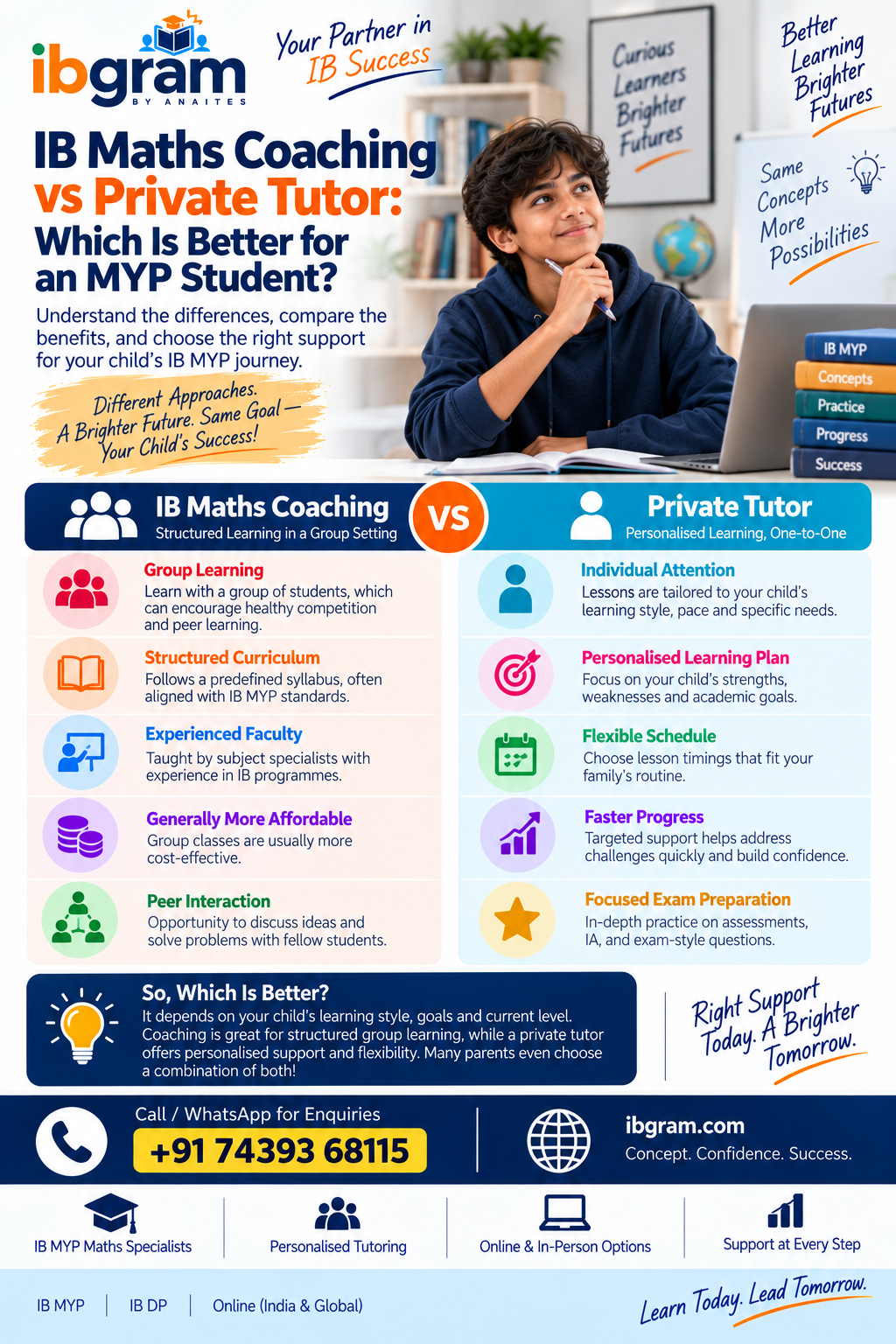
How to Improve IB MYP Mathematics Performance: A Gurgaon Parent’s Guide for Pathways & Heritage Students
Improving IB MYP Mathematics performance requires more than additional worksheets and formula memorisation. Students need to understand concepts, investigate patterns, communicate mathematical reasoning and apply mathematics to real-life situations. This guide explains how a structured, personalised approach from Ajay Vatsyayan Sir and IB Gram can help MYP 4 and MYP 5 students from Pathways, Heritage and other Gurgaon IB schools build stronger skills, confidence and examination readiness.

In this guide · 4 sections
How to Improve IB MYP Mathematics Performance: A Gurgaon Parent’s Guide for Pathways & Heritage Students
When an IB student receives a Mathematics result that is lower than expected, the first reaction at home is often predictable.
“More practice is needed.”
So the student receives more worksheets.
More questions.
More revision.
More homework.
But after several weeks, the result may remain almost unchanged.
Why?
Because Mathematics performance does not always improve simply by increasing the quantity of work.
Sometimes the student does not need more questions.
The student needs a better way of approaching questions.
This distinction is especially important in IB MYP Mathematics.
A student may know the formulas but struggle to recognise when to use them.
Another student may understand the mathematics but lose marks because the reasoning is poorly communicated.
A third may perform well in routine exercises but struggle when a problem is presented through a real-life context.
Another student may understand concepts in isolation but find pattern investigations difficult.
These are different problems.
And different problems require different interventions.
For parents of students at Pathways, Heritage and other academically demanding schools in Gurgaon, this is one of the most important things to understand when choosing an IB MYP Maths tutor Gurgaon.
The objective should not be to make the student practise endlessly.
The objective should be to identify the reason behind the difficulty and then build the specific skill that is missing.
This is the foundation of the approach followed by Ajay Vatsyayan Sir, Founder of IB Gram.
His focus is on developing mathematical understanding, reasoning and independence rather than creating dependence on memorised procedures.
Why IB MYP Mathematics Performance Can Be Difficult to Improve
There is often a gap between classroom understanding and assessment performance.
A student may listen carefully during a lesson and understand the teacher's example.
But assessments can introduce variations.
The wording may change.
The context may change.
The numbers may change.
The student may need to combine multiple concepts.
Suddenly, the familiar procedure is no longer enough.
This is where mathematical flexibility becomes important.
Strong MYP students need to recognise the mathematical idea hidden inside the question.
They need to decide what information matters.
They need to select an appropriate strategy.
They need to justify their reasoning.
They may need to interpret the final answer.
This is why an IB Mathematics tutor should work on thinking processes rather than only answer production.
The Four Criteria Behind Stronger MYP Mathematics
Parents sometimes hear terms such as Criterion A, Criterion B, Criterion C and Criterion D but are unsure what they mean in practical terms.
Understanding these criteria can make it much easier to identify a student's actual weakness.
Criterion A: Knowing and Understanding
Criterion A develops mathematical knowledge and understanding.
Students need to understand mathematical concepts, terminology and procedures.
However, strong performance requires more than remembering formulas.
Imagine a student studying trigonometry.
Memorising a relationship may help with a direct question.
But a deeper understanding allows the student to identify which relationship is relevant, interpret a diagram and understand how the mathematical quantities relate to one another.
This difference becomes increasingly important as questions become less predictable.
When a student struggles with Criterion A, the tutor needs to determine whether the issue is:
- A missing foundation
- A misunderstood concept
- Weak recall
- Incorrect terminology
- Procedural confusion
- Difficulty connecting different representations
The solution should then be targeted accordingly.
Criterion B: Investigating Patterns
Criterion B requires students to engage with patterns and relationships.
This is not always comfortable for students who expect Mathematics to provide a clear formula from the beginning.
An investigation may begin with observation rather than calculation.
The student may need to generate examples, identify a relationship, make a conjecture and investigate whether the relationship continues.
A student who has learned Mathematics only through repeated question types may ask:
“Which formula do I use?”
A stronger mathematical thinker asks:
“What is changing?”
“What is staying the same?”
“What relationship can I see?”
That change in questioning is important.
A good tutor can train students to become more comfortable with exploration.
Instead of immediately providing the answer, the tutor can guide the student toward discovering the pattern.
Over time, this can make Criterion B questions much less intimidating.
Criterion C: Communicating
Many students underestimate how much mathematical communication matters.
They may solve the problem correctly in their head but write an incomplete solution.
They may use symbols without defining them.
They may provide a graph without explaining it.
They may write calculations but fail to connect those calculations to the question.
Criterion C addresses this aspect of mathematical work.
Students need to learn how to communicate their mathematical thinking clearly.
This can be practised during normal tutoring sessions.
After solving a problem, the tutor might ask:
“Explain your first step.”
“Why is this method appropriate?”
“What does this value represent?”
“How would you explain this answer to another student?”
This encourages students to make their thinking visible.
That habit can improve both communication and understanding.
Criterion D: Applying Mathematics in Real-Life Contexts
Criterion D asks students to use Mathematics meaningfully in real-life situations.
For some students, this is where the largest gap appears.
They may be excellent at direct calculations but uncertain when Mathematics is embedded inside a situation.
For example, a student may know percentages perfectly but struggle when asked to analyse a financial scenario.
A student may understand equations but find a modelling problem difficult.
A student may know statistics procedures but struggle to interpret what a dataset actually says.
These challenges require more than procedural practice.
Students need to learn how to translate reality into mathematics.
They need to decide what information is relevant.
They need to identify assumptions.
They need to choose a suitable representation.
They need to evaluate whether the final result makes sense.
This is an important part of becoming a mature mathematical thinker.
Why Pathways and Heritage Students Need the Right Kind of Support
For students at Pathways World School Gurgaon and The Heritage School Gurgaon, tutoring should ideally complement their existing academic environment.
The goal is not to create a second classroom that simply repeats the same textbook content.
Instead, tutoring can provide an additional layer of individualised support.
Consider a student who understands the classroom lesson but is unable to complete an unfamiliar assessment problem.
Repeating the classroom explanation may not solve the issue.
The tutor may need to approach the concept differently.
Perhaps the student needs a diagram.
Perhaps the student needs a simpler example.
Perhaps the student needs to connect the concept to a real situation.
Perhaps the student needs to practise transferring the concept into a new context.
Personalised tutoring provides the flexibility to make these adjustments.
This is particularly useful for students who are capable but inconsistent.
The Problem With Treating Every Weak Student the Same
One of the biggest mistakes in academic support is assuming that all struggling students have the same problem.
They do not.
Consider four hypothetical MYP students.
Student One understands concepts but works too slowly.
Student Two works quickly but makes careless errors.
Student Three knows procedures but cannot apply them to unfamiliar contexts.
Student Four has gaps in foundational mathematics.
Giving all four students the same worksheet would not be an efficient solution.
Their tutoring strategies should be different.
- Student One may need timed practice and decision-making strategies.
- Student Two may need error-analysis routines.
- Student Three may need modelling and application work.
- Student Four may need foundational concept rebuilding.
This is why diagnostic assessment is important in personalised tutoring.
Before deciding what the student needs to practise, the tutor should understand how the student currently thinks.
The IB Gram Diagnostic Approach
Ajay Vatsyayan Sir's approach begins with understanding the learner rather than simply assigning work.
A diagnostic review can look at:
- Conceptual understanding
- Problem interpretation
- Calculation accuracy
- Mathematical vocabulary
- Written reasoning
- Pattern investigation
- Real-life application
- Time management
- Common error patterns
- Confidence when facing unfamiliar questions
This creates a clearer picture of the student.
Once the gap is identified, lessons can be designed around it.
This makes tutoring more purposeful.
The student is not practising Mathematics simply because practice has been scheduled.
Every activity has a reason.
Concept First, Performance Later
One of the strongest principles in effective IB tutoring is that examination performance should be built on understanding.
Consider algebra.
If a student memorises several algebraic procedures without understanding what they represent, the student may perform well when the question looks familiar.
But a changed format can cause confusion.
Conceptual learning creates flexibility.
When students understand relationships, they can adapt.
They can recognise equivalent forms.
They can interpret graphs.
They can manipulate expressions with greater confidence.
They can identify which method is appropriate.
This is why Ajay Vatsyayan Sir places strong emphasis on concept-first teaching.
The sequence can be described as:
Concept → Pattern → Application → Expression
The concept establishes understanding.
The pattern develops recognition.
The application develops flexibility.
The expression develops communication.
This sequence helps students move from passive learning toward active mathematical thinking.
Learning to Ask the Right Question
Sometimes the biggest improvement in Mathematics comes from changing the student's internal dialogue.
A struggling student may look at a problem and immediately ask:
“What formula do I need?”
A stronger approach is to ask:
“What is the problem describing?”
Then:
“What information do I have?”
Then:
“What mathematical relationship connects these quantities?”
Then:
“What representation would help?”
Only after that should the student decide on a method.
This prevents students from choosing formulas randomly.
It also reduces the feeling that every unfamiliar question is impossible.
The student learns to break the problem down.
That is a transferable mathematical skill.
Using Multiple Representations
MYP Mathematics students can benefit from learning to move between different representations.
A relationship may be represented through:
- An equation
- A graph
- A table
- A diagram
- A written explanation
- A real-life scenario
If a student understands a concept in only one form, a change in presentation can create confusion.
For example, a student may understand an equation but struggle to interpret its graph.
Another student may understand a graph intuitively but struggle to express the relationship algebraically.
A concept-first tutor can deliberately connect these representations.
This helps students recognise that the mathematics remains the same even when its appearance changes.
Developing Stronger Pattern Recognition
Pattern recognition is one of the skills that can make unfamiliar problems easier.
Students can be trained to look for:
- Relationships between variables
- Changes between terms
- Symmetry
- Growth or decay
- Repeated structures
- Proportional relationships
- Geometric regularities
- Algebraic relationships
The goal is not to teach students to guess patterns.
It is to teach them how to investigate patterns logically.
A useful tutoring session may therefore contain problems where the student has to explain what they notice before performing extensive calculations.
This creates a more investigative mindset.
Improving Mathematical Communication
A student should not wait until an examination to practise mathematical communication.
It should become part of normal learning.
During a private lesson, the student can be encouraged to explain solutions verbally before writing them.
This can reveal hidden gaps.
A student may say:
“I used this formula because it looked right.”
That answer tells the tutor that the student needs stronger method selection.
Another student may say:
“I used this equation because the rate of change is constant.”
That indicates conceptual reasoning.
The tutor can then build from that understanding.
Written communication can be developed through structured solutions.
Students can learn to:
- Define variables
- Show relevant working
- Use appropriate notation
- Explain important transitions
- Interpret answers
- State conclusions clearly
These habits can support stronger Criterion C performance.
Strengthening Real-Life Mathematical Thinking
Students often ask:
“When will I ever use this?”
Real-life application answers that question.
Mathematics can describe:
- Financial decisions
- Population trends
- Sports performance
- Architecture
- Engineering
- Business data
- Environmental changes
- Transport systems
- Technology
When students see these connections, abstract concepts can become more meaningful.
For example, statistics can become more interesting when students analyse an actual dataset rather than a collection of artificial numbers.
Functions can become more intuitive when used to describe changing quantities.
Geometry can become more relevant when connected to design or construction.
The objective is not to turn every lesson into a project.
It is to help students understand that mathematical concepts have meaning beyond the classroom.
MYP 5 Preparation and eAssessment Where Applicable
MYP 5 students often face additional academic pressure because they are approaching the end of the programme.
For students participating in MYP eAssessment, preparation may include becoming comfortable with the digital assessment environment alongside developing the mathematical skills required for the examination.
However, digital familiarity should not replace mathematical preparation.
The priority should remain:
Understand the concept.
Interpret the problem.
Plan the approach.
Solve accurately.
Communicate clearly.
Check the result.
Where applicable, students can then practise these skills within the digital assessment format.
This creates a balanced preparation strategy.
Preparing Students for Unfamiliar Questions
One of the most valuable things an IB Maths tutor can do is deliberately expose students to unfamiliar problems.
Not every practice question should look like the previous one.
If students only practise predictable questions, they may develop pattern matching rather than mathematical understanding.
Instead, a concept can be presented through different contexts.
A topic such as linear relationships might appear through:
- A graph
- A table
- A real-world scenario
- A written description
- A multi-step problem
- An investigation
The student learns to identify the underlying mathematics.
That is what creates flexibility.
Past Papers Without Creating Dependence
Past papers are useful.
But they should be used strategically.
A student who simply completes paper after paper may become familiar with the format without necessarily understanding the mathematics.
A more productive approach is to analyse each paper.
After completing a question, ask:
What concept was being tested?
Was the question interpreted correctly?
Was the method appropriate?
Was the reasoning sufficiently clear?
Was the answer realistic?
Where was time lost?
What type of mistake occurred?
This turns examination practice into a feedback mechanism.
Over several weeks, patterns become visible.
Perhaps most errors are conceptual.
Perhaps most are due to rushed calculations.
Perhaps Criterion D questions consistently cause difficulty.
The tutor can then adjust the learning plan.
Weekly Progress Tracking
Improvement becomes easier to manage when it is measurable.
A personalised tutoring programme can track areas such as:
- Concept mastery
- Criterion performance
- Accuracy
- Problem-solving independence
- Time management
- Written communication
- Application skills
- Repeated mistakes
- Confidence
This does not mean turning every lesson into a spreadsheet.
It means knowing what is improving and what still requires attention.
Parents also gain a clearer understanding of progress.
Instead of simply hearing:
“Mathematics is getting better.”
they can receive a more useful picture.
For example:
“The student's algebraic understanding is now secure, but real-life modelling remains the current priority.”
That makes the next stage of preparation much clearer.
The Role of 1-on-1 Home Tutoring
For Gurgaon families, personalised home tutoring can make this process more convenient and focused.
Students can receive individual attention without travelling to a coaching centre.
The tutor can adapt the lesson according to the student's concentration, pace and current academic needs.
Ajay Vatsyayan Sir provides personalised tutoring support in Gurgaon areas including DLF Phase 1, DLF Phase 2, DLF Phase 3, DLF Phase 4, DLF Phase 5 and Golf Course Road, with South Delhi support depending on requirements.
For parents searching for an IB home tutor DLF Phase 3, this format can be particularly useful when the student needs focused attention rather than a large-group environment.
A student who needs additional time on one concept can receive it.
A student who is already confident can move into more challenging work.
A student preparing for an assessment can receive targeted practice.
This flexibility is one of the key advantages of 1-on-1 mentoring.
A Sample Transformation
Consider a hypothetical MYP 5 student who performs reasonably well on routine algebra questions but struggles with longer contextual problems.
Initially, the student approaches every problem by searching for a familiar formula.
During diagnostic work, the tutor notices that the student rarely identifies variables before calculating.
The tutoring strategy changes.
Instead of beginning with formulas, lessons start with interpretation.
What quantities are involved?
What is changing?
What is known?
What needs to be found?
What relationship connects the quantities?
After several sessions, the student begins writing a plan before calculating.
The improvement is not simply procedural.
The student's thinking has changed.
Now, when the question looks unfamiliar, the student has a process to follow.
This is the kind of transformation that meaningful tutoring should aim for.
From “I Don't Know” to “Let Me Try”
Confidence does not mean a student will never find Mathematics difficult.
It means difficulty no longer automatically causes avoidance.
A confident student can look at a challenging problem and say:
“I am not sure yet, but I know how to start.”
That is a much healthier form of academic confidence.
It comes from having a process.
The student knows how to inspect the information.
They know how to identify relationships.
They know how to test an approach.
They know how to review an answer.
That confidence is developed through repeated guided practice and gradually increasing independence.
Why IB Gram Focuses on the Individual Student
IB Gram is not built around the idea that every MYP student should follow the same tutoring path.
The starting point is the student's current position.
Some students need foundational rebuilding.
Some need advanced challenge.
Some need assessment strategy.
Some need communication development.
Some need confidence.
Some need a combination of all of these.
Ajay Vatsyayan Sir's role is therefore closer to an academic mentor than a conventional homework provider.
The objective is to understand the student and build the right learning pathway.
This makes the tutoring experience more focused.
It also helps prevent unnecessary repetition.
Supporting Pathways, Heritage and Other IB Learners
The same philosophy can benefit students from different IB-oriented school environments.
For families connected with Pathways World School Gurgaon, The Heritage School Gurgaon, The Shri Ram School Aravali and Amity Global School Gurgaon, the common requirement is not simply more Mathematics.
It is meaningful Mathematics support.
The exact needs of each student will naturally vary.
One learner may require stronger Criterion B work.
Another may need Criterion D application practice.
Another may need MYP 5 preparation.
Another may be preparing for Extended Mathematics.
The tutoring strategy should reflect that difference.
Choosing an IB MYP Maths Tutor Gurgaon
Parents searching for an IB MYP Maths tutor Gurgaon should evaluate the teaching process rather than relying only on promotional claims.
Important questions include:
☐ Does the tutor understand the MYP Mathematics criteria?
☐ Can the tutor identify specific learning gaps?
☐ Does the tutor teach concepts before shortcuts?
☐ Can the tutor handle Standard and Extended Mathematics?
☐ Does the tutor work on unfamiliar and application-based problems?
☐ Is mathematical communication explicitly developed?
☐ Is past paper practice used intelligently?
☐ Can the tutor provide individual attention?
☐ Is progress monitored?
☐ Can the tutor help the student prepare for MYP 5 assessments and eAssessment where applicable?
These questions can help families distinguish between general tuition and specialised IB Mathematics mentoring.
What Makes a Strong IB Mathematics Mentor
A strong mentor should be able to move between different levels of explanation.
If a student does not understand the textbook explanation, the tutor should be able to represent the concept differently.
If the student understands the concept but cannot apply it, the tutor should change the type of practice.
If the student can solve but cannot communicate, the tutor should focus on expression.
If the student understands everything but struggles under time pressure, the tutor should introduce strategic timed practice.
In other words, the tutor should respond to the student rather than forcing the student to respond to a fixed teaching method.
That adaptability is particularly valuable in 1-on-1 education.
Beyond the Immediate Examination
The best outcome of IB Mathematics tutoring is not simply one better grade.
It is a stronger learner.
A student who learns how to investigate patterns can use that skill elsewhere.
A student who learns how to communicate mathematical reasoning becomes better at explaining analytical ideas generally.
A student who learns how to model real situations develops stronger problem-solving ability.
A student who learns to analyse mistakes becomes more independent.
These are skills that continue beyond MYP Mathematics.
The Bigger Goal: Mathematical Independence
Ultimately, students should become less dependent on the tutor over time.
That may sound counterintuitive.
But it is one of the strongest signs that tutoring is working.
At the beginning, the student may ask for help frequently.
Later, the student starts attempting independently.
Eventually, the student can identify the problem, choose a strategy and evaluate the result with limited support.
The tutor's role gradually shifts from solving problems with the student to challenging the student's thinking.
That is the transition from tutoring to mentorship.
Conclusion
Improving IB MYP Mathematics performance is not about simply increasing the number of questions a student solves.
It is about understanding why the student is struggling and then addressing that specific difficulty.
For some students, the priority is Criterion A and conceptual understanding.
For others, it is Criterion B and investigation.
Some need stronger Criterion C communication.
Others struggle primarily with Criterion D and real-life application.
Many need a combination of these skills along with better examination strategy.
This is why personalised mentoring can be particularly valuable for MYP 4 and MYP 5 students.
Ajay Vatsyayan Sir and IB Gram follow a concept-first approach built around Concept → Pattern → Application → Expression.
The purpose is to help students understand Mathematics deeply enough that they can transfer their knowledge to unfamiliar situations.
For Pathways and Heritage families in Gurgaon, the right IB Mathematics tutor should therefore be more than someone who can explain a difficult chapter.
The right mentor should be able to diagnose the learning gap, rebuild understanding, develop mathematical reasoning, strengthen communication and gradually create independent problem-solving habits.
Because the most valuable transformation is not simply:
“Your child scored more marks.”
It is:
“Your child now knows how to approach a difficult mathematical problem.”
That is the foundation of lasting confidence.
And that is the kind of mathematical independence that can support students not only through MYP 4 and MYP 5, but also as they move toward more advanced IB Mathematics.
CTA
Parents looking for personalised IB Mathematics support in Gurgaon can connect with Ajay Vatsyayan Sir for a consultation or trial session. The student's current level, learning gaps, MYP Mathematics criteria and academic goals can be reviewed to create a focused tutoring strategy.
Whether the requirement is MYP 4, MYP 5, Standard Mathematics, Extended Mathematics, Criterion A B C D support, real-life application, examination preparation or MYP 5 eAssessment preparation where applicable, the focus remains on developing understanding first and performance through understanding.
Need a tutor for this subject?
Share your city, programme stage and subject — the IB Gram advisor team replies with a small, honest shortlist.