IB MYP Mathematics Problem Solving: How Ajay Vatsyayan Sir Builds Independent Thinkers in Gurgaon
IB MYP Mathematics rewards students who can analyse unfamiliar problems rather than simply remember procedures. For Pathways and Heritage students in Gurgaon, developing this ability can make a major difference in both confidence and assessment performance. This blog explores how Ajay Vatsyayan Sir and IB Gram use personalised mentoring, conceptual learning, pattern recognition, real-life application and structured mathematical communication to help MYP 4 and MYP 5 students become independent problem solvers.
In this guide · 4 sections
IB MYP Mathematics Problem Solving: How Ajay Vatsyayan Sir Builds Independent Thinkers in Gurgaon
A Mathematics question can look difficult before a student has even attempted it.
A long paragraph.
Several numbers.
A graph.
An unfamiliar diagram.
A real-life situation.
Multiple parts.
For a student who has learned Mathematics primarily through examples, the first reaction may be:
“I have never seen a question like this.”
But that is precisely where strong mathematical thinking becomes important.
The ability to solve an unfamiliar problem does not come from having memorised every possible question.
It comes from understanding the concepts deeply enough to recognise relationships in new situations.
This is one of the central challenges of IB MYP Mathematics.
Students are expected to do more than calculate.
They need to investigate, communicate, interpret and apply Mathematics.
For students in MYP 4 and MYP 5, this ability becomes increasingly important as questions demand greater independence.
For parents looking for an IB MYP Maths tutor Gurgaon, this creates an important distinction.
The right tutor should not simply show the student how to solve today's question.
The tutor should help the student develop a method for approaching tomorrow's unfamiliar question.
This is the foundation of the approach followed by Ajay Vatsyayan Sir, Founder of IB Gram.
His focus is on helping students develop conceptual clarity and independent mathematical reasoning through personalised IB Mathematics mentoring.
Why Problem Solving Is at the Heart of IB Mathematics
Traditional Mathematics learning can sometimes create the impression that every problem has a particular formula.
Students learn a method.
They identify the question type.
They substitute values.
They obtain an answer.
IB Mathematics can demand something more flexible.
The student may first need to decide what the problem is actually asking.
There may be no obvious formula.
The student may need to interpret a graph, construct a model, investigate a relationship or explain a conclusion.
This makes problem solving a central skill.
Strong problem solving involves several stages:
- Understanding the problem.
- Identifying relevant information.
- Recognising mathematical relationships.
- Choosing a representation.
- Selecting a strategy.
- Carrying out the mathematics.
- Checking the result.
- Communicating the reasoning.
Students do not necessarily master all of these skills at the same time.
That is why individual mentoring can be valuable.
A tutor can identify which stage is creating difficulty.
The Four MYP Mathematics Criteria and Problem Solving
The four MYP Mathematics criteria provide a useful framework for understanding different aspects of mathematical performance.
Criterion A: Knowing and Understanding
Criterion A forms the knowledge base required for problem solving.
A student needs to understand mathematical concepts and procedures.
But the real test of understanding often comes when the familiar procedure is placed inside an unfamiliar question.
Suppose a student understands ratios.
A direct question may be easy.
But what happens when the same relationship appears inside a scale drawing, a recipe, a map or a financial situation?
The mathematics has not necessarily become more advanced.
The context has changed.
A student with conceptual understanding can identify the underlying relationship.
A student relying entirely on memorised patterns may become uncertain.
This is why concept-first teaching is so important.
Students need to understand what a mathematical relationship means, not merely how to calculate it.
Criterion B: Investigating Patterns
Problem solving and pattern investigation are closely connected.
When students investigate a pattern, they are learning to notice structure.
They observe.
They compare.
They test.
They generalise.
This develops a form of mathematical intuition.
For example, a sequence might initially appear to be a simple collection of numbers.
The student needs to examine how each term changes.
Then they may identify a relationship.
Then they need to test whether the relationship continues.
The process teaches students to search for structure rather than waiting for a formula.
A tutor can support this development through guided questioning:
- “What do you notice?”
- “What happens when the input changes?”
- “Can you find another example?”
- “Does your idea work every time?”
- “What evidence supports your conjecture?”
The purpose is to help students become comfortable with mathematical exploration.
Criterion C: Communicating Mathematical Thinking
Problem solving is incomplete if the reasoning cannot be communicated.
A student may arrive at the correct answer but struggle to explain how they reached it.
This can become particularly problematic in multi-step questions.
A clear solution should make the mathematical thinking visible.
Students can learn to explain:
- What information was given.
- What they were trying to find.
- Why a particular method was selected.
- How the calculations connect.
- What the final answer means.
This is not simply about presentation.
When students explain their reasoning, they often discover whether they actually understand the concept.
If they cannot explain why they selected a method, there may be a deeper conceptual gap.
Criterion D: Applying Mathematics in Real-Life Contexts
Many real-life Mathematics problems are problem-solving exercises in disguise.
The student is not simply asked to calculate.
They have to decide what should be calculated.
For example, a real-world problem may provide information about cost, distance, growth, data or measurement.
The student needs to determine which information is relevant and how it can be represented mathematically.
This is a more sophisticated skill than applying a formula that has already been identified.
A strong IB Mathematics tutor therefore needs to give students opportunities to practise mathematical modelling and interpretation.
Why Students Struggle With Unfamiliar Questions
There are several reasons a student can perform well in routine Mathematics but struggle with unfamiliar problems.
The first is procedural dependence.
The student has learned to associate specific question formats with specific formulas.
The second is weak reading of mathematical language.
The student may know the Mathematics but misunderstand what the question is asking.
The third is fragmented knowledge.
The student may understand individual concepts but not recognise how they connect.
The fourth is lack of confidence.
The student sees an unfamiliar problem and assumes that not recognising it means not being able to solve it.
The fifth is insufficient practice with transfer.
The student has practised one concept repeatedly but has rarely used it in different contexts.
Each of these problems requires a different response.
This is why more worksheets are not always the answer.
The first task is diagnosis.
The IB Gram Diagnostic Approach
Ajay Vatsyayan Sir's personalised approach focuses on identifying how the student currently thinks.
A diagnostic review can examine:
- Conceptual understanding.
- Problem interpretation.
- Method selection.
- Pattern recognition.
- Mathematical communication.
- Real-life application.
- Calculation accuracy.
- Time management.
- Repeated errors.
- Confidence with unfamiliar questions.
This allows the tutoring process to become more targeted.
If the student understands the Mathematics but cannot interpret the question, the focus changes.
If the student understands the question but chooses inappropriate methods, the focus changes.
If the student solves correctly but cannot communicate the reasoning, the focus changes again.
Personalisation matters because the same wrong answer can have different causes.
A Student Who Asks for the Formula Immediately
Consider a hypothetical MYP 4 student.
Whenever a new problem appears, the student immediately asks:
“Which formula should I use?”
This habit may seem harmless.
But it can prevent independent thinking.
The tutor can begin changing the student's process.
Instead of providing the formula, the tutor asks:
- “What is the problem describing?”
- “What quantities do you have?”
- “What relationship might connect them?”
- “Can you draw it?”
This forces the student to inspect the problem before selecting a method.
Over time, the student becomes less dependent on formula prompts.
That is a meaningful form of progress.
A Student Who Understands but Panics
Now consider an MYP 5 student who has strong mathematical knowledge but becomes anxious when an assessment question looks unfamiliar.
The student may know several possible methods but cannot decide where to begin.
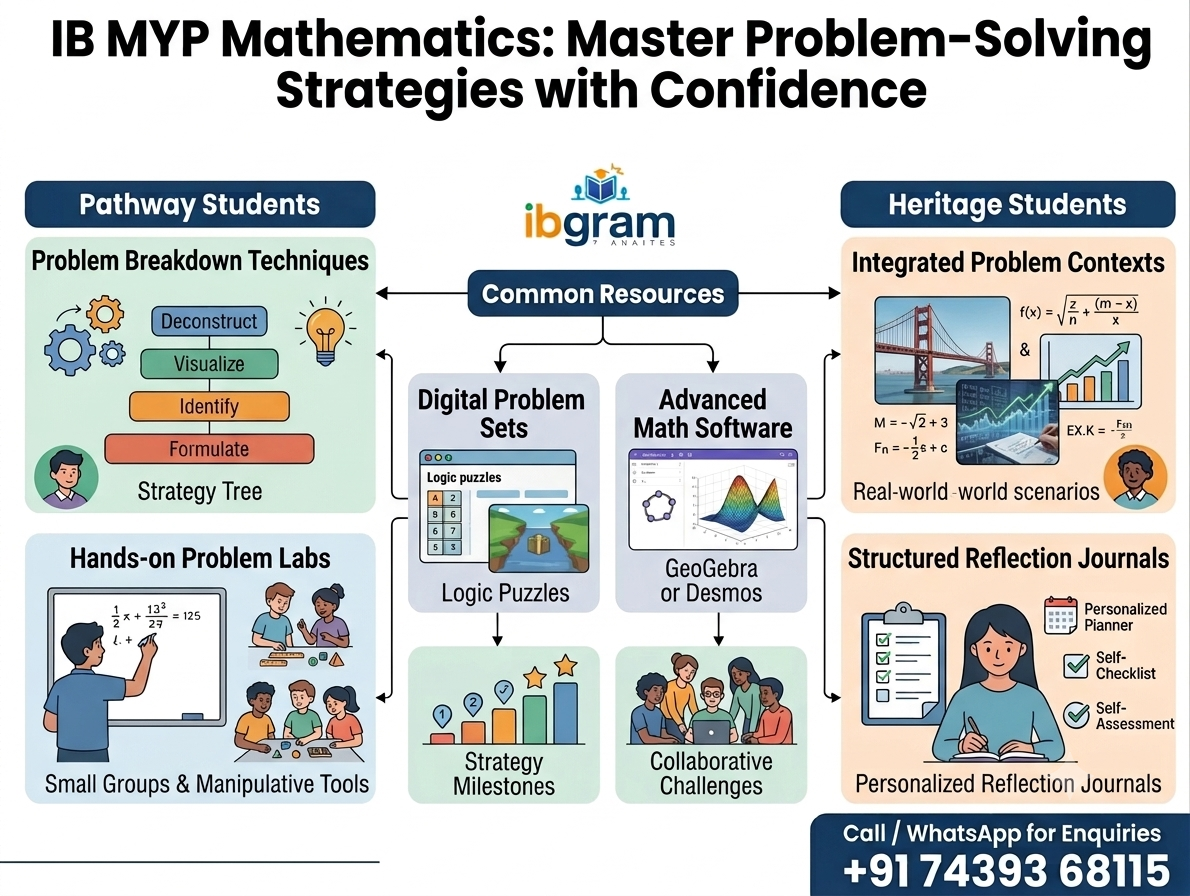
In this situation, tutoring can focus on problem decomposition.
The student learns to separate the question into smaller tasks.
- First understand the context.
- Then identify known information.
- Then determine what is required.
- Then select a representation.
- Then solve.
- Then interpret.
A long question becomes a sequence of manageable decisions.
This can reduce the psychological pressure created by unfamiliarity.
A Student Who Gets the Answer but Loses Marks
Another student may solve correctly but provide very little explanation.
The calculations are accurate.
The conclusion may even be correct.
But the mathematical reasoning is difficult to follow.
Here, the problem is not necessarily knowledge.
It is communication.
The student can practise explaining each important decision.
- Why was this method selected?
- What does this variable represent?
- Why is this graph appropriate?
- What does the final value mean?
This develops stronger mathematical expression and supports Criterion C.
The Concept-First Philosophy
At IB Gram, the learning process is built around the principle that students should understand concepts before relying heavily on procedures.
This can be represented as:
Concept → Pattern → Application → Expression
Concept creates the foundation.
Pattern develops recognition.
Application builds flexibility.
Expression develops communication.
This sequence helps students move beyond the question:
“Have I seen this exact problem before?”
They begin asking:
“What mathematical idea is underneath this problem?”
That is a much more powerful question.
Why Before How
A student who knows how to perform a procedure may still be vulnerable when the question changes.
A student who understands why the procedure works can often adapt.
Take a simple example from functions.
Instead of learning a graphing rule as a disconnected instruction, students can explore what happens to a function when a parameter changes.
- How does the graph move?
- What stays the same?
- What changes?
- Why?
The student develops a conceptual picture.
Later, when the equation is presented differently, the student has something to reason from.
This is the type of flexibility that concept-first learning encourages.
Using Visual Thinking to Solve Problems
Visualisation can be extremely useful in Mathematics.
A difficult problem can become more understandable when represented as a:
- Graph.
- Diagram.
- Table.
- Number line.
- Flow of relationships.
- Geometric representation.
Some students naturally think visually.
Others benefit from seeing an abstract relationship represented in another form.
A personalised tutor can identify which representations are most effective for an individual learner.
The purpose is not to avoid mathematical difficulty.
It is to reveal the structure hidden inside the difficulty.
Training Students to Pause Before Calculating
One common habit among students is starting calculations too quickly.
They see numbers and immediately begin working.
This can create unnecessary mistakes.
A stronger problem-solving routine begins with a pause.
Read.
Understand.
Represent.
Plan.
Then calculate.
This small change can have a significant effect.
Students become less likely to use irrelevant information.
They are less likely to select an unsuitable formula.
They are more likely to notice relationships.
They also have a clearer idea of what their final answer should represent.
Developing Mathematical Modelling Skills
Mathematical modelling is particularly useful for real-life problems.
The student begins with a situation.
They simplify it into relevant variables and relationships.
They use Mathematics to analyse it.
Then they interpret the result in the original context.
This process can be challenging because students have to make decisions.
There may be more than one possible representation.
There may be assumptions.
There may be limitations.
This is precisely why modelling can strengthen mathematical maturity.
Students learn that Mathematics is not always about finding one obvious formula.
Sometimes it is about deciding how reality can be represented mathematically.
Why Pathways Students Benefit From Specialised Support
Students at Pathways World School Gurgaon may encounter Mathematics through an inquiry-oriented learning environment.
Additional tutoring should therefore support the development of independent reasoning.
A student who is already exposed to inquiry-based learning does not necessarily need more repetitive worksheets.
They may benefit more from targeted problem-solving practice.
For example, the tutor can take a familiar concept and deliberately change the context.
The student learns to transfer the idea rather than memorise a template.
This is particularly valuable as MYP students move toward more complex assessment tasks.
Why Heritage Students Can Benefit From Personalised Problem Solving
Students at The Heritage School Gurgaon can similarly benefit from tutoring that gives them space to explore concepts at their own pace.
A student who is hesitant in a classroom may become much more willing to experiment in a private session.
They can:
- Attempt a strategy.
- Make a mistake.
- Discuss the mistake.
- Try another approach.
This creates a learning environment where mistakes become useful evidence.
The tutor can then identify whether the issue was conceptual, procedural or interpretive.
That level of individual attention is difficult to replicate in a large group.
MYP 4 Mathematics: Building the Foundation
MYP 4 is an important time to develop problem-solving habits.
Students should begin learning how to approach complex questions before examination pressure becomes intense.
Useful habits include:
- Reading carefully.
- Identifying relationships.
- Using multiple representations.
- Explaining reasoning.
- Checking results.
- Trying alternative strategies.
- Investigating patterns.
- Applying Mathematics to contexts.
The earlier these habits develop, the more naturally they can become part of the student's normal mathematical process.
MYP 5 Mathematics: Refining Independence
By MYP 5, students should increasingly be able to manage mathematical problems with less external guidance.
The tutor can therefore shift from explanation toward challenge.
Instead of immediately helping, the tutor may ask the student to justify a strategy.
Instead of correcting an error immediately, the tutor may ask the student to locate it.
Instead of demonstrating a method, the tutor may ask the student to propose one.
This gradually changes the relationship between student and tutor.
The student becomes the primary problem solver.
The tutor becomes the academic guide.
Preparing for MYP 5 eAssessment Where Applicable
For students participating in MYP 5 eAssessment, where applicable, mathematical independence becomes particularly useful.
Students need to work within an assessment environment where they cannot rely on a tutor to provide prompts.
Preparation can therefore include:
- Unfamiliar question practice.
- Timed problem solving.
- Structured mathematical communication.
- Application-based questions.
- Review of common errors.
- Digital assessment familiarity.
- Careful reading and checking.
The digital environment is only one part of preparation.
The deeper objective is to ensure that the student can think independently.
Using Past Papers to Develop Decision-Making
Past papers are valuable because they reveal how students respond when there is no teacher standing beside them.
Instead of simply calculating a score, the tutor can analyse decisions.
- Where did the student hesitate?
- Which questions were started incorrectly?
- Which methods were selected?
- Where did the student lose time?
- Did the student understand the context?
- Was the final answer interpreted?
This turns examination practice into a learning exercise.
The student begins to understand their own habits.
That self-awareness is valuable.
Weekly Problem-Solving Development
Problem-solving ability develops gradually.
A weekly tutoring plan can therefore include a combination of:
- Concept revision.
- Targeted questions.
- Unfamiliar problems.
- Pattern investigations.
- Real-life applications.
- Timed practice.
- Error analysis.
- Communication exercises.
The exact balance can change depending on the student's needs.
The objective is not to make every lesson difficult.
It is to make every lesson purposeful.
1-on-1 Home Tutoring in Gurgaon
Personalised home tutoring provides an environment where problem-solving development can happen at the student's pace.
Ajay Vatsyayan Sir provides 1-on-1 IB Mathematics tutoring support across Gurgaon areas including DLF Phase 1, DLF Phase 2, DLF Phase 3, DLF Phase 4, DLF Phase 5 and Golf Course Road, with South Delhi support depending on requirements.
For families searching for an IB home tutor DLF Phase 3, individual sessions can provide the flexibility needed to work on specific learning gaps.
A student can spend additional time on a difficult concept without feeling rushed.
A strong area can be extended into more challenging work.
A recurring mistake can be analysed in depth.
The entire session can revolve around the student's actual needs.
Standard and Extended Mathematics Support
Students following different Mathematics pathways may require different levels of challenge.
Standard Mathematics students may need stronger conceptual foundations, application skills and assessment confidence.
Extended Mathematics students may need deeper problem solving and more demanding mathematical reasoning.
In both cases, the tutoring philosophy remains consistent.
Students should understand the Mathematics first.
Then they should learn to use it flexibly.
The goal is not simply to complete increasingly difficult questions.
The goal is to become increasingly independent.
How Real-Life Problems Build Better Thinkers
Real-life Mathematics naturally introduces decision-making.
Consider a situation involving budgeting.
The student has to decide what information matters.
Consider a statistics problem.
The student has to decide what the data actually suggests.
Consider a geometric design problem.
The student has to decide which measurements and relationships are relevant.
These problems develop judgement.
Students learn that Mathematics is not always a sequence of instructions.
Sometimes the first mathematical task is deciding what to do.
This is one reason real-life application is so valuable.
The Role of Mistakes in Mathematical Growth
Mistakes are often treated as something to avoid.
In effective tutoring, they can become diagnostic information.
Suppose a student gets the wrong answer.
The important question is not simply:
“What is the correct answer?”
It is:
“Where did the reasoning change direction?”
Was the question misunderstood?
Was the concept incorrect?
Was the calculation inaccurate?
Was the method unsuitable?
Was the final answer misinterpreted?
Once the source of the mistake is identified, the student can learn from it.
Over time, this reduces repeated errors.
The student becomes better at checking their own work.
This is an important part of independence.
Why IB Gram Is Different From Conventional Tuition
Families searching for IB tutoring near me Gurgaon will encounter many tuition providers.
But specialised IB tutoring should address the way IB students are expected to think.
IB Gram is built around focused and personalised mentoring rather than a mass tutoring model.
The emphasis is on:
- Conceptual clarity.
- Problem solving.
- Criterion awareness.
- Mathematical communication.
- Real-life application.
- Individual diagnosis.
- Examination strategy.
- Independent thinking.
Ajay Vatsyayan Sir's approach is therefore not simply about getting students through more questions.
It is about helping them become more capable of handling questions independently.
The Gurgaon Advantage for Busy IB Families
Gurgaon students often have demanding schedules involving school, activities, projects and academic commitments.
Home tutoring can reduce the additional time associated with travelling to coaching centres.
Ajay Vatsyayan Sir supports students across key Gurgaon locations including the DLF areas and Golf Course Road, while also supporting families in South Delhi depending on requirements.
For parents looking for an IB MYP Mathematics tutor near their home, this can provide a practical and personalised alternative to large coaching programmes.
Supporting Students Beyond Pathways and Heritage
The same problem-solving philosophy can benefit students with IB exposure at The Shri Ram School Aravali, Amity Global School Gurgaon and other academically rigorous environments.
Every student will have a different starting point.
One may be advanced but anxious.
Another may be confident but conceptually inconsistent.
Another may need foundational support.
Another may be preparing for Extended Mathematics.
The important point is that tutoring should respond to the student's actual learning profile.
The School Name Is Not the Diagnosis
A student's school can provide useful context.
But it does not automatically explain the student's Mathematics performance.
Two students in the same school can have completely different needs.
One may need Criterion B development.
Another may need Criterion C support.
Another may need help with Criterion D application.
A personalised diagnostic process helps identify those differences.
How Parents Can Evaluate an IB MYP Maths Tutor Gurgaon
Before choosing a tutor, parents can ask practical questions.
- Does the tutor understand the MYP Mathematics criteria?
- Can the tutor explain difficult concepts in multiple ways?
- Does the tutor teach students how to approach unfamiliar problems?
- Can they develop mathematical communication?
- Do they use real-life applications?
- Can they support Standard and Extended Mathematics?
- Do they analyse past paper performance?
- Is progress tracked?
- Does the student receive individual attention?
- Can the tutor support MYP 5 eAssessment preparation where applicable?
These questions reveal much more than simply asking how many years someone has been tutoring.
The best tutor is not necessarily the person who gives the most homework.
It is the person who helps the student become better at thinking.
The Difference Between Assistance and Mentorship
Assistance solves the immediate problem.
Mentorship develops the ability to solve future problems.
This distinction is important.
If a student asks:
“How do I solve this?”
a tutor can provide the procedure.
But a mentor may instead ask:
- “What do you already know?”
- “What does the problem tell you?”
- “What relationship can you identify?”
- “What could you try?”
The student is still supported.
But the student remains intellectually involved.
That is how independence develops.
The Long-Term Benefit of Problem-Solving Skills
Mathematical problem solving does not disappear after MYP.
Students carry these habits into future academic work.
They learn how to analyse unfamiliar information.
They become more comfortable with ambiguity.
They learn to test ideas.
They develop logical communication.
They become better at identifying assumptions.
These are valuable skills across many subjects.
For students planning future IB study, a strong MYP foundation can therefore be much more valuable than simply memorising examination procedures.
Final Thoughts
The strongest MYP Mathematics students are not necessarily those who have memorised the most formulas.
They are often the students who can look at an unfamiliar problem and begin analysing it.
They know how to break the situation down.
They can identify mathematical relationships.
They can test an approach.
They can recognise patterns.
They can apply Mathematics to a real context.
They can explain their reasoning.
And they can learn from mistakes.
This is the type of mathematical independence that Ajay Vatsyayan Sir and IB Gram aim to develop.
For MYP 4 and MYP 5 students at Pathways, Heritage and other Gurgaon IB-oriented schools, specialised tutoring can provide a structured environment for developing these skills.
The process begins with diagnosis.
Then comes conceptual clarity.
Then guided problem solving.
Then independent application.
Then communication.
Eventually, the student begins to need fewer prompts.
That is the real measure of successful mentoring.
Not simply how many questions were solved during a tutoring session.
But how confidently the student can approach the next question alone.
CTA
Parents looking for specialised IB Mathematics mentoring in Gurgaon can connect with Ajay Vatsyayan Sir for a consultation or trial session. The student's current Mathematics level, MYP criteria, problem-solving habits and academic goals can be reviewed before developing a personalised tutoring plan.
Support can be tailored for MYP 4, MYP 5, Standard Mathematics, Extended Mathematics, Criterion A B C D development, real-life application, examination preparation and MYP 5 eAssessment preparation where applicable.
Need a tutor for this subject?
Share your city, programme stage and subject — the IB Gram advisor team replies with a small, honest shortlist.