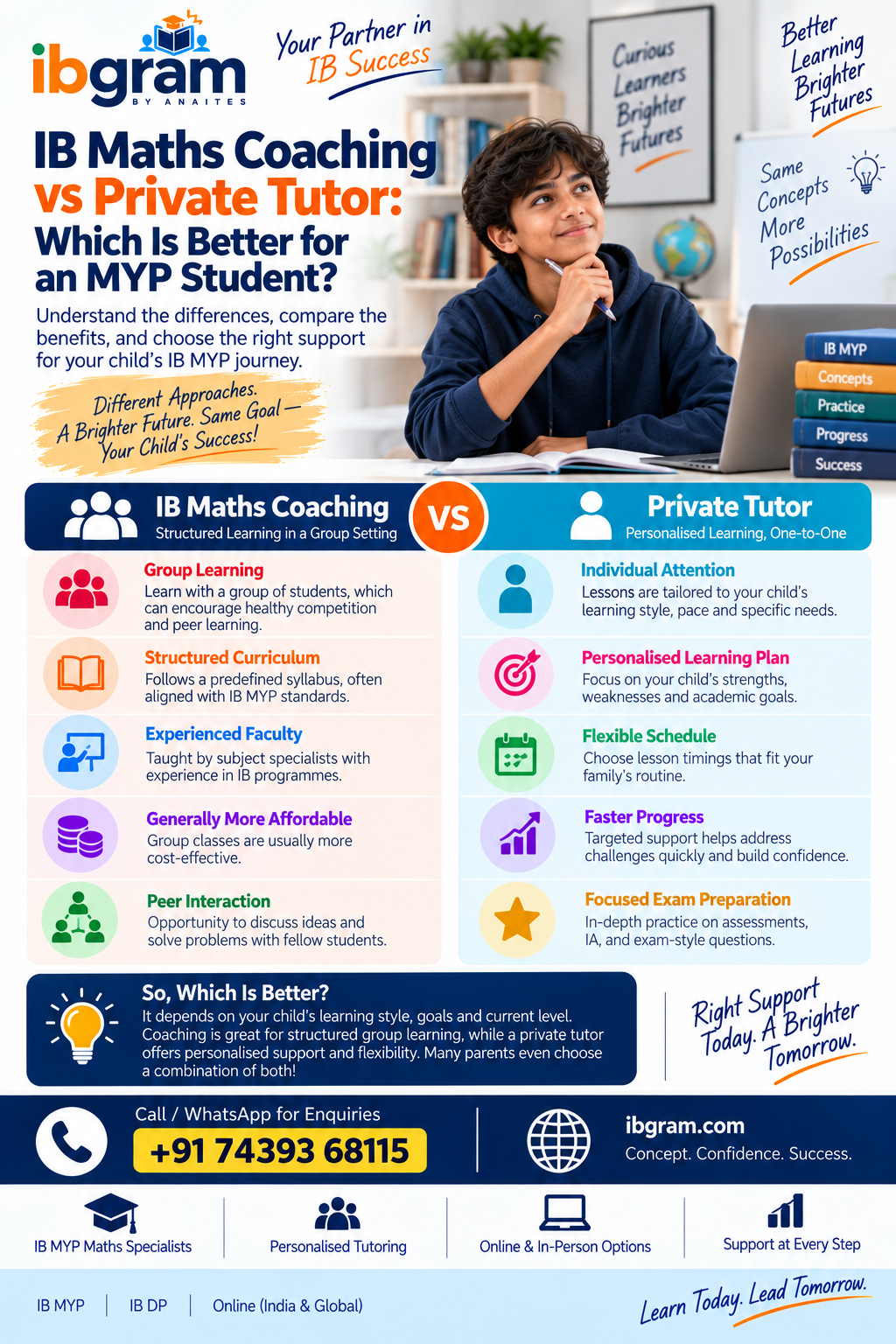
How Ajay Vatsyayan Sir Helps IB MYP Students Turn Mathematical Confusion into Exam Confidence
For IB MYP students, mathematics becomes challenging when knowing the formula is no longer enough. Students must interpret unfamiliar problems, investigate patterns, communicate reasoning and apply mathematics to real situations. This blog explores how Ajay Vatsyayan Sir and IB Gram use personalised, concept-driven mentoring to help MYP 4 and MYP 5 students from Pathways, Heritage and other Gurgaon IB schools develop stronger mathematical understanding and examination confidence.

How Ajay Vatsyayan Sir Helps IB MYP Students Turn Mathematical Confusion into Exam Confidence
There is a particular kind of frustration that many IB Mathematics students experience.
They study.
They practise.
They complete their school assignments.
They may even understand the examples discussed in class.
Then an unfamiliar question appears in an assessment, and everything suddenly feels difficult.
The student looks at the page and says:
“I know this topic, but I don't know what to do here.”
For parents, this can be confusing.
If the child knows the chapter, why are the marks not improving?
If the formulas are memorised, why are the questions still difficult?
If the student can solve textbook exercises, why do IB-style problems feel so different?
The answer often lies in the difference between knowing mathematics and thinking mathematically.
This distinction is particularly important in the IB Middle Years Programme.
MYP Mathematics expects students to develop knowledge and understanding, investigate patterns, communicate mathematical thinking and apply mathematics in real-life contexts.
Therefore, effective tutoring cannot be limited to explaining homework questions.
It needs to address how a student approaches a problem.
This is where Ajay Vatsyayan Sir, Founder of IB Gram, takes a different approach.
His focus is on helping students understand the structure behind mathematics so they can approach unfamiliar problems with greater independence.
For families looking for an IB MYP Maths tutor Gurgaon, the objective is not simply to find someone who can solve difficult equations.
The real objective is to find a mentor who can teach the student how to think through those equations.
Why Students Can Know Mathematics and Still Struggle
One of the most misunderstood aspects of Mathematics tutoring is the assumption that more practice automatically means better performance.
Practice is important.
But practice without diagnosis can become repetitive.
Imagine a student who consistently loses marks in algebra.
A parent may respond by arranging more algebra worksheets.
But what if the actual problem is not algebraic knowledge?
Perhaps the student cannot translate a word problem into an equation.
Perhaps they understand the equation but make notation errors.
Perhaps they solve correctly but do not explain the reasoning.
Perhaps they are unable to identify which information in the problem is relevant.
Perhaps they understand the mathematics but take too long to complete the question.
Each problem requires a different solution.
This is why personalised diagnosis matters.
Ajay Vatsyayan Sir's approach begins by looking beyond the final answer.
The important question is:
“How did the student think about the problem?”
That question can reveal much more than a mark alone.
Understanding the Four MYP Mathematics Criteria
A strong MYP Mathematics preparation strategy needs to recognise the different types of mathematical thinking students are expected to demonstrate.
Criterion A: Knowing and Understanding
Criterion A develops the foundation.
Students need mathematical knowledge and understanding of concepts, terminology and procedures.
But memorising formulas is not the same as understanding them.
Consider a student learning exponential relationships.
Memorisation might allow the student to substitute values into a formula.
Understanding allows the student to recognise exponential behaviour in a graph, interpret growth or decay and understand how changing a parameter affects the model.
That deeper knowledge becomes useful when the question is presented differently.
A specialised IB Mathematics tutor therefore focuses on meaning before speed.
Students should know what they are calculating and why the calculation is appropriate.
Criterion B: Investigating Patterns
Criterion B introduces a more investigative form of mathematics.
Instead of being given a direct procedure, students may need to examine a sequence or relationship and determine what is happening.
This can be uncomfortable initially.
A student accustomed to “formula in, answer out” may ask:
“What formula am I supposed to use?”
But an investigation may not begin with a formula.
It may begin with observation.
Students need to notice relationships, test ideas and formulate generalisations.
A strong tutoring session can therefore encourage students to explore before being told the method.
The tutor might ask:
“What do you notice?”
“Try another value.”
“Does the same relationship still work?”
“Can you explain why?”
This builds a habit of mathematical curiosity.
Over time, students can become more comfortable with questions that do not provide an obvious starting point.
Criterion C: Communicating
Mathematical communication is another area where capable students can lose marks.
Some students have the right idea but present it poorly.
Their working may be difficult to follow.
Variables may not be defined.
Reasoning may be omitted.
A graph may be included without explanation.
The final answer may be written without interpretation.
In an IB environment, mathematical communication deserves deliberate attention.
Students need to learn how to present a solution as a logical sequence rather than a collection of calculations.
During tutoring, this can be developed by asking students to explain their decisions.
Why was this equation used?
What does this number represent?
Why does the graph have this shape?
How does the final result answer the original question?
When students learn to articulate their thinking, their mathematical understanding often becomes stronger as well.
Criterion D: Applying Mathematics in Real-Life Contexts
Criterion D can be especially challenging because it asks students to move mathematics outside the familiar textbook environment.
The student may be given a real situation and expected to decide how mathematics can be used.
This involves interpretation and modelling.
For example, a student may encounter data related to transport, finance, population, architecture, sports or environmental change.
The mathematical challenge is not always obvious.
The student has to identify the relationship first.
This requires judgement.
A strong IB Maths Extended tutor Gurgaon should therefore help students become comfortable with contextual problems rather than treating them as an afterthought.
Students need to develop the habit of asking:
“What is this situation telling me?”
“What can mathematics represent here?”
“What assumptions am I making?”
“Is my answer realistic?”
These questions transform mathematics from a set of school exercises into a problem-solving language.
Why Pathways Students Benefit from a Different Tutoring Approach
Pathways students often study in an academically demanding environment where independent inquiry and conceptual understanding are important.
That can be a major advantage.
However, it also means that students who are used to traditional rote-based learning may initially need time to adapt.
A Pathways School maths tutor should therefore understand that the student's difficulty may not be a simple “chapter problem.”
The student may need help with interpretation.
They may need to learn how to approach an investigation.
They may need stronger mathematical vocabulary.
They may need support in organising their working.
They may need more practice with real-world modelling.
Or they may simply need confidence when faced with unfamiliar questions.
The role of specialised tutoring is to identify which of these issues is actually affecting performance.
Why Heritage Students May Need Conceptual Reinforcement
Students at The Heritage School Gurgaon also operate within a learning environment where understanding and application can be important parts of academic development.
For such students, tutoring should ideally complement classroom learning.
The purpose should not be to teach an entirely separate version of Mathematics.
Instead, tutoring can reinforce concepts from school and provide additional opportunities to explore them from different perspectives.
Suppose a student is learning probability.
A routine approach might involve solving a set of probability calculations.
A deeper approach could involve discussing uncertainty, representing outcomes, comparing experimental and theoretical probability and interpreting results.
The second approach may take slightly longer initially.
But it can give the student a stronger conceptual foundation.
That foundation becomes valuable when assessment questions change their appearance.
Ajay Vatsyayan Sir: A Mentor Focused on Mathematical Thinking
Ajay Vatsyayan Sir, Founder of IB Gram, specialises in IB Mathematics mentoring with a focus on concept clarity and structured academic development.
His teaching approach is designed for students who need more than routine tuition.
The focus can include MYP 4 and MYP 5 Mathematics, Standard and Extended Mathematics, and broader IB Mathematics preparation including DP AA and AI.
The central philosophy is straightforward.
Students should understand mathematics before they are expected to perform it quickly.
This means that a lesson may spend meaningful time on a concept before moving into examination-style practice.
The purpose is not to slow students down.
It is to make their future learning faster.
Once the concept is clear, students can recognise it more easily across different questions.
From Dependence to Independence
A student who constantly asks:
“Which formula should I use?”
is often relying heavily on external guidance.
The long-term objective of tutoring should be to help that student ask a different question:
“What mathematical relationship is this problem describing?”
That is a significant change.
It means the student is beginning to analyse the problem independently.
Ajay Vatsyayan Sir encourages this development through guided questioning.
Instead of immediately correcting every mistake, the student can be encouraged to reconsider the step.
“What were you trying to calculate?”
“Does this value make sense?”
“Can you represent it another way?”
“Where does the question give you this information?”
These questions make students active participants in the learning process.
Concept → Pattern → Application → Expression
The IB Gram teaching philosophy can be understood through a four-stage progression.
Concept
The student understands the mathematical idea.
Pattern
The student recognises how that idea behaves across different examples.
Application
The student uses it in unfamiliar and real-world contexts.
Expression
The student communicates the reasoning clearly.
This progression helps connect classroom learning with IB-style assessment.
It also helps students avoid a common trap.
They may understand a concept in isolation but fail to recognise it when it appears inside a longer problem.
The Pattern stage helps build that recognition.
The Application stage develops flexibility.
The Expression stage ensures that the student's thinking can be communicated effectively.
Building Confidence Through Small Wins
Confidence in Mathematics is rarely created through motivational speeches.
It is usually created through successful experiences.
A student solves a difficult problem.
Then understands why it worked.
Then encounters a slightly different problem.
Then solves that one.
Gradually, the student's internal belief changes.
“I can't do this.”
becomes
“I can figure this out.”
This is why tutoring sessions should be appropriately challenging.
Problems should be difficult enough to develop thinking but structured enough that the student can make progress.
The goal is not to make every lesson easy.
The goal is to make difficulty manageable.
Preparing for MYP 5 and eAssessment Where Applicable
MYP 5 represents an important stage for students.
They are approaching the end of the MYP and may be preparing for future academic pathways.
For students participating in MYP eAssessment, preparation may also involve becoming comfortable with the digital assessment environment and the style of questions presented on screen.
This should not be reduced to simply practising on a computer.
Students still need the mathematics first.
A good preparation plan can combine:
Concept revision.
Criterion-focused practice.
Unfamiliar problems.
Timed exercises.
Mathematical communication.
Past paper analysis.
Error correction.
Digital-format familiarity where applicable.
The purpose is to reduce the cognitive load created by unfamiliarity.
When students know how to interpret a problem, organise their thinking and communicate a solution, the assessment environment becomes easier to manage.
Using Past Papers as Diagnostic Tools
Past papers can reveal more than a student's score.
They can show patterns in mistakes.
For example, a student might repeatedly lose marks because they:
Skip units.
Do not explain reasoning.
Misread command terms.
Rush the final step.
Choose an unsuitable representation.
Fail to interpret the result.
Struggle with multi-step questions.
Have difficulty transitioning from mathematics to real-life interpretation.
This information can be used to design subsequent lessons.
Instead of simply saying:
“You got 62 percent.”
the tutor can identify:
“You understand the underlying concepts, but most of your lost marks are coming from interpretation and communication.”
That is a much more actionable conclusion.
Personalised 1-on-1 Home Tutoring in Gurgaon
For many families, private home tutoring is attractive because it removes several practical difficulties.
Students do not have to travel to a coaching centre.
Lessons can be personalised.
The tutor can adapt the pace.
Parents can receive clearer insight into the student's progress.
Ajay Vatsyayan Sir offers personalised tutoring support across Gurgaon areas including DLF Phase 1, DLF Phase 2, DLF Phase 3, DLF Phase 4, DLF Phase 5, Golf Course Road and surrounding locations, with South Delhi support depending on requirements.
For families searching for an IB home tutor DLF Phase 3, the benefit is therefore more than convenience.
It is the ability to create a focused academic environment around the individual learner.
One student may need 20 minutes of conceptual revision before practice.
Another may need to move quickly into challenging problems.
A third may require extensive support with mathematical communication.
One fixed lesson structure cannot serve all three equally well.
Personalisation can.
A Diagnostic First Approach
One of the strongest features of individual tutoring is the opportunity to begin with diagnosis.
Before designing a long-term plan, the tutor can assess:
Current mathematical understanding.
Core conceptual gaps.
Problem-solving habits.
Criterion-specific weaknesses.
Accuracy.
Speed.
Written communication.
Ability to interpret real-life contexts.
This creates a more targeted learning strategy.
For parents, it also answers an important question:
“What exactly does my child need help with?”
Without diagnosis, tutoring can become a guessing game.
With diagnosis, each lesson has a clearer purpose.
A Student Who Knows the Formula but Cannot Use It
Consider a hypothetical MYP 4 student who knows the formula for calculating the area of a sector.
In a direct textbook question, the student performs well.
Then the assessment presents a real-life situation involving a circular design and asks the student to determine the amount of material required.
The student becomes stuck.
The formula has not changed.
The context has.
This tells the tutor something important.
The problem is not necessarily mathematical knowledge.
The student needs help transferring knowledge into application.
The tutoring response should therefore focus on modelling and interpretation rather than giving another page of formula-based exercises.
That is the difference between treating the symptom and addressing the learning gap.
A Student Who Can Solve but Cannot Explain
Another student may reach correct answers consistently but lose marks when explanations are required.
The solution is not necessarily more calculation practice.
The student needs communication practice.
During lessons, the tutor can ask the student to explain:
What was given?
What was required?
Why was the chosen method appropriate?
What does the answer mean?
What evidence supports the conclusion?
This gradually turns silent calculation into mathematical expression.
A Student Who Freezes on Unfamiliar Problems
Some students perform well when questions resemble examples they have seen.
When the structure changes, they freeze.
This is often related to pattern recognition.
The student has learned to recognise question templates rather than mathematical concepts.
A concept-first approach can address this by deliberately varying the surface appearance of problems.
The same mathematical idea can be presented through:
A graph.
A table.
A written scenario.
A diagram.
A numerical problem.
A real-life context.
This teaches students to look beneath the surface.
They learn to identify the mathematical structure rather than the appearance of the question.
The Importance of Emotional Confidence
Academic performance is not purely intellectual.
A student who repeatedly experiences failure can become anxious about Mathematics.
That anxiety may cause avoidance.
Avoidance reduces practice.
Reduced practice creates further gaps.
The cycle continues.
A good mentor can help break that cycle by creating achievable progress.
The student needs to experience difficult mathematics without feeling that difficulty means failure.
Mistakes become part of the learning process.
The tutor can analyse the mistake rather than simply mark it wrong.
This creates a healthier relationship with challenging problems.
Over time, confidence becomes based on evidence.
The student knows:
“I have solved difficult problems before.”
That belief matters during examinations.
IB Mathematics Beyond Marks
Grades are important, but they are not the complete measure of mathematical development.
An MYP student should ideally become more independent over time.
They should be able to read a complex problem.
Identify relevant information.
Choose a representation.
Explore possibilities.
Test a strategy.
Check the result.
Explain the reasoning.
These are transferable skills.
They matter not only in Mathematics but also in sciences, economics, computer science and other analytical disciplines.
This is why strong MYP Mathematics mentoring can have value beyond one examination.
Why IB Gram Is Not About Shortcuts
There is always temptation in examination preparation to search for shortcuts.
Shortcuts have their place.
But they cannot replace understanding.
A student may memorise a technique that works for one question type.
Then the assessment changes the context.
The shortcut stops working.
A conceptually strong student has a different advantage.
They understand the underlying relationship.
Therefore, even when the question changes, they can reason through it.
IB Gram's approach is built around this principle.
The goal is to develop students who are adaptable rather than dependent on templates.
Supporting Students Across Different Gurgaon School Environments
Although Pathways and Heritage are key schools for families seeking specialised IB support in Gurgaon, students from other academically demanding schools may also benefit from an IB-focused approach.
This can include students with IB exposure at The Shri Ram School Aravali, Amity Global School Gurgaon and other international or IB-oriented environments.
Every student remains different.
The tutoring plan should therefore be based on the learner's actual needs rather than simply the school's name.
The same MYP Mathematics curriculum can produce very different learning challenges for different students.
That is why individual assessment matters.
How Parents Can Identify the Right IB Mathematics Tutor
When comparing tutors, parents should consider more than qualifications or years of experience.
Ask:
Does the tutor understand MYP Mathematics criteria?
Can they distinguish conceptual weakness from procedural mistakes?
Do they teach students to approach unfamiliar problems?
Do they work on mathematical communication?
Can they teach real-life application?
Do they understand the needs of Standard and Extended Mathematics?
Can they provide personalised 1-on-1 support?
Do they track progress?
Can they combine concept building with examination preparation?
These questions help parents evaluate whether a tutor is genuinely suited to IB Mathematics.
The right fit is not necessarily the tutor who gives the most homework.
It is the tutor who makes the student's thinking stronger.
The Bigger Transformation
The most meaningful change in a student's Mathematics journey may happen quietly.
The student starts asking better questions.
Instead of:
“Which formula?”
they ask:
“What relationship is this?”
Instead of:
“Is this answer correct?”
they ask:
“Does this result make sense?”
Instead of:
“I don't know how to start.”
they ask:
“What information do I have?”
These changes indicate mathematical maturity.
And mathematical maturity is exactly what strong MYP preparation should develop.
Conclusion
IB Mathematics becomes significantly more manageable when students stop treating every problem as a separate puzzle.
They begin to recognise concepts.
They identify patterns.
They apply mathematics to situations.
They communicate their reasoning.
That progression is at the heart of the IB Gram approach led by Ajay Vatsyayan Sir.
For MYP 4 and MYP 5 students from Pathways, Heritage and other Gurgaon IB environments, personalised mentoring can provide the additional structure needed to convert classroom learning into independent mathematical thinking.
Whether a student needs stronger Criterion A understanding, more confidence with Criterion B investigations, better Criterion C communication, stronger Criterion D application or focused MYP 5 eAssessment preparation where applicable, the starting point should always be the same:
Understand the mathematics first.
Then learn to use it.
Then learn to explain it.
Then learn to use it when the question looks completely different.
That is how confusion can gradually become clarity.
That is how practice becomes meaningful.
And that is how students can move from simply solving Mathematics questions to becoming confident mathematical thinkers.
CTA
Parents looking for personalised IB Mathematics mentoring in Gurgaon can connect with Ajay Vatsyayan Sir for a consultation or trial session. The first step is to understand the student's current level, identify specific learning gaps and determine the most appropriate path for MYP 4, MYP 5, Standard or Extended Mathematics support.
Need a tutor for this subject?
Share your city, programme stage and subject — the IB Gram advisor team replies with a small, honest shortlist.